


Antique Shadow Profile Picture
An antique shadow profile picture captures a likeness in solid black or gold, offering a personal window into past lives.
Antique Shadow Profile Picture
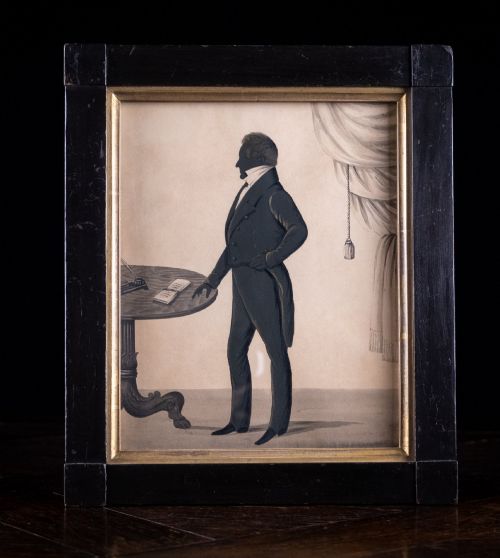
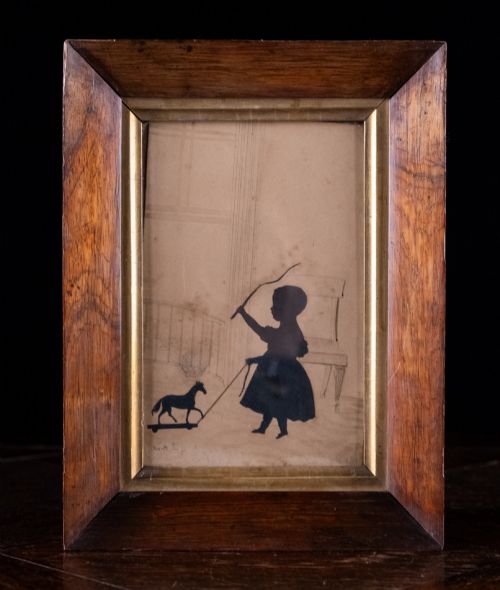
An antique shadow profile picture presents a striking likeness captured through cut paper, painted glass, or ink. Buyers encountering these works find pieces originating from the Georgian, Regency, and Victorian periods.
The selections on this page range from single portraits of gentlemen and children to elaborate conversation pieces involving multiple figures and animals. Most examples survive within their original frames, preserving the integrity of the period.
Makers such as Augustin Edouart and John Miers appear in this tradition, alongside works attributed to the British School. These portraits record individual identities with remarkable economy of line.
Materials and construction
Makers utilised paper and ink, often cutting profiles freehand with scissors before mounting them against a contrasting background. Some artists painted directly onto glass with black pigment and gold leaf highlights.
Frames play a crucial role in the physical structure of these works, constructed from rosewood, maple, papier-mache, and brass. These housings protect the delicate paper and glass surfaces from environmental damage over the centuries.
The periods represented span the Georgian, Regency, William IV, and Victorian eras, alongside specific dates from the nineteenth century.
Assessing the work
Quality rests upon the precision of the cutting or brushwork, where master practitioners achieve subtle facial expressions and accurate proportions without preliminary sketching. The inclusion of detailed gold leaf embellishment or handwritten identification elevates certain examples.
The survival of original materials, including convex glass and period timber frames, determines the integrity of an antique shadow profile picture. Pieces that retain contemporary labels or attribution show a higher level of documented provenance.
Augustin Edouart·John Miers·J. Deacon·Royal Victoria Gallery
The Antique Shadow Profile Picture Glossary
- Silhouette
- A portrait profile filled in with a solid colour, typically black, to depict a subject's outline. This form predates photography and relies entirely on shadow for recognition.
- Conversation piece
- An artwork depicting a group of figures in a single scene, often engaged in daily activities. These complex compositions frequently include children, animals, and detailed background settings.
- Hollow cut
- A technique where the profile is cut out from a sheet of paper, leaving the surrounding paper to serve as the mount. The cutout area is often backed with dark fabric or paper to create contrast.
- Convex glass
- Curved glass used in framing portrait miniatures and silhouettes to create depth. This material protects the delicate surface while casting subtle reflections across the artwork.
Antique Shadow Profile Picture: Frequently Asked Questions
Are these portraits signed?
Many works remain unsigned because they were produced by travelling artists or commercial gallery operators who did not mark every piece. Signed examples usually feature handwritten ink inscriptions on the reverse or the artist's trade label.
Attribution often relies on the distinctive cutting technique, framing style, or subject matter documented by historians.
How do I care for framed paper?
These works require protection from direct sunlight to prevent the fading of dark pigments and paper backgrounds. Maintaining stable indoor humidity prevents the warping of wooden frames and protects fragile paper components.
Displaying pieces away from heat sources ensures the preservation of original glass and backing materials.
What is a conversation piece?
A conversation piece is a portrait showing multiple people interacting within a shared scene rather than a simple head and shoulders study. These detailed compositions frequently incorporate domestic pets, furniture, and architectural elements.
Such works provide a narrative glimpse into the domestic lives of families during the nineteenth century.