

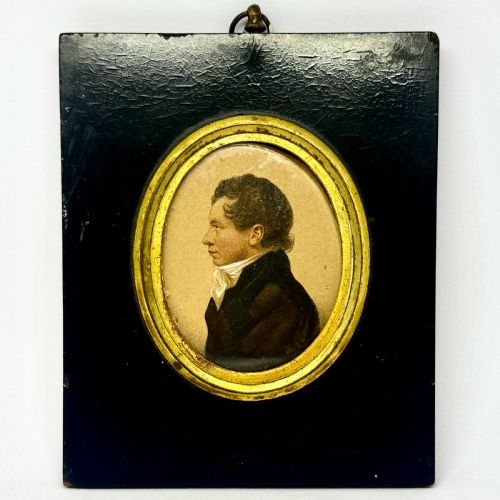


Black Papier Mache Silhouette
A black papier mache silhouette captures a likeness in sharp profile, offering a direct window into Georgian and Regency life.
Black Papier Mache Silhouette
When you search for a black papier mache silhouette, you are looking at framed portrait miniatures and wall art that preserve the likeness of sitters from the Georgian and Regency periods. These profile likenesses capture gentlemen, ladies, and children with distinct silhouettes set against contrasting backgrounds.
The versions you are most likely to meet on this page hail from the nineteenth century, often encased in polished frames of ebonised wood or mounted with brass fittings. They represent a direct line to portraiture before the widespread use of photography.
How They Were Made
Makers fashioned the base supports from papier-mache, a durable and light material that took well to smooth shaping and polishing. Artists then applied delicate paper cuttings, painted details in watercolour, or worked directly on glass to form the crisp black profiles.
Frames of ebonised wood often housed these portraits, frequently accented with brass hangers, convex glass, and gilded touches that highlighted the stark contrast of the central silhouette.
Black Papier Mache Silhouette Retail Price Guide 2026
Typical asking prices for black papier mache silhouette among the pieces listed under this phrase on Sellingantiques today, from the lower quarter to the upper quarter. They describe what is for sale here now, not the wider market.
Listings feature works spanning the Georgian and Regency periods, utilising materials such as brass, glass, paper, and papier-mache.
What Varies in Quality
The precision of the profile cutting or painting marks the primary division in quality, separating hurried studio work from the deft hand of a skilled artist. Finer examples capture subtle details like hair strands, lace on a turban cap, or touches of colour on glass.
The preservation of the materials also dictates standing, with pristine paper, clear glass, and untouched ebonised wood frames commanding greater appreciation than pieces showing heavy wear or modern replacements.
George Atkinson·Thomas London·J. Deacon
The Black Papier Mache Silhouette Glossary
- Papier-mache
- A composite material made of paper pulp or reinforced paper sheets mixed with glue, then moulded and dried. It provides a lightweight yet sturdy base for framing.
- Ebonised wood
- Timber treated to resemble expensive ebony through staining and polishing. It creates a dark, uniform border that makes the bright profile stand out.
- Convex glass
- Curved glass panes that bulge outward from the frame. They protect the delicate paper or painted surface while adding depth to the miniature.
Black Papier Mache Silhouette: Frequently Asked Questions
How were these silhouettes displayed?
Original owners hung these small portraits on walls, often grouping several together in intimate arrangements. Their compact scale suited smaller parlour rooms.
Most feature integrated brass loops or hangers designed for wall mounting, encased behind protective glass to shield the paper from dust.
How do I date a silhouette?
Dating relies heavily on the clothing, hair styles, and headdresses worn by the sitter, such as Regency turban caps. Frame styles and materials also offer strong chronological clues.
Georgian examples tend to show different costume cuts compared to nineteenth-century pieces, helping collectors place them within a specific decade.
Are all silhouettes painted on paper?
While paper cuttings are common, artists also painted profiles directly onto materials like glass. Some pieces incorporate subtle watercolour highlights or gilded details.
Skilled practitioners used fine brushes to add colour to glass portraits, creating depth and a glossy finish distinct from matte paper.