

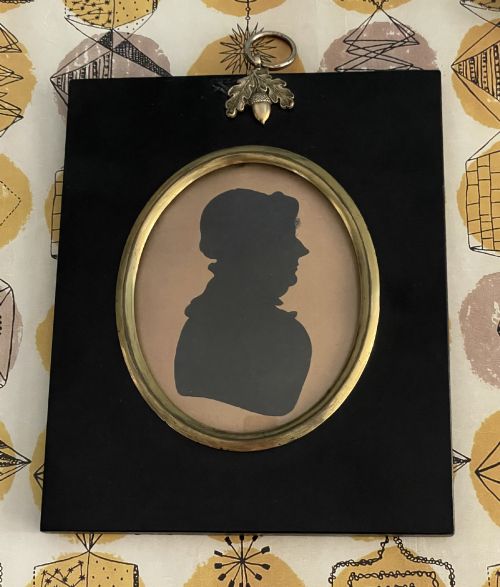
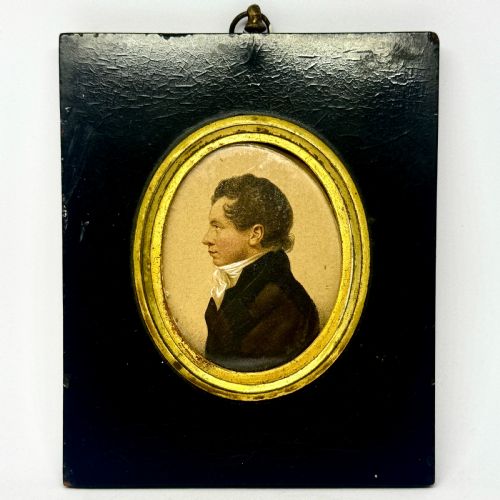


Brass Framed Silhouette Portrait
These brass framed silhouette portrait pieces capture the direct likeness of Georgian and Regency sitters in sharp, clean profile.
Brass Framed Silhouette Portrait
A brass framed silhouette portrait is a profile likeness set into metalwork, often formed as a miniature portrait or framed art intended for wall hanging. The pieces seen here span the Georgian, Regency, and 19th Century periods, capturing sitters such as children, gentlemen, and ladies.
Most examples rely on cut paper, painted paper, or silhouettes rendered directly onto plaster or glass. The brass framing commonly encloses ebonised wood or papier-mache surrounds, creating a strong contrast around the dark profile.
Makers recorded in these listings include established profile artists who signed their work, alongside anonymous pieces from the early 19th Century. The forms range from simple wall art to paired miniature portraits.
Materials and construction methods
Makers utilised brass for the exterior frames, often pairing this metal with ebonised wood or papier-mache surrounds to accentuate the dark profile within. Glass protects the delicate surface of the paper, plaster, or painted glass panels.
Listings feature works spanning the Georgian, Regency, and Victorian periods, utilising brass, glass, paper, and papier-mache.
Judging quality and execution
Quality rests upon the crispness of the cut or the precision of the brushwork, which separates skilled profile artists from amateur attempts. Finer examples display delicate gilded detailing that illuminates the contours of the sitter's costume and hair.
The integration of the brass frame with materials like papier-mache or ebonised wood dictates the overall elegance of the piece. Well-preserved glass and clean mounting surfaces ensure the silhouette remains visually striking.
George Atkinson·James Gillespie·Thomas London·J. Deacon·John Miers
The Brass Framed Silhouette Portrait Glossary
- Silhouette
- A solid dark profile image of a person, typically shown side-on and filled with black pigment or cut from paper.
- Ebonised wood
- Timber treated to resemble heavy, black ebony, frequently used for the inner borders of these frames.
- Papier-mache
- A durable composite material made from paper pulp and binder, moulded to form smooth frames and surrounds for miniature portraits.
- Gilded
- Coated with a thin layer of gold leaf or gold paint, used here to highlight details on the portrait.
- Plaster
- A solid composition material used as a base for moulded profile portraits, notably utilised by prominent silhouette artists.
Brass Framed Silhouette Portrait: Frequently Asked Questions
How were these portraits displayed originally?
These pieces were designed primarily as wall art, hung in small groupings or pairs within domestic parlours. Their compact size allowed them to be arranged closely together on panelled or papered walls.
Owners also kept them on small easel stands or stored them in custom cases, depending on the specific format of the miniature.
What materials make up the frames?
The exterior surrounds feature brass frames, frequently combined with deep ebonised wood or moulded papier-mache. Glass protects the face of the portrait against dust and handling.
Backings often consist of simple timber panels held in place by old pins or paper seals.
How do I date a silhouette?
Dating relies on the costume of the sitter, the hairstyle, and the construction of the frame. Regency pieces often display high-waisted dresses and turban caps, while Georgian examples show distinct periwigs or tailoring.
Signatures or inscriptions on the reverse provide definitive dates and attribution to specific artists.
Are all silhouettes cut from paper?
Not all examples are cut paper; many are painted directly onto glass, paper, or plaster. Artists utilised fine brushes and watercolour pigments to achieve deep black profiles and subtle shading.
Gilded highlights were frequently applied over the dark pigment to define buttons, collars, and hair ribbons.