
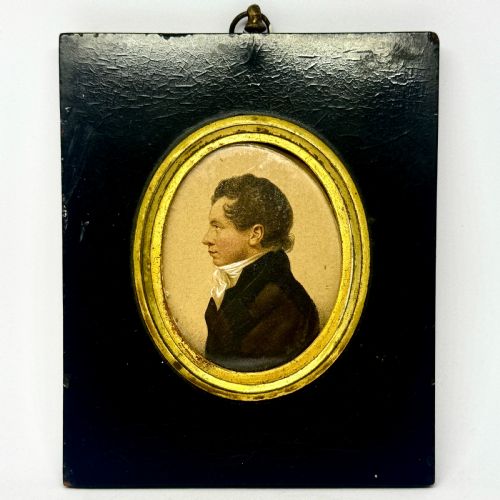


Black Painted Profile Portrait
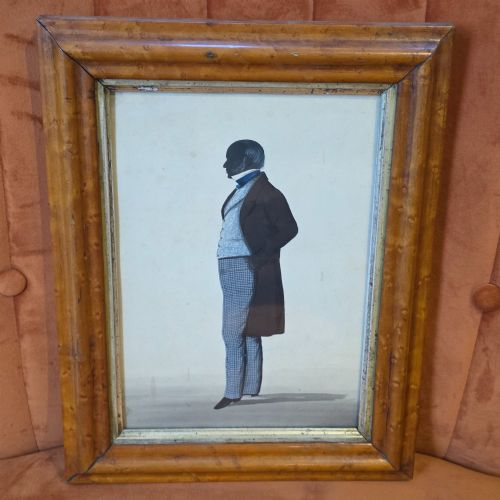
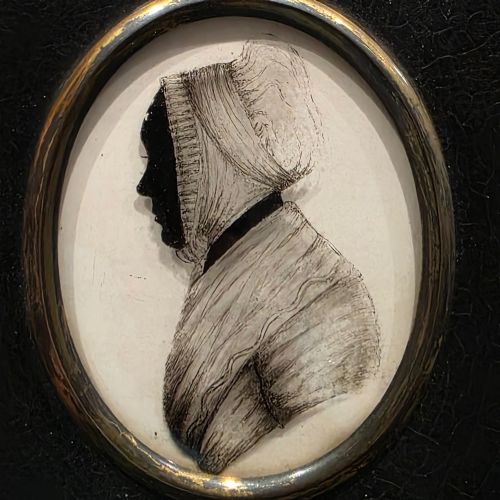
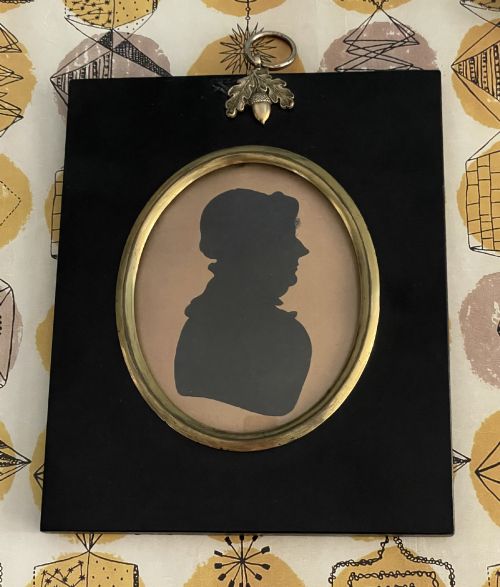
A black painted profile portrait captures a likeness in sharp silhouette, offering a direct glimpse into Georgian and Victorian lives.
Black Painted Profile Portrait
The material record spans the eighteenth, nineteenth, and early twentieth centuries, moving from Georgian folk art through Regency refinement to Victorian sentimentality. These pieces take the form of wall art, framed artwork, and pendants, capturing named sitters alongside anonymous subjects.
Methods and Materials
Artists painted directly onto glass, plaster, paper, and card using fine ink and dark pigments to build the silhouette. Many examples incorporate delicate gilded highlights to accent clothing, jewellery, and hair details against the flat black background.
Makers housed these fragile works within ebonised wood, rosewood, and precious metal frames or pendants, often pairing the painted image with protective convex glass.
Listings feature works executed on glass, paper, plaster, card, and ivory, spanning the eighteenth century through to the art deco period.
Factors of Quality
Superior execution shows in the precision of the brushwork and the accuracy of the facial profile, capturing an identifiable likeness with minimal strokes. Lesser examples rely on heavy, flat pigment application that obscures the subtlety of the sitter's expression.
The distinction between ordinary works and master pieces also rests on the preservation of the original backing material, whether clear glass or smooth plaster, alongside the integrity of any contemporary signature or inscription.
John Miers·J. Deacon·John Smith of Edinburgh·Archibald Skirving·Leo Klin
The Black Painted Profile Portrait Glossary
- Silhouette
- A portrait rendered as a solid dark shape, usually in profile. The form gained widespread popularity in the eighteenth century before the invention of photography.
- Reverse painted on glass
- A technique where the artist paints directly onto the underside of a glass sheet, viewing the finished image through the front for a glossy finish.
- Plaster
- A fine composite material used as a smooth ground for painted silhouettes. It provides a solid, matte surface that holds delicate pigment well.
- Ebonised wood
- Timber treated to resemble heavy, black ebony. This dark framing material traditionally sets off the pale skin tones and bright highlights of a profile.
- Miniature
- A small-scale portrait designed for personal intimacy. These pieces often fit inside pocket watches, pendants, or small desk frames.
Black Painted Profile Portrait: Frequently Asked Questions
How do I date a black painted profile portrait?
Dating relies heavily on the clothing style, hairstyle, and framing materials of the sitter. Eighteenth and Regency examples often feature distinct neoclassical dress and convex glass frames.
Later Victorian and Edwardian pieces shift in costume and frequently incorporate richer jewellery mounts or distinct backing papers. Comparing the handwriting on any accompanying provenance notes also helps narrow the period.
Are these portraits always painted?
While many works involve direct application of dark paint or ink, artists also produced silhouettes by cutting paper or applying pigment to plaster. Some sophisticated examples combine cut paper with painted watercolour and gilded embellishments.
Each technique creates a different texture and depth within the monochrome profile.
How should I care for a painted glass portrait?
These fragile works require protection from direct sunlight to prevent the black pigment and any watercolour tints from fading over time. Maintaining a stable indoor humidity prevents degradation of the delicate backing materials.
Cleaning should remain strictly limited to dusting the exterior frame, avoiding moisture near old glass joints.