
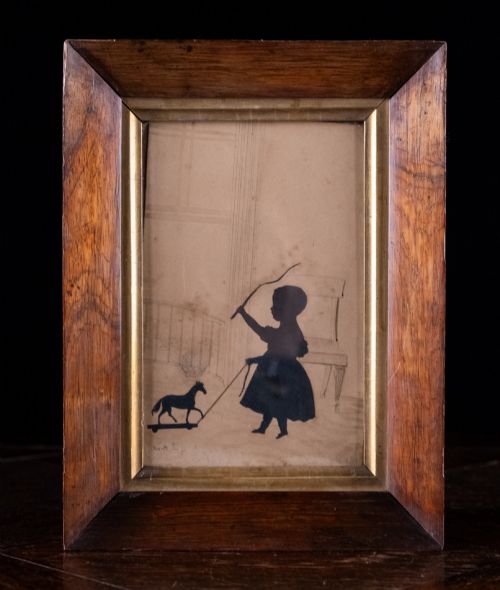


Augustin Edouart Silhouette
An augustin edouart silhouette is a paper profile portrait capturing Regency and William IV sitters with remarkable dexterity.
What an augustin edouart silhouette is
An augustin edouart silhouette comprises cut paper profile portraits and domestic scenes originating from the nineteenth century. These works depict human figures such as gentlemen and clergymen alongside numerous animal subjects, particularly dogs.
The pieces frequently appear as framed artwork for walls, manifesting as single portraits, conversation pieces, or pairs. Buyers most commonly encounter depictions of dogs alongside human subjects executed during the Regency and William IV periods.
Subjects range from individual pets like spaniels and poodles to named individuals such as John Radcliffe MA and the Clements family. The variety spans simple mounted profiles to complex compositions involving children and toys.
How they were made
Makers cut paper freehand using scissors rather than relying on mechanical tracing devices or hollow-cut techniques. Ink and watercolour often supplement the paper forms to add detail to the subjects.
Makers housed these paper works behind glass within wooden frames, frequently utilising maple or incorporating gold leaf accents and brass fittings. The combination of paper, ink, and wood defines the physical construction of nineteenth-century examples.
Nineteenth-century dogs immortalised in paper include musical hounds, bouncy spaniels, and dogs seeking attention.
What varies in quality
The dexterity of the paper cutting distinguishes the finesse of the work, separating simple profiles from lively, detailed animal and human studies. Poses showing movement, such as walking or begging dogs, demonstrate superior handling of the medium.
The composition complexity also alters the character of the piece, moving from single animal figures to multi-figure conversation pieces. Framing materials such as maple veneer and gold leaf preservation further influence the presentation.
Augustin Edouart
The Augustin Edouart Silhouette Glossary
- Cut silhouette
- A profile portrait created by snipping paper with scissors rather than painting or drawing. This technique forms the defining characteristic of these nineteenth-century works.
- Conversation piece
- An artwork depicting a group of people engaged in a social setting or domestic activity. These multi-figure compositions portray families together.
- Regency
- A British historical period spanning the early nineteenth century noted for distinctive decorative arts. Pieces from this era often exhibit refined neoclassical influence.
- William IV
- A British stylistic period bridging the Regency and Victorian eras. Works from this time maintain the crisp paper-cutting traditions established earlier in the century.
Frequently Asked Questions
What is an augustin edouart silhouette?
An augustin edouart silhouette is a paper profile portrait created during the nineteenth century by a prominent silhouette artist.
These works portray human sitters and various animals, particularly dogs, mounted behind glass in wooden frames.
How were these silhouettes produced?
Artists cut black paper freehand with scissors, capturing the likeness of subjects without preliminary drawing.
Some examples incorporate ink and watercolour details, then sit within maple or gilded frames.
What subjects appear in these works?
Subjects include named individuals, clergymen, and family conversation pieces alongside numerous canine breeds.
Dogs appear as poodles, spaniels, terriers, and pets engaged in playful activities.
How do I date these silhouettes?
Nineteenth-century dating relies on the Regency and William IV stylistic markers present in the framing and attire.
Paper characteristics and contemporary framing materials help establish the period of execution.