
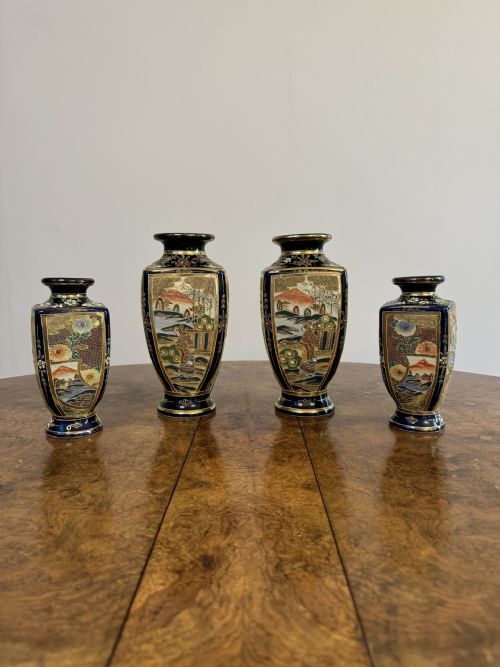
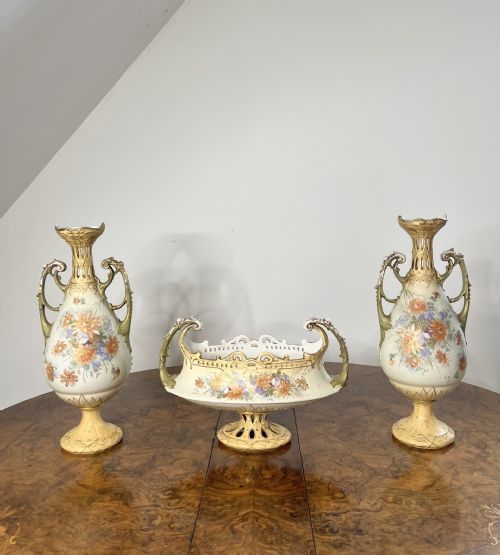
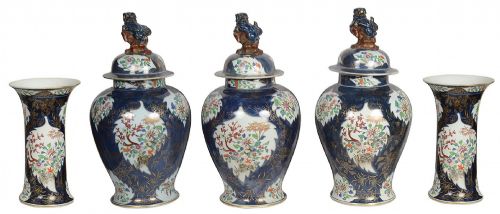


Antique Porcelain Vase Set
An antique porcelain vase set brings symmetry and historical weight to a room, offering matching or coordinated ceramic vessels shaped over centuries.
How they were made
Makers shaped these ceramic and porcelain vessels by hand or in moulds before applying glazes, enamel colours, and hand-painted scenes. Artisans frequently incorporated gold leaf, gilding, and metallic ormolu mounts to accent the porcelain bodies.
Firing techniques allowed factories like Royal Vienna, Paris, and Doulton Lambeth to produce durable ironstone, earthenware, and fine porcelain bodies. Surface decoration often combined underglaze painting with overglaze enamels and applied decorative elements.
What varies in quality
The distinction between standard production and the finest sets lies in the precision of the hand-painted scenes and the crispness of the porcelain or ironstone moulding. Superior examples display meticulous brushwork by named or skilled decorators, harmonious colour palettes, and well-preserved gilding.
Completeness and matching provenance elevate the standing of a garniture set, particularly when individual vessels retain their original lids and uniform scale. The integration of metal mounts, such as ormolu or gilt bronze, also separates mass-produced items from high-grade artistic commissions.
Several sets include tiny miniature garlands for when your mantelpiece requires a very small army of vases.
Flight Barr and Barr·Royal Vienna·Minton·Doulton Lambeth·Mason
The Antique Porcelain Vase Set Glossary
- Garniture
- A set of matching vases or ornamental vessels designed to be displayed together on a mantelpiece or sideboard.
- Imari palette
- A traditional Japanese decorative style utilising rich cobalt blue, iron red, and gold on a white porcelain ground.
- Ormolu
- Gilt bronze mounts applied to the base, handles, or rim of nineteenth-century porcelain vases and clock sets.
- Ironstone
- A heavy, durable type of ceramic patented in the nineteenth century as a robust alternative to soft-paste porcelain.
- Flatback
- A ceramic figure or decorative object moulded with a flat, unpainted reverse side intended to stand against a wall.
Antique Porcelain Vase Set: Frequently Asked Questions
What is a garniture set?
A garniture set consists of three or more matching vases or decorative vessels designed to sit together as a balanced display on a mantelpiece or cabinet.
These sets were popular in European and Asian interiors to create formal symmetry in a room.
How do I display antique vases?
Antique vases and garnitures look best placed centrally on a mantel, sideboard, or dedicated side table where their matching scale can be appreciated.
Keep them away from direct sunlight and high traffic areas to protect delicate hand-painted scenes and gilding.
How can I tell the period?
Dating relies on stylistic clues like Regency classical lines, Victorian ornamentation, or Meiji period Japanese motifs recorded in the piece details.
Factory marks, paste composition, and mounting techniques also help narrow down the decade of manufacture.
Were these sets used for flowers?
Many larger garniture vases and lidded urns served a purely decorative purpose rather than holding water and fresh flowers.
Some smaller forms and teapots saw functional use, while large display pieces remained ornamental focal points.