
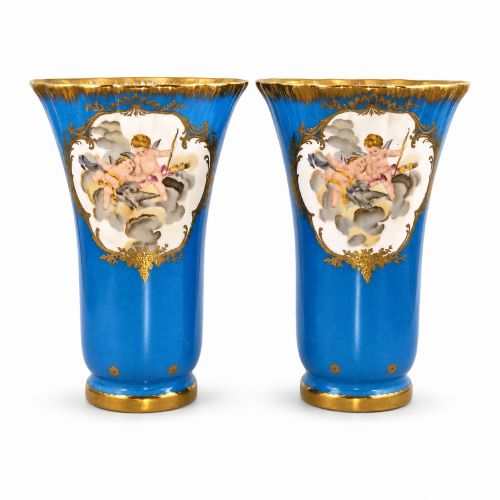


French Revival Porcelain Urns
French revival porcelain urns bring nineteenth-century continental display into a room through painted ceramic and cast metal mounts.
French Revival Porcelain Urns
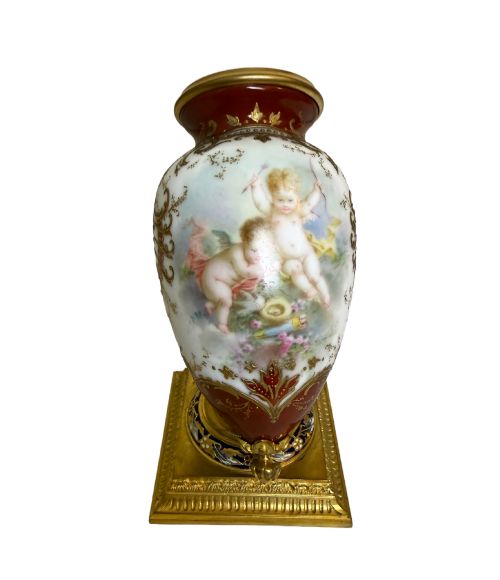
French revival porcelain urns span the nineteenth century, taking the form of lidded vases, garnitures, and decorative vessels rooted in historical European styles. The examples found here most frequently reflect nineteenth-century interpretations of Sevres production alongside Rococo and Louis XVI revivals.
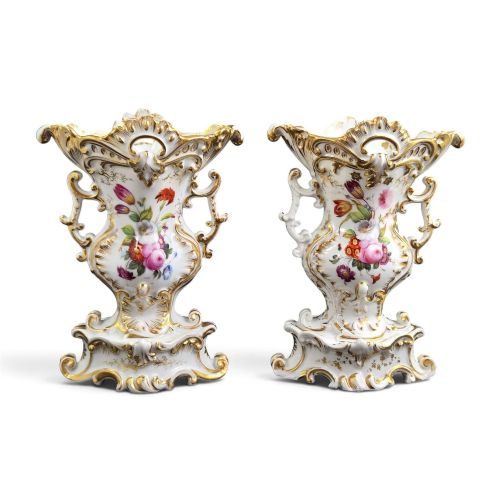
Makers and factories across France and wider Europe produced these ornamental objects to satisfy a sustained appetite for decorative display. Pieces appear singly or as matched pairs, often mounted with metal handles, bases, and rims that elevate simple ceramic bodies into grander architectural forms.
The objects serve primarily as decorative focal points for mantelpieces, side tables, and cabinets rather than utilitarian vessels. Their presence combines painted ceramic panels with gilded metalwork, capturing the aesthetic of earlier royal manufactories within Victorian interiors.
How they were made
Makers combined fired ceramic bodies with cast gilt bronze and ormolu mounts, securing the porcelain components within metal armatures. Hand-painted floral motifs and cobalt or bleu celeste grounds decorated the ceramic surfaces, frequently enhanced with raised white enamel or gold leaf.
Foundries cast the metal mounts using traditional techniques before applying gilding or ormolu finishes to create decorative handles, collars, and bases. Potters and painters worked alongside bronze workers to produce unified garnitures, mantel clocks, and lidded urns that married ceramic art with metalwork.
Several makers added perforated lids specifically so fragrant dried petals could perfume nineteenth-century parlours without blocking the view of the hand-painted porcelain.
What varies in quality
The refinement of the hand-painted decoration separates standard production from finer examples, particularly in the detail of floral scenes and figural panels. Superior pieces display crisp brushwork and controlled use of raised enamel over rich ground colours.
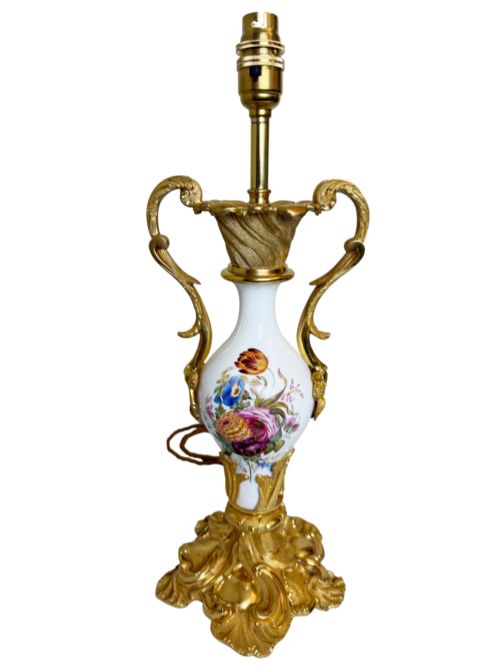
The weight and crispness of the gilt bronze or ormolu mounts dictate the overall quality of an urn, distinguishing finely chased metalwork from simpler cast components. Heavier, more articulate mounts indicate greater workshop investment in the finished decorative scheme.
Jacob Petit·Samson Paris·Vion et Baury·KPM Berlin·Vincenti of Paris·JP Delettrez
The French Revival Porcelain Urns Glossary
- Sevres Style
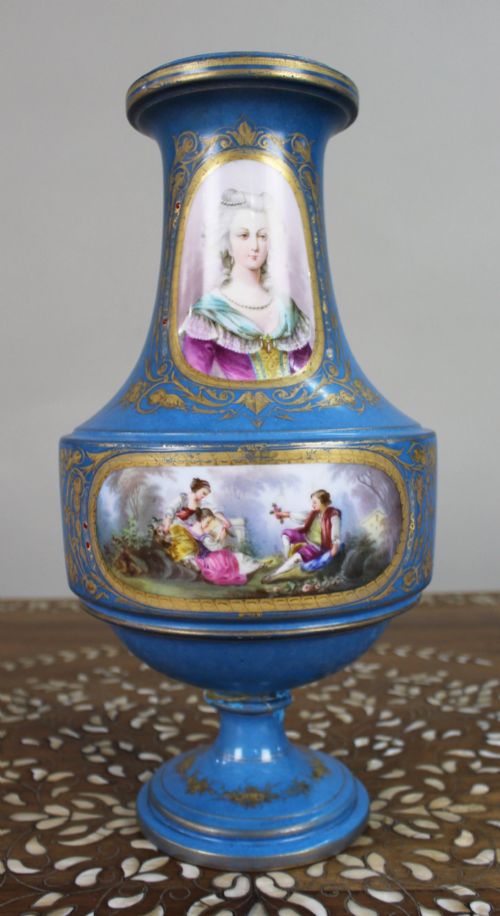
- Decoration or form imitating the porcelain produced by the royal French manufactory. This aesthetic relies on rich blue grounds and elaborate hand-painted reserve panels.
- Ormolu
- Finely ground high-carat gold applied to a bronze base metal through a mercury amalgamation process. The technique produces a warm, durable metallic finish characteristic of nineteenth-century decorative mounts.
- Garniture
- A set of ornamental vessels designed to be displayed together on a mantelpiece or sideboard. These sets typically comprise a central clock or large urn flanked by two matching smaller pieces.
- Bleu Celeste
- A bright turquoise blue glaze colour developed at the Sevres factory during the eighteenth century. Nineteenth-century revival pieces frequently adopted this hue for decorative impact.
- Potpourri
- A perforated lidded vessel designed to hold dried scented plant material. These containers allowed fragrance to diffuse while serving as decorative mantel ornaments.
French Revival Porcelain Urns: Frequently Asked Questions
What are french revival porcelain urns?
French revival porcelain urns are nineteenth-century decorative vessels inspired by earlier royal styles such as Sevres and Rococo. They combine glazed ceramic bodies with gilt metal mounts to create ornamental display pieces.
These objects were produced primarily in France and across Europe during the Victorian era for interior decoration. They survive today as mantel ornaments, lamp conversions, and garniture components.
How do you identify a Sevres style urn?
Sevres style urns are identified by their characteristic rich blue ground colours, hand-painted panels, and elaborate gilt bronze mounts. They often feature classicized shapes derived from eighteenth-century French porcelain production.
Many pieces carry painted or impressed marks mimicking the royal manufactory, though most date from the nineteenth-century revival period rather than the original era.
Were these urns used for flowers?
Most French revival porcelain urns served as purely decorative objects rather than functional flower containers. Lidded versions and potpourri jars were designed to sit on mantelpieces or within garniture sets to display wealth and taste.
Some examples feature pierced lids for releasing scent, while others were made simply to complete a symmetrical arrangement on a fireplace.
How should I clean gilded ormolu mounts?
Gilded ormolu mounts require gentle dusting with a soft dry cloth to prevent the accumulation of dirt within the chased details. Moisture and commercial metal cleaners should be avoided as they can strip the historic gold surface.
Preserving the original finish relies on minimal intervention and stable indoor environmental conditions away from direct sunlight and heat sources.
Can I convert these urns into lamps?
Many nineteenth-century urns and vases were adapted into table lamps during subsequent decades by running electrical wiring through the base or mounts. This conversion was a common twentieth-century practice for repurposing decorative porcelain.
Collectors generally prefer examples that retain their original unblemished lids and uncompromised structural integrity, though converted lamps remain widespread.