



Sevres Style Porcelain Garniture
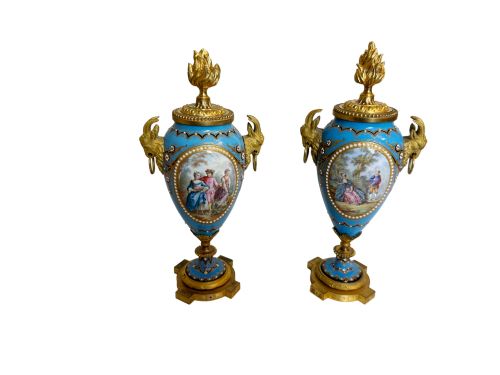
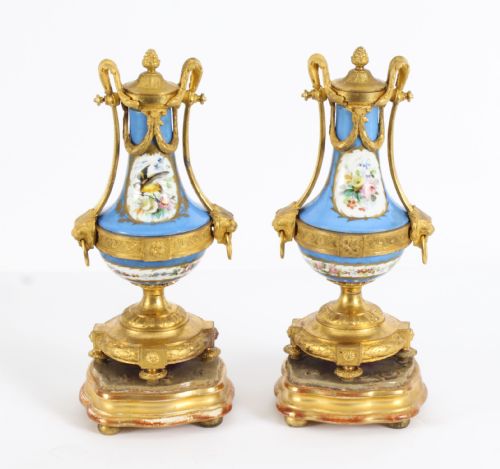
A sevres style porcelain garniture brings dramatic nineteenth-century French elegance to a mantelpiece through matched decorative sets.
Sevres Style Porcelain Garniture
When you search for a sevres style porcelain garniture, you encounter matched sets of ornamental vases, urns, cassolettes or clock garnitures designed to display porcelain bodies alongside metal mounts. These sets originate primarily from the nineteenth century, spanning periods from eighteen fifty to nineteen twenty, and frequently incorporate styles such as French Rococo Revival and Louis XVI Revival.
The version you are most likely to meet on this page consists of a central clock paired with flanking vases or urns, or simply a balanced pair of lidded vases rendered in characteristic ground colours like bleu de roi or bleu celeste. Such arrangements served as symmetrical centrepieces for period salons and drawing rooms, designed to sit harmoniously upon a mantel shelf.
Makers and workshops of the period, including Vincenti of Paris, utilised these porcelain components to create elaborate decorative schemes commemorating historical figures or adopting classical motifs. The resulting pieces combine ceramic bodies with intricate metal castings to achieve the grand decorative effect characteristic of nineteenth-century French production.
Materials and construction
The construction of these pieces relies upon the combination of fired porcelain bodies with cast and chased metal mounts in ormolu, gilt bronze, or gilded metal. Artisans shaped the porcelain to form urns, vases, lyre clocks, and cassolettes, frequently applying rich blue glazes and enamel details directly to the ceramic surface.
Mounts and fixtures were cast separately and finished with fire gilding or ormolu treatment to secure the porcelain components and provide decorative handles, bases, and bezels. Glass domes occasionally accompany these sets to protect the delicate gilt surfaces and enamel work from dust and handling.
Listings feature items from the nineteenth and early twentieth centuries, incorporating materials such as porcelain, ormolu, gilt bronze, and glass.
Distinctions in quality
Quality in these garnitures rests upon the crispness of the bronze or ormolu casting and the depth of the porcelain body's glaze. Finer examples display meticulously hand-painted panels and tight, precise fitting between the metal mounts and the ceramic vessels.
The weight and detail of the cast metal work differentiate standard production from exhibition pieces. Superior sets maintain harmonious proportions between the central clock or main urn and the flanking companions, with careful attention paid to the gilding and enamel finishes.
Vincenti of Paris
The Sevres Style Porcelain Garniture Glossary
- Garniture
- A set of matched ornamental objects designed to be displayed together on a mantelpiece or sideboard, typically comprising a clock flanked by vases or a pair of urns.
- Cassolette
- A reversible ornamental vase featuring a lid that can be turned to display either a solid decorative top or a perforated burner for potpourri.
- Ormolu
- Finely ground high-carat gold applied to a bronze base using a mercury amalgamation technique, producing a rich golden lustre characteristic of French decorative metalwork.
- Bleu de Roi
- A deep, rich royal blue enamel or glaze colour frequently utilised on nineteenth-century French porcelain bodies.
- Bleu Celeste
- A bright, pale turquoise blue ground colour used in porcelain decoration to imitate earlier soft-paste ceramic palettes.
Sevres Style Porcelain Garniture: Frequently Asked Questions
How do I style a garniture set?
Place the central clock or larger urn in the exact centre of the mantelpiece, then arrange the matching flanking vases symmetrically on either side to create a balanced focal point.
Ensure the pieces have adequate clearance from heat sources and foot traffic to protect the delicate ormolu mounts and painted porcelain surfaces.
What periods do these pieces date from?
The pieces listed span the nineteenth and early twentieth centuries, with dates ranging from eighteen fifty through to nineteen twenty.
Most examples reflect revival styles popular during the nineteenth century, including Louis XVI and French Rococo aesthetics.
Are glass domes original?
Glass domes frequently accompanied nineteenth-century clock garnitures to protect the intricate gilt bronze and delicate enamel work from environmental dust.
While many sets survive without their original covers, surviving domes add a layer of period authenticity to the display.
How should I clean porcelain and ormolu?
Dust the porcelain and metal mounts gently with a soft, dry brush to prevent the accumulation of dirt within the crevices of the cast ormolu.
Avoid using liquid cleaners, commercial polishes, or abrasive cloths, as these can strip the delicate gilding and damage the hand-painted enamel decoration.