




Antique Panther Statue
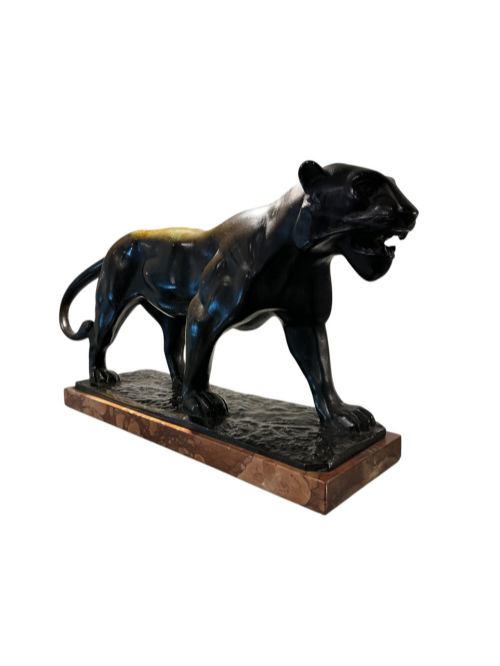
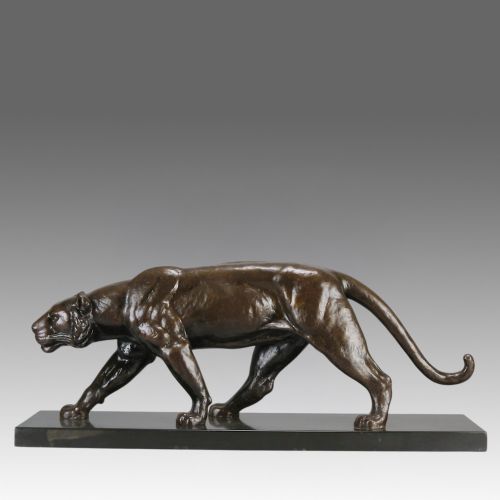
An antique panther statue brings fierce twentieth-century grace to a room, offering the sleek movement of big cats cast in metal or carved in stone.

Antique Panther Statue
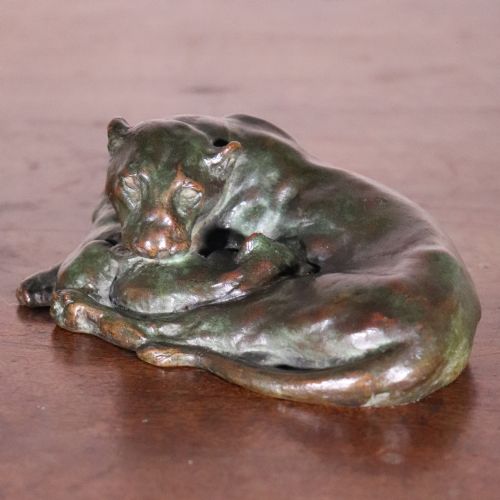
When you search for an antique panther statue, you enter a world of dramatic feline sculpture spanning the late nineteenth and mid-twentieth centuries. The pieces on this page range from nineteenth-century academic animalier bronzes to geometric Art Deco creations.
You are most likely to meet Art Deco bronze or spelter panthers mounted on marble bases, alongside earlier mythological groups featuring Ariadne. These works capture the powerful anatomy and predatory stealth of the animal through various stylistic lenses.
Materials and construction
Foundries cast these figures in bronze or spelter, often finishing the metal with rich patination or silvering to accentuate muscular tension. Parian and bisque porcelain also appear, offering a smooth, matte white surface suited to neoclassical studies.
Sculptors anchored heavy metal figures onto shaped bases of black marble or onyx, balancing the prowling or crouching postures securely. Signature marks and foundry stamps frequently appear directly on the metal or the stone plinths.
Styles represented include Art Deco, Animalier, Neoclassical, French Animalier, and nineteenth-century French sculpture.
Distinctions in quality
Quality rests in the precision of the casting and the fidelity of the musculature, where superior examples render every sinew and expression with sharp conviction. Lesser pieces rely on softer surface definition and simpler patination.
The integration between the feline figure and its stone base marks a further distinction, with finer sculptures utilising dense, well-cut marble or onyx that complements the metallic tones above.
Alexandre Ouline·Johann Heinrich Dannecker·Anna Vaughn Hyatt Huntington·Chiparus·Clovis Masson·Michel Decoux·Andrey·Georges Gardet·Barye
The Antique Panther Statue Glossary
- Animalier
- A nineteenth-century artistic movement dedicated to the realistic portrayal of animals, particularly predators in motion. Practitioners studied live specimens closely in menageries.
- Spelter
- A zinc alloy commonly utilised as a less expensive alternative to bronze during the Art Deco period. It accepts patination well to simulate heavier metals.
- Patinated Bronze
- Bronze treated with chemical solutions to produce a specific surface colour or aged tone. This finish protects the metal and heightens visual depth.
- Parian Porcelain
- A fine-grained, unglazed porcelain resembling white marble, named after the famous marble quarried on the Greek island of Paros. It was frequently used for nineteenth-century figurative studies.
Antique Panther Statue: Frequently Asked Questions
What is an animalier sculpture?
An animalier sculpture focuses specifically on the lifelike depiction of animals, capturing natural movement and anatomical precision. These works became immensely popular across Europe during the nineteenth century.
Artists spent considerable time observing wild beasts in captivity to understand their muscle structures and behaviours before casting them in bronze.
How do I tell bronze from spelter?
Bronze is heavier, denser, and colder to the touch than spelter, with a durable metallic structure that resists minor surface damage. Spelter is a softer zinc alloy that often shows lighter grey metal beneath worn patination.
Inspecting the underside or areas of natural wear usually reveals the distinct colour and weight differences between the two materials.
Why are marble bases used?
Marble bases provide necessary weight and stability for heavy metal sculptures, preventing them from tipping during display. They also offer a contrasting architectural frame that elevates the organic lines of the cat.
The dark tones of black marble were particularly favoured during the Art Deco era to complement patinated or silvered bronze.
How should I clean my statue?
Dust the metal and stone surfaces gently with a soft, dry cloth to prevent the accumulation of grit in crevices. Avoid chemical cleaners or excessive moisture, which can damage patinated finishes on bronze or spelter.
Preserving the natural surface patina maintains the historical integrity and visual character of the antique piece.