
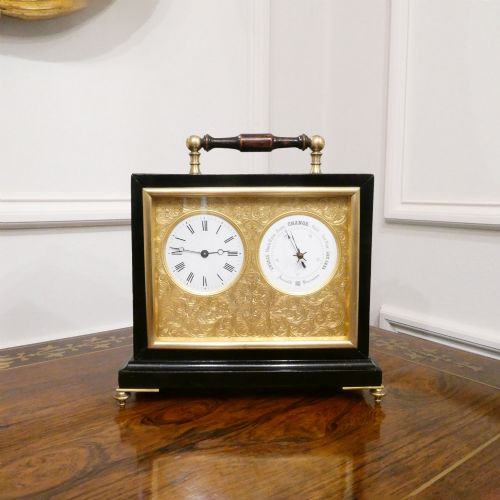
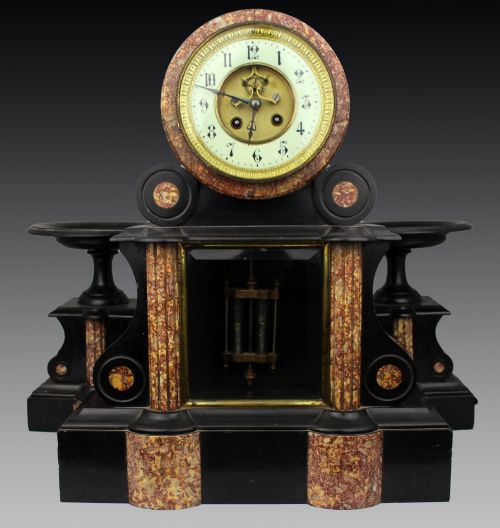
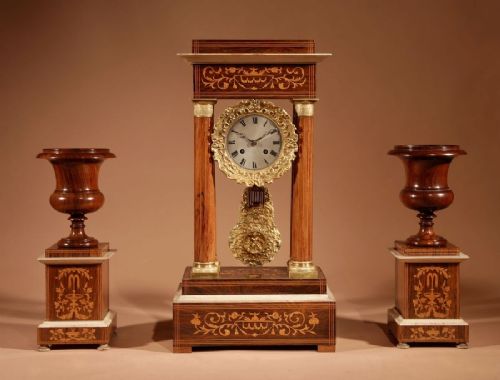
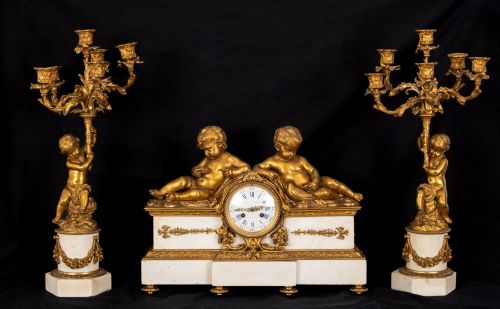




Antique Mantel Clock Set
An antique mantel clock set brings symmetry and striking presence to a room, pairing a central timepiece with matching garnitures.
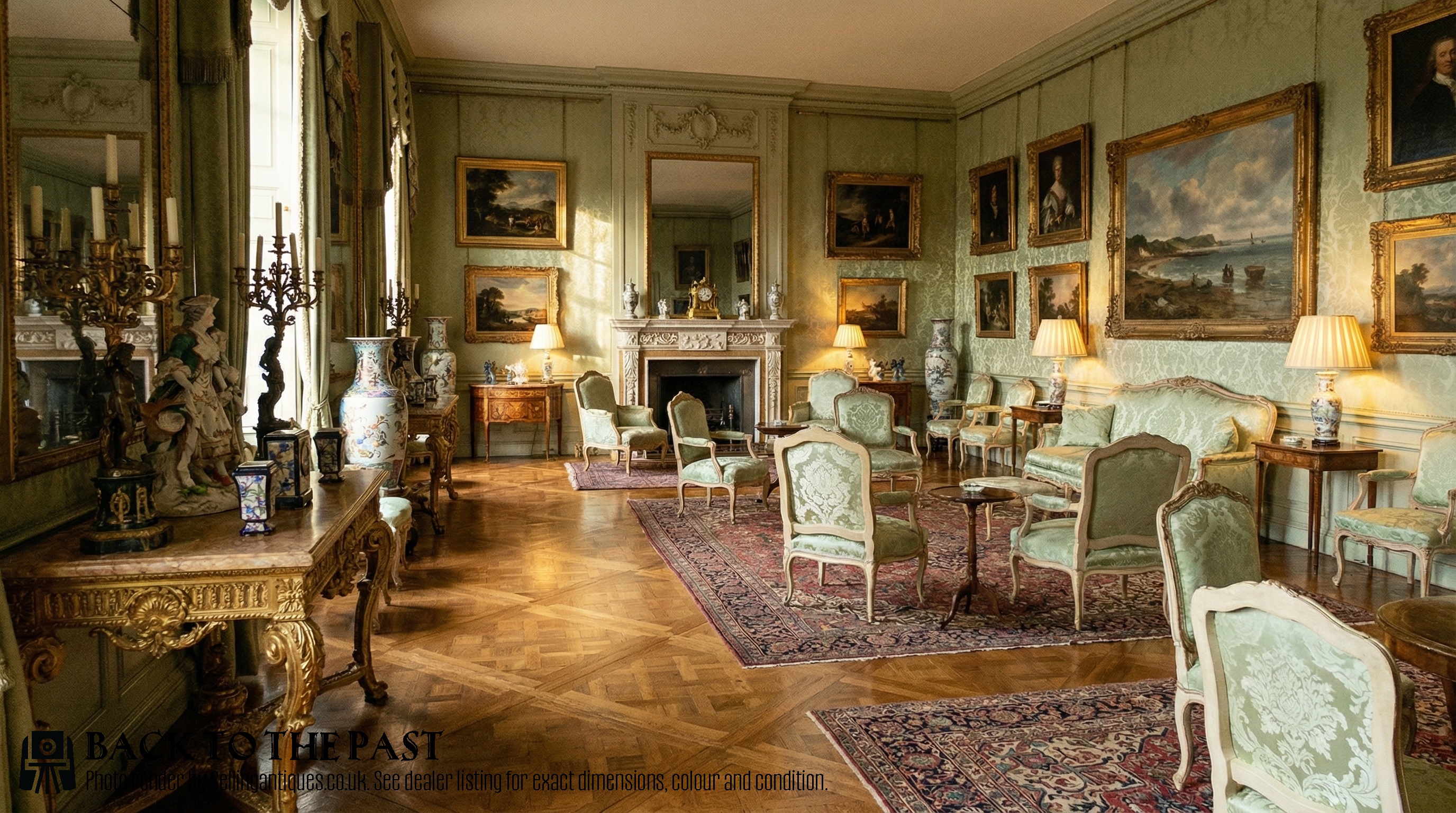
Antique Mantel Clock Set
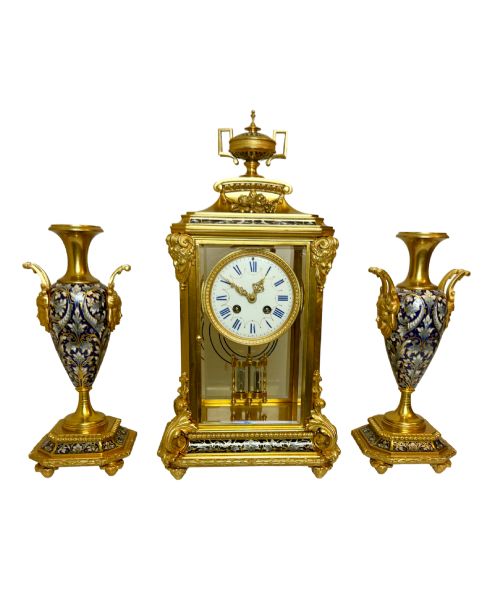
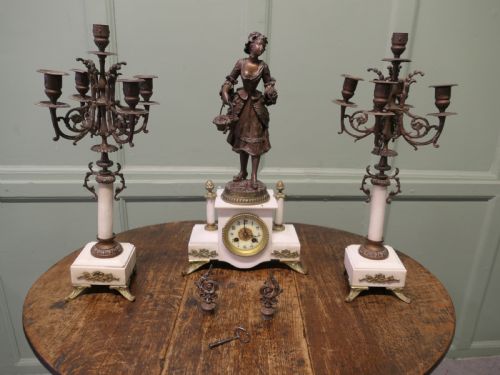
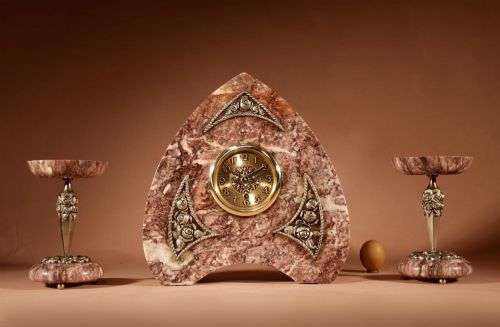
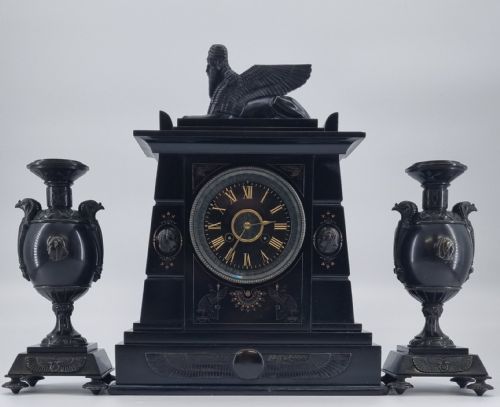
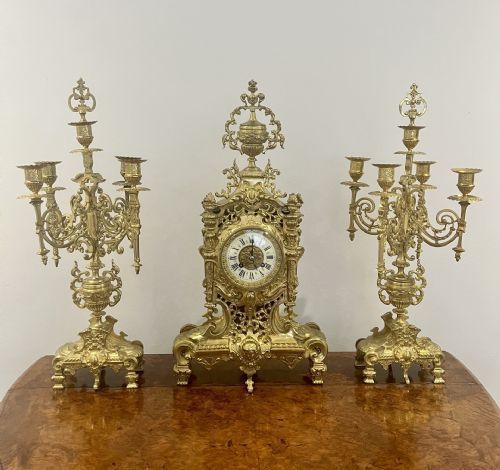
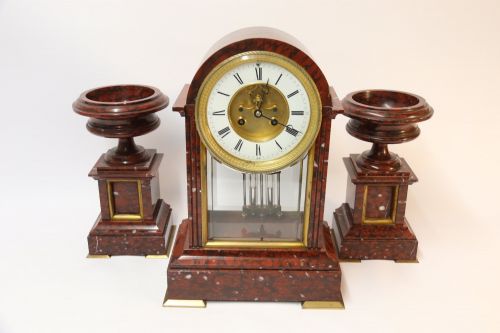
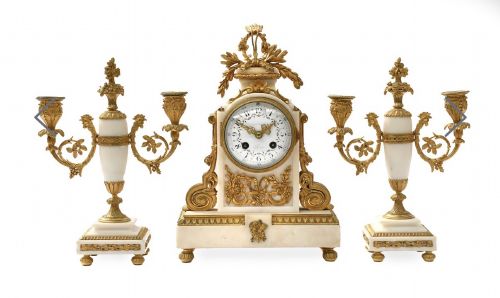
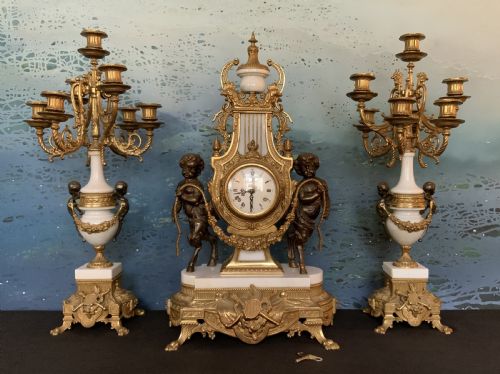
An antique mantel clock set comprises a central timepiece accompanied by matching side pieces such as candelabras, urns, or vases, designed to coordinate across a fireplace or sideboard. These arrangements appear frequently in French styles from the nineteenth century, alongside later Art Deco iterations.
The main clock stands as the focal point, while the paired garnitures balance the visual weight on either side. Such suites range from compact arrangements housed under glass domes to large multi-piece sets incorporating heavy candelabras.
Most examples originate from nineteenth-century France, reflecting periods like the Second Empire, Louis XVI Revival, and Rococo Revival. Buyers also encounter Edwardian and Art Deco designs produced in Britain, France, and Italy.
Materials and construction
Makers utilised dense natural stones like black and white marble, onyx, and slate as the foundational body for many clock cases and garnitures. These stone elements often combine with cast metal mounts, gilt bronze, or ormolu.
Decorative surfaces frequently incorporate hand-painted porcelain panels, champlevé enamel, and detailed bronze castings. Dials typically feature white enamel with Roman or Arabic numerals, sometimes protected behind curved glass doors.
Movements relied on mechanical brass gear trains, often housing eight-day striking mechanisms driven by springs or pendulums. Skilled artisans cast, chased, and gilded the metal components by hand, matching the finish across every piece in the set.
Antique Mantel Clock Set Retail Price Guide 2026
Typical asking prices for mantel clock set among the pieces listed under this phrase on Sellingantiques today, from the lower quarter to the upper quarter. They describe what is for sale here now, not the wider market.
Listings feature marble, ormolu, bronze, and porcelain across Victorian, Art Deco, and nineteenth-century French periods.
Factors determining quality
The precision of the metal chasing and the depth of the fire-gilding separate standard items from exceptional studio pieces. Finer sets display crisp ornamentation on the bronze or ormolu mounts, where hand-tooling defines the acanthus leaves and cherubs rather than soft, mass-produced casting lines.
The integration of materials dictates the overall harmony of the suite, with superior examples featuring perfectly matched marble grains and unblemished porcelain panels. Signatures on the movement backplate or dial from established makers add a layer of documented craftsmanship.
Japy Frères·Samuel Marti·Henry Dasson·Seth Thomas
The Antique Mantel Clock Set Glossary
- Garniture
- A matching set of ornamental pieces designed to flank a central object like a clock. They commonly take the form of urns, vases, or candelabras.
- Ormolu
- Finely ground high-carat gold mercury-gilded onto a bronze object. It gives the metal a warm, durable surface lustre.
- Champlevé
- An enamelling technique where troughs are dug into a metal surface and filled with vitreous enamel before firing. The resulting design shows vibrant colours bounded by thin metal lines.
- Portico clock
- A mantel clock featuring a architectural frame supported by four columns. This neoclassical style gained popularity in nineteenth-century France.
- Bleu de Roi
- A deep, rich cobalt blue glaze used extensively on decorative porcelain. It frequently appears on French clock dials and ceramic garniture bodies.
Antique Mantel Clock Set: Frequently Asked Questions
What is a clock garniture?
A clock garniture is a decorative matching set consisting of a central clock and two flanking objects, such as urns or candelabras. These pieces were designed to sit together on a mantelpiece or console table to create visual balance.
The matched items share identical materials, styles, and decorative motifs, tying the decorative scheme of a room together. In historical interiors, they formed the definitive centrepiece of a fireplace arrangement.
How do I identify French mantel clock styles?
French mantel clocks display distinct stylistic markers linked to specific nineteenth-century revivals. Louis XVI style pieces feature classical symmetry, urn motifs, and restrained ormolu mounts, while Rococo Revival examples show asymmetrical scrolls and naturalistic floral details.
Examining the materials provides further clues, as heavy marble bodies with gilt bronze mounts often point to Second Empire or Third Republic workshops. Signatures on the clock movement can also confirm the French origin and production period.
How do I care for an antique clock set?
Antique clock sets require stable indoor environments away from direct sunlight and fluctuating heat sources. Wood, marble, and gilt surfaces benefit from gentle dusting with a soft, dry cloth without chemical polishes.
Mechanical movements need periodic professional servicing to clean old oils and ensure the gear trains run accurately. Winding should be performed gently using the correct key, avoiding over-tightening the mainspring.
What materials were used in antique clock sets?
Maker workshops combined a wide variety of materials to achieve ornate decorative effects. Natural stones such as black marble, white marble, onyx, and slate provided heavy, stable foundations for the clocks and garnitures.
Metal components relied on cast brass, bronze, and gilt ormolu, often paired with hand-painted porcelain plaques and champlevé enamel details. Dials frequently featured white enamel with contrasting numerals protected by glass bezels.