
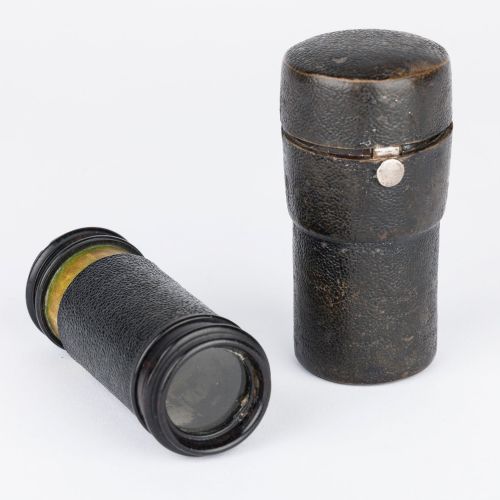


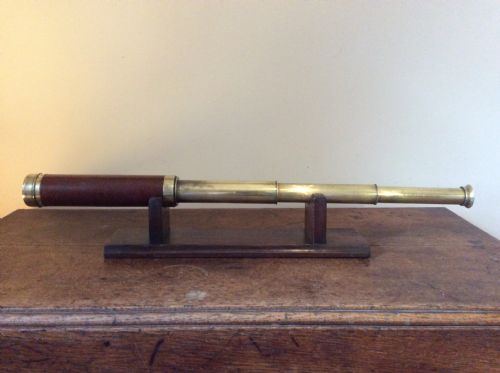
Antique Leather Telescope
An antique leather telescope brings practical maritime optics to your desk, combining polished brass tubes with hand-stitched skin.
Antique Leather Telescope
When you search for an antique leather telescope, you are looking at optical instruments designed for maritime navigation, terrestrial viewing, and military campaigns across the Georgian, Victorian, and Edwardian periods.
The versions you are most likely to meet on this page are multi-draw spyglasses housed in brass, with outer barrels wrapped in stitched leather or crocodile skin for grip.
Formats range from pocket-sized three and six-draw tubes to large officer of the watch models, sometimes accompanied by fitted wooden cases or table stands.
Materials and construction methods
Constructed primarily from drawn brass tubing, these instruments rely on glass lenses for magnification and optical clarity.
The outer brass barrels are routinely dressed with tanned leather, glued and hand-stitched at the seam to provide a secure, non-slip grip in wet maritime conditions.
Cardboard linings often stabilise the interior sliding draws, while wood is utilised for fitted storage boxes and occasional presentation stands.
Listings feature instruments constructed from brass, leather, glass, wood, oak, nickel, and cardboard across Georgian, Victorian, and Edwardian periods.
Assessing build quality and optics
Quality rests in the precision of the draw-tubes and the clarity of the glass optics, where tighter tolerances ensure smooth extension without wobble.
Maker signatures engraved onto the brass draw-plate separate standard workshop output from eminent opticians like Ross of London or Dollond.
The integrity of the leather binding and the presence of original cases or lens caps elevate the historical completeness of the piece.
Ross of London·Voigtländer and Sohn AG·Newton and Co·Broadhurst Clarkson and Co·Cary London·L Casella·Chadburn Brothers of Sheffield·JP Cutts·Steward·T and H Doublet·Davis of London
The Antique Leather Telescope Glossary
- Draw
- A sliding tube section that extends the telescope to its operational focal length. Most portable models utilise between three and six draws.
- Spyglass
- A compact handheld refracting telescope designed for terrestrial observation. These were widely carried by officers and travellers.
- Terrestrial
- An optical setup that uses an erecting lens system to display the image the right way up. This makes distant land objects easy to identify.
- Refractor
- An optical telescope that uses lenses to bend light and form an image. This is the primary design used in historical handheld spyglasses.
- Officer of the watch
- A heavy-duty marine telescope utilised on naval vessels for signalling and horizon scanning. These often feature large objective lenses.
Antique Leather Telescope: Frequently Asked Questions
How do you use an antique telescope?
Extend all the brass draw-tubes fully until the instrument locks into its operating position. Support the barrel firmly and adjust the eyepiece focus while sighting a distant object.
Keep the lenses protected with caps when not in use to prevent dust accumulation on the internal glass elements.
Can you still see clearly through them?
Most surviving examples still deliver functional magnification, provided the internal glass lenses remain clean and properly aligned. Terrestrial erecting systems ensure the view appears upright rather than inverted.
Performance depends on the original optical specification and the absence of internal haze or fungus on the glass surfaces.
What periods do these telescopes cover?
The available inventory spans from the eighteenth century through the Georgian and Victorian eras up to the Edwardian period and the First World War. Victorian instruments dominate the selection, reflecting the height of British maritime expansion.
Earlier examples tend to feature simpler wooden or bare brass bodies before leather dressing became standard practice.
How do I care for the leather casing?
Maintain the leather barrel by keeping it away from direct heat sources and damp environments that encourage deterioration. Gentle cleaning with a dry cloth removes surface dust without harming the stitching.
Avoid modern chemical polishes that might stain the aged hide or transfer residue onto the adjacent brasswork.