


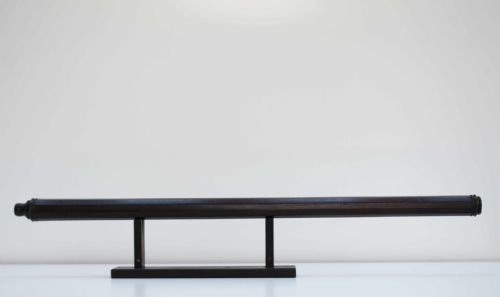


Terrestrial Telescope
These terrestrial telescope examples offer a direct view into historical optics, combining brass and leather for practical magnification.
Terrestrial Telescope
A terrestrial telescope is an optical instrument designed for land viewing, producing an upright image rather than the inverted view common in astronomical devices. The versions most commonly met here span the Georgian, Victorian, and Edwardian periods, often constructed with multiple drawers for portability.
These instruments frequently appear in forms such as small pocket variants, library models, and military campaign configurations. Materials range from polished brass tubes to leather-wrapped barrels and timber mounts, reflecting their utilitarian and scientific origins.
How they were made
Makers fashioned the primary structural tubes from drawn brass, often housing the sections within stitched leather grips or polished wood casings such as mahogany and fruitwood. Glass lenses inside these telescopic draws directed light to achieve magnification.
Workshop assembly relied on precise metal-working techniques to ensure the sliding draws fit snugly without losing alignment during extension and retraction.
One listed telescope bears the name Starboy, suggesting a playful departure from formal Victorian scientific labelling.
What varies in quality
The standard of a terrestrial telescope rests upon the clarity of its optical glass and the precision of its multi-draw construction. Finer examples display crisp maker signatures engraved on the brass draw tubes alongside robust leather or timber housings.
Simpler instruments show basic joinery and standard glass formulas, whereas pieces by known opticians demonstrate superior mechanical tolerances and finer finishing across the metal components.
Steward of London·Broadhurst Clarkson and Co·Cary London·L Casella London·Davis of London·John Gilbert
The Terrestrial Telescope Glossary
- Draw
- A sliding tubular section of a telescope that extends to focus the instrument. Multiple draws allow a longer focal length to collapse into a compact portable size.
- Achieving non-achromatic
- An optical design characteristic of earlier instruments where lenses do not fully correct for colour fringes. This appears in eighteenth-century examples.
- Campaign telescope
- A portable instrument designed for military use in the field, often featuring protective leather outer coverings. These were built to withstand travel and rough handling.
- Library telescope
- A larger stationary instrument intended for indoor use, typically mounted on a sturdy wooden or iron stand rather than handheld.
Terrestrial Telescope: Frequently Asked Questions
How do I use a multi-draw telescope?
Gently pull each brass section outward until fully extended, holding the main body steady to avoid straining the fittings.
Adjust the final smaller draw slowly until the distant object comes into sharp focus.
Were these used at sea?
Many terrestrial telescope designs served maritime purposes, allowing sailors to spot land and other vessels.
Protected leather grips helped resist sea spray and provided a secure hold on deck.
How do I date a brass telescope?
Examine the style of the lettering engraved on the draw tubes and the number of extending sections.
Georgian and Victorian makers often stamped specific addresses or signatures that correspond to historical trade directories.
Can I mount a library telescope?
Library instruments often feature threaded mounts or heavy bases designed to sit securely on desks or tables.
They require a stable surface because their size magnifies hand movements if held directly.