
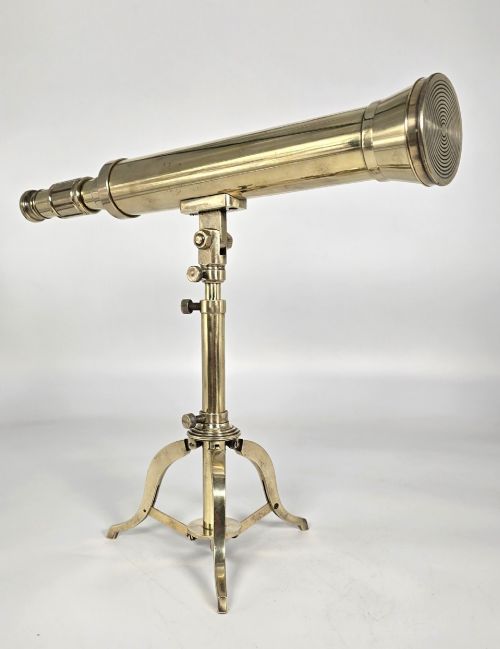


English Brass Spyglass
An English brass spyglass is a practical optical instrument built for travel, maritime watch, or fieldwork.
English Brass Spyglass
An English brass spyglass is a portable optical instrument designed for terrestrial observation, navigation, and maritime use. These pieces range from compact single-draw cylinders to multdraw folding tubes intended for pockets or campaign chests.
The versions most commonly met on this page are Victorian and Edwardian examples featuring multiple draw tubes. Makers such as Ross of London, Newton & Co, and Broadhurst Clarkson & Co produced these instruments for officers, explorers, and travellers.
Form follows function closely in these instruments, leading to variations like the Officer of the Watch telescope and specialised walking cane combinations. Some retain original leather dressings, fruitwood bodies, or dedicated folding brass tripods.
What varies in quality
The optical clarity and the precision of the draw action separate standard instruments from those made by premier makers. Smooth movement between brass sections indicates careful fitting of the metal components.
Signed barrels by known opticians command greater attention than unsigned pieces. The presence of original fitted leather cases, wooden tripods, or uncommon materials like bone adds distinct weight to an instrument.
Some Victorian gentlemen converted their optical instruments into walking sticks, hiding a fully functioning spyglass inside a bone cane.
Ross of London·Newton & Co·Broadhurst Clarkson & Co·Davis of London·Dollond
The English Brass Spyglass Glossary
- Draw
- A sliding tube section that extends the length of the telescope. Multiple draws allow a long focal length to collapse into a short cylinder for transport.
- Terrestrial telescope
- An optical instrument configured to show upright images rather than inverted ones. This setup uses an erecting lens system specifically for viewing land objects.
- Day or night telescope
- A configuration featuring a larger objective lens to gather more light in low visibility conditions. These instruments served maritime watches at dawn and dusk.
- Objective lens
- The primary glass lens at the front of the telescope that gathers light. Its diameter determines the brightness and clarity of the observed image.
- Campaign telescope
- A portable instrument designed for military officers on active service. These pieces prioritize robust construction and compact folding formats.
English Brass Spyglass: Frequently Asked Questions
How do I use a draw telescope?
Extend all the brass sections fully until each click or stop engages. Hold the instrument steady and rotate the eyepiece end slightly until the distant image comes into sharp focus.
Keep your fingers clear of the glass surfaces and avoid forcing any section that sticks. Collapse the tubes carefully from the eyepiece end downward when storing.
What is the difference between a spyglass and a telescope?
In historical terms, a spyglass specifically denotes a compact, handheld, portable telescope used by sailors and travellers. Traditional telescopes often remained mounted on heavy tripods for astronomical or stationary land observation.
Portable spyglasses rely on sliding draw tubes for rapid deployment in the field. Both terms describe refracting optical instruments using lenses.
How do I date an English brass spyglass?
Examine the maker signature, the style of the lettering, and the number of draw tubes. Makers active in specific decades often stamped their address alongside their trade name on the final draw tube.
Materials also offer clues, as leather coverings, wood types, and box construction shifted across the Georgian, Regency, Victorian, and Edwardian periods. Comparing the piece with documented workshop timelines narrows the manufacturing window.
Can I clean the lenses on an antique spyglass?
Dust the glass surfaces gently with a soft artist brush to remove loose particles. Avoid using household glass cleaners or harsh solvents on antique optical coatings and brass fittings.
If internal haze obscures the view, consult a professional conservator rather than attempting to dismantle the historical lens cell yourself.