


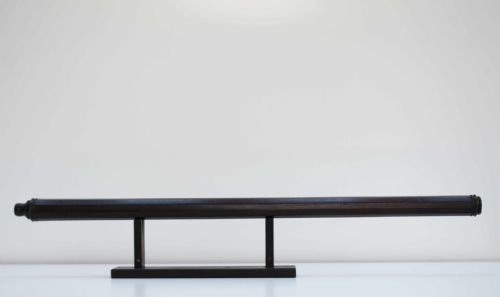
Brass Nautical Scope
A brass nautical scope brings the precision of maritime navigation into your home, offering tactile optics built for the open sea.
Brass Nautical Scope
A brass nautical scope encompasses a variety of portable and tabletop telescopes designed for terrestrial and marine observation, emerging across periods from the mid eighteenth century through to the early twentieth century. These instruments range from compact two-draw and multi-draw handheld versions to cased four-draw apparatuses mounted on stands.
The versions most frequently met on this page are Victorian English handheld draw telescopes, often bound in leather and signed by renowned makers such as Ross of London or Newton & Co. Alongside these, buyers encounter Regency and Edwardian examples, as well as specialised naval pieces like officer of the watch telescopes from the early twentieth century.
Form follows function in these scientific instruments, with non-achromatic decagonal shapes appearing alongside traditional cylindrical draw tubes. Whether configured for tabletop display or carried on deck, each piece reflects the practical demands of historical navigation and terrestrial viewing.
Materials and construction
Brass forms the structural core of every scope, utilised for the draw tubes, main barrels, and mountings to provide durability and a resilient metallic finish. Nickel plating also appears on select tabletop variations to offer an alternative surface texture.
Leather frequently wraps the brass barrels of handheld terrestrial and maritime scopes, providing a secure grip for the user while protecting the metal beneath. Wood and glass complete the construction, with oak and mahogany housing cased instruments and precision lenses delivering the magnification.
Makers constructed these instruments using multi-draw sliding brass tubes, ranging from two-draw pocket versions up to complex six-draw configurations. Early examples incorporate specialised optical designs such as non-achromatic decagonal reverse taper barrels.
Early sea captains relied on day or night lenses to squeeze every last drop of twilight out of a foggy horizon.
Standards of craftsmanship
Quality in a brass nautical scope rests upon the precision of the draw action and the clarity of the optical glass. Superior examples exhibit smooth, balanced movement across every brass drawer without excessive play or binding.
The presence of crisp maker signatures engraved into the metal distinguishes workshop output from anonymous trade pieces. The integration of stitched leather cladding and fitted wooden presentation cases further separates standard utility instruments from finer cased apparatuses.
Voigtländer and Sohn AG·Ross of London·Richardson·Newton and Co·Broadhurst Clarkson and Co·Chadburn Brothers·Davis of London·John Gilbert
The Brass Nautical Scope Glossary
- Draw
- A sliding section of the brass barrel that extends to adjust the focal length of the telescope. Multi-draw designs allow the instrument to collapse into a compact portable length.
- Terrestrial
- An optical configuration designed for viewing land objects rather than astronomical bodies, presenting the image the right way up. These scopes use additional lenses to erect the image for daytime navigation.
- Achromatic
- An optical lens system designed to correct chromatic aberration, bringing light of different wavelengths into focus at the same point. Non-achromatic examples lack this specific correction, reflecting earlier manufacturing standards.
- Decagonal
- Having ten angles and ten sides in the cross-section of the telescope body. This geometric shaping appears on specific historical instruments alongside standard cylindrical forms.
- Navigational instrument
- A tool utilised by officers and mariners at sea to calculate position, sight distant landmarks, or monitor horizon activity. These pieces formed essential equipment aboard naval and merchant vessels.
Brass Nautical Scope: Frequently Asked Questions
How do draw telescopes work?
A draw telescope operates by sliding the nested brass tubes outward until the internal lenses achieve the correct focal length for a clear image. Each stacked section extends to lock the optical path into place.
Users adjust the final draw tube gently until distant terrestrial or maritime subjects come into sharp focus.
What is an officer of the watch telescope?
An officer of the watch telescope is a specialised maritime instrument utilised by naval personnel to monitor ship movement and horizon activity during deck duties. These scopes prioritise rapid deployment and robust construction.
They frequently feature protective leather bindings and clear maker engravings from notable military suppliers.
How should I clean a brass scope?
Maintaining a brass scope involves dusting the metal and leather surfaces gently with a soft, dry cloth. Avoid abrasive polishes that can remove historical patina or damage maker signatures.
Glass lenses require specialist optical cleaning tissue and fluid to prevent scratching the delicate glass elements.
Can I use antique scopes outdoors?
Many antique scopes remain fully functional for terrestrial viewing in bright daylight conditions. However, historical optics lack modern coatings and sealing against moisture.
Collectors generally handle them with care, storing them in fitted wooden cases or displaying them on tabletops rather than relying on them for modern fieldwork.