


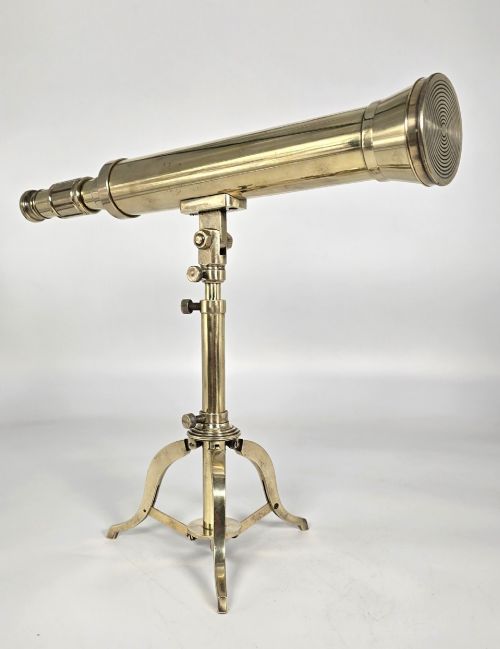


Vintage Nautical Spyglass
A vintage nautical spyglass is an optical instrument designed for maritime use, offering magnification through brass tubes and lenses.
Vintage Nautical Spyglass
When you search for a vintage nautical spyglass, you are looking at portable optical instruments designed for maritime use across several centuries. The pieces on this page span the Georgian, Victorian, and Edwardian periods, stretching from the mid-eighteenth century to the early twentieth century.
You are most likely to meet multi-draw telescopes housed in brass and leather, often configured for terrestrial or marine observation. These range from pocket-sized examples to large library instruments on folding brass tripods.
How they were made
Maker workshops constructed these instruments primarily from polished brass tubes combined with glass lenses for magnification. Many examples incorporate protective outer coverings of stitched leather, mahogany, fruitwood, walnut, or oak to withstand life at sea.
Makers utilised draw mechanisms to allow the brass barrels to collapse into compact lengths for transport. Precision machining ensured the sliding sections aligned correctly to maintain optical focus.
Day or night lenses allowed naval officers to squint through the murkiest maritime gloom long before modern coatings existed.
What varies in quality
The distinction between standard commercial pieces and master optical work lies in the precision of the lens grinding and the stability of the draw action. Makers of high standing achieved sharper optical clarity and smoother friction between the extending brass barrels.
Materials also separate the tiers, with robust hardwoods and carefully sewn leather jackets marking out pieces intended for demanding service. Finer instruments retain crisp maker signatures engraved onto the brass draw tubes.
Nairne & Blunt·Ross of London·Voigtländer & Sohn AG·Clarkson, London·Steward of London·Newton & Co·Broadhurst Clarkson & Co·Cary London·L. Casella, London·Chadburn Brothers of Sheffield·John Gilbert
The Vintage Nautical Spyglass Glossary
- Draw
- A sliding section of a telescope tube that extends to alter the focal length. Most instruments feature multiple draws.
- Achromatic
- An optical lens designed to reduce chromatic and spherical aberration. This corrects colour fringing in the field of view.
- Terrestrial
- An optical setup configured to present an upright image for viewing land objects. Marine spyglasses use this design.
- Objective
- The primary lens at the front of the telescope that gathers light. Its diameter determines the light-gathering power of the instrument.
Vintage Nautical Spyglass: Frequently Asked Questions
How do I use a draw telescope?
Grip the main body tube and pull each extending section outward until fully extended. Adjust the final small draw near the eyepiece until the distant view comes into sharp focus.
Keep the lenses clean and handle the brass draws carefully to prevent bending the metal tubes during operation.
What is an officer of the watch telescope?
This is a marine telescope specifically configured for naval personnel on watch duty aboard ship. The size balances portability with sufficient magnification to spot distant vessels and landmasses.
Such instruments often feature leather grips to assist handling in wet maritime conditions.
How do I date a brass telescope?
Examine any engraved maker signatures on the draw tubes and cross-reference them with known operational years. The number of draws, typography, and mounting styles also indicate whether an instrument belongs to the Georgian or Victorian eras.
Materials like mahogany and specific leather stitching styles point toward particular decades of manufacture.
Can I use these antiques outdoors?
These historical instruments remain functional for viewing distant terrestrial objects in good daylight. Care is required to protect vintage glass lenses and original brass finishes from harsh weather.
Store the spyglass collapsed in a dry environment when not in use to preserve the materials.