
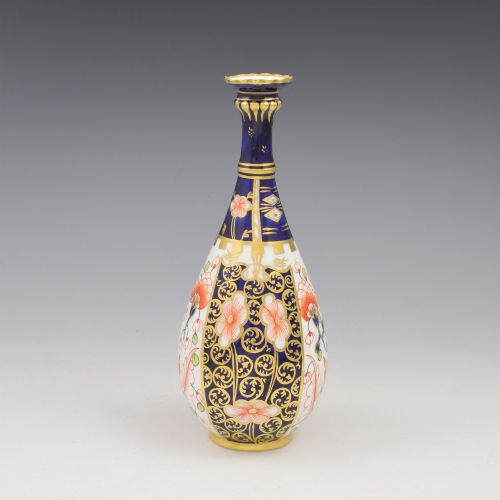


Antique Imari Bottle Vase
These antique imari bottle vases bring vibrant colour and traditional hand-painted patterns into a room, offering a striking display of porcelain artistry from Japan and Europe.
Antique Imari Bottle Vase
When you search for an antique imari bottle vase, you are looking at ceramic vessels designed with a narrow neck and a bulbous body, painted in characteristic palettes. The versions most commonly met on this page originate from Japanese export workshops and the Meiji period, alongside Victorian British porcelain and continental pieces.
The forms range from slender neck vases and bottle shapes to larger decorative garniture sets and wine bottles. These pieces encompass 17th century Arita production, 19th century Japanese export work, and Victorian interpretations such as Derby porcelain.
Materials and methods
These pieces are formed from hard-paste porcelain, decorated using cobalt glaze beneath the surface and applied enamel pigments over the glaze. Many examples incorporate accents of gold leaf to highlight the intricate patterns.
The manufacturing traditions span Japanese Edo and Meiji period workshops, where Arita potters mastered high-fired porcelain, as well as European factories replicating the orientalist style during the Victorian era.
The listings here span porcelain, enamel, gold leaf, and cobalt glaze across the seventeenth, nineteenth, and Victorian periods.
Distinctions in quality
The finer examples demonstrate superior control in brushwork, with precise application of cobalt glaze and crisp enamel detailing that remains sharp across the surface. Lesser pieces may show coarser brushwork or less defined transitions between the decorative panels.
The sophistication of the gilding and the harmony of the red, blue, and gold colour palette separate standard production wares from the exceptional pieces produced by established potteries and skilled individual workshops.
Stevenson and Hancock King Street Derby
The Antique Imari Bottle Vase Glossary
- Imari
- A style of Japanese porcelain decorated in underglaze blue, iron red, and gold, originating from the town of Arita. This decorative scheme was widely copied in Europe during the nineteenth century.
- Garniture
- A set of matching vases or vessels designed to be displayed together on a mantelpiece or sideboard. These sets typically comprise three or more pieces of graded or matching sizes.
- Cobalt glaze
- A deep blue mineral pigment applied beneath the transparent glaze before firing. It produces the characteristic dark blue tones found in traditional porcelain decoration.
- Meiji period
- The era of Japanese history spanning from eighteen sixty-eight to nineteen twelve. This period produced a large volume of export porcelain intended for Western markets.
Antique Imari Bottle Vase: Frequently Asked Questions
How were these bottle vases used originally?
These vessels served primarily as decorative items within the home, displayed on mantelpieces or cabinets to showcase wealth and taste. Some specific forms, such as wine bottles, had practical functions for serving liquids.
Over time, many of these pieces transitioned into purely ornamental objects, often arranged in matching sets or garnitures to balance the decor of formal reception rooms.
How do I tell Japanese Imari from European copies?
Japanese export pieces generally feature distinct paste characteristics, traditional Arita potting techniques, and specific hand-painted motifs developed during the Edo and Meiji periods. European factories often utilised local porcelain pastes and distinct factory marks.
Examining the base, the weight of the porcelain, and the specific shades of the cobalt blue and iron red provides strong clues regarding the geographic origin of the piece.
What is a garniture set?
A garniture set consists of three or more matching or complementary vases designed to be displayed together as a decorative unit. These sets create symmetry and visual weight when placed across a mantelpiece or large piece of furniture.
Individual pieces within a garniture may share identical motifs or feature alternating designs that follow the same overarching palette.
How should I clean my antique porcelain vase?
Dust the surface gently with a soft, dry brush to remove particulate matter without risking the delicate enamel and gold leaf decorations. Avoid submerging the piece in water, especially if the piece shows old repairs or porous areas.
For more stubborn dust, use a slightly damp cloth with plain water, taking care to dry the surface immediately afterwards with a soft cloth.