
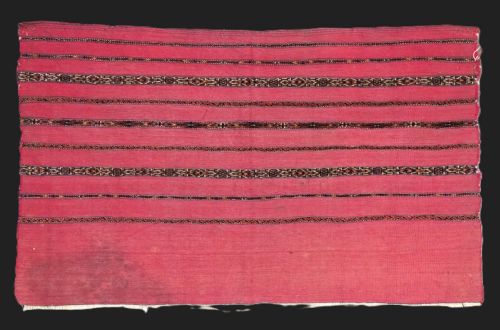
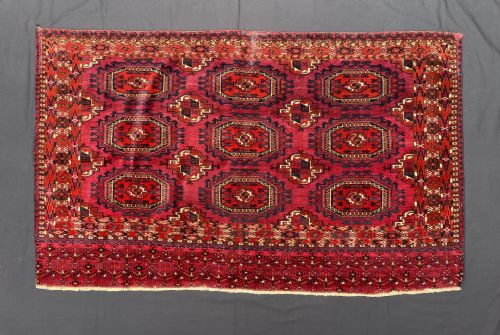


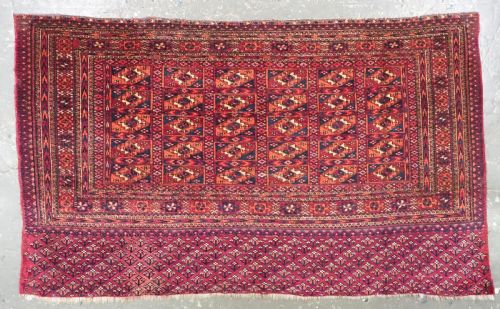
Antique Chuval Hanging
An antique chuval hanging provides a glimpse into nomadic Central Asian heritage through tribal weaving traditions.
Antique Chuval Hanging
An antique chuval hanging originates as a large Central Asian storage bag face produced by tribal weavers, specifically from Turkmen groups such as the Tekke, Ersary, Yomut, and Saryk.
These pieces generally date from the mid-nineteenth century through to the early twentieth century, encompassing various tribal workshops and regional designs across Turkmenistan.
Collectors encounter complete examples with plain weave backs and hanging loops alongside individual bag faces that served functional storage purposes within nomadic households.
How they were made
Weavers constructed these textiles predominantly using wool and hand-spun wool foundations, occasionally incorporating white cotton and crimson silk accents for specific design elements.
The distinct visual patterns rely heavily on natural dyes to achieve rich colour palettes, deployed across tribal and nomadic motifs like guls and panel tree designs.
Several surviving bag faces retain their original hanging loops, ready to resume service after more than a century.
What varies in quality
The fineness of the weave and the complexity of the gul arrangements distinguish different examples, alongside the presence of original backing materials and hanging loops.
Structural preservation and the clarity of the natural dye palette contribute significantly to the overall integrity of each textile.
The Antique Chuval Hanging Glossary
- Chuval
- A large nomadic storage bag used by Turkmen tribes. These were traditionally employed for domestic storage inside yurts.
- Gul
- A major repeating medallion motif characteristic of Turkmen tribal rugs and bag faces. Different tribes utilised distinct gul forms for identification.
- Torba
- A smaller storage bag format produced by nomadic weavers. These function similarly to chuvals but in reduced dimensions.
- Ak chuval
- A variant of the storage bag featuring a lighter colour ground. These contrast with the deep crimson grounds typical of kizil versions.
Antique Chuval Hanging: Frequently Asked Questions
What is an antique chuval hanging?
An antique chuval hanging is the decorative face or complete body of a nomadic storage bag made by Turkmen tribes in Central Asia.
These textiles were originally utilised inside traditional tents for household storage before entering the collector market.
How were chuval bags used originally?
Nomadic families used these large bags to store bedding, clothing, and personal possessions inside their dwellings.
They were often hung against the lattice walls of a yurt or stacked on top of one another.
How do you hang a textile safely?
Mounting a fragile textile requires distributing the weight evenly across the entire top edge rather than pinning it at isolated points.
Many collectors use custom conservation stitching to attach a support sleeve or Velcro hanging strip.
How do I identify different Turkmen tribes?
Tribal attribution relies on examining the structural proportions, structural materials like cotton or wool, and specific medallion motifs.
Tekke, Ersary, Yomut, and Saryk weavers each employed distinct variations of guls and border patterns.