
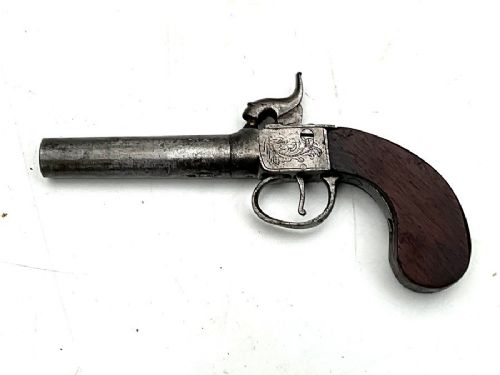

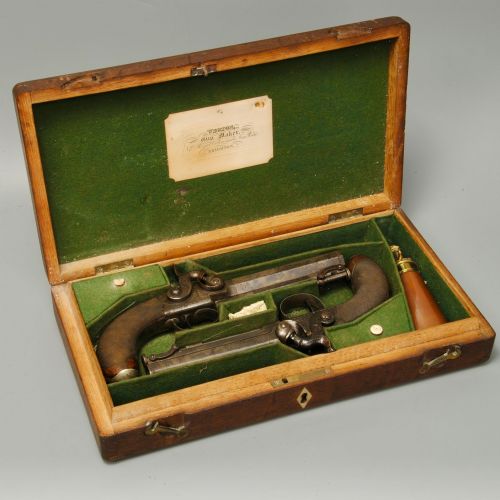
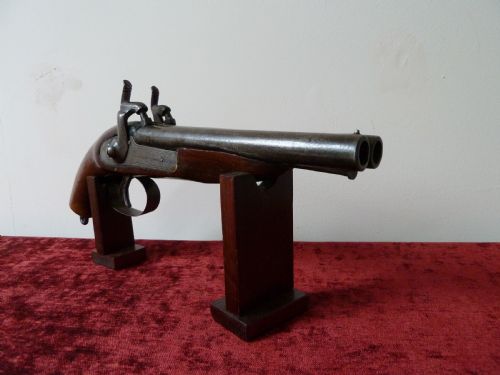


19th Century Caplock Pistol
A 19th century caplock pistol represents an era of rapid firearm development, offering collectors solid steel mechanics and tactile walnut grips.
19th Century Caplock Pistol
A 19th century caplock pistol is a firearm relying on the percussion cap system, which superseded flintlock mechanisms during this period. The listings here showcase examples primarily from the nineteenth century, including the year 1850 and the Victorian era.
Collectors encounter various forms on this page, ranging from single-shot pocket pistols and belt pistols to double barrel configurations and boxlock percussion pistols with flick bayonets. Military pieces and officer models also appear alongside civilian gentlemens variants.
Origin points span domestic British workshops and continental makers such as Auguste Francotte in Liège. These items fall broadly under antique firearms and antique pistols.
How they were made
Makers constructed these firearms using robust materials including steel and iron for barrels and lock mechanisms, paired with shaped walnut stocks. Some configurations incorporate brass components to strengthen frames or mountings.
The integration of functional accessories such as flick bayonets demonstrates advanced mechanical skill in metalwork. Cases and storage elements occasionally involve baize linings to protect the metal and wood finishes.
Some pocket pistols concealed spring-loaded bayonets, ensuring an argument could be settled even after the smoke cleared.
What varies in quality
The distinction between standard examples and superior pieces rests on the precision of the lock mechanism and the crispness of engraving on the metalwork. High quality items often demonstrate superior balance and more refined joinery between the walnut stock and the steel frame.
Signed works by established makers command attention through finer tolerances in the percussion caplock action and superior finishing on barrels. Plain military issues prioritise utility, whereas gentlemens pocket and belt versions exhibit more ornate detailing.
Mortimer·Deane, Adams and Deane·Auguste Francotte
The 19th Century Caplock Pistol Glossary
- Percussion cap
- A small detonating priming device placed on the nipple of a firearm to ignite the main powder charge when struck by the hammer. This innovation replaced earlier flintlock systems.
- Boxlock
- A firearm action where the breech and the lock frame are forged as a single piece, creating a compact and robust design. This style appears frequently on pocket pistols.
- Flick bayonet
- A spring-loaded blade attached beneath the barrel that releases forward instantly for close-quarters defence. It adds considerable mechanical complexity to a pistol.
- Belt pistol
- A compact firearm designed to be tucked securely into a waistband or belt for convenient carry. These pieces usually feature sturdy iron or steel belt hooks.
- Solid-frame revolver
- A handgun featuring a rigid, non-hinged frame holding a rotating cylinder for multiple shots. This design provides structural integrity during firing.
19th Century Caplock Pistol: Frequently Asked Questions
What is a 19th century caplock pistol?
A 19th century caplock pistol is a muzzle-loading firearm that uses a percussion cap struck by a hammer to ignite the gunpowder. These pieces mark the technological shift away from flintlocks.
They encompass various forms designed for civilian self-defence, military service, and target shooting throughout the Victorian and Regency periods.
How were these pistols used?
Owners carried these firearms for personal protection during travel, particularly in pocket or belt formats suited to concealment. Military officers utilised specific service models in the field.
Civilian variants served gentlemen and travellers who required reliable personal defence before the widespread adoption of modern cartridge revolvers.
How do I display a caplock pistol?
Displaying these firearms safely involves securing them in controlled environments away from excessive moisture to preserve the steel and walnut. Many collectors use dedicated wall mounts or enclosed cabinets.
Ensuring the piece remains unloaded and stable is paramount for both safety and the long-term preservation of antique mechanisms.
How do I tell different periods apart?
Distinguishing periods relies on observing stylistic markers, proof marks, and the evolution of mechanical systems from early Georgian designs to later Victorian military hardware. Material choices and barrel shapes also provide chronological clues.
Signatures and maker stamps help date specific pieces precisely by linking them to active workshop years.