
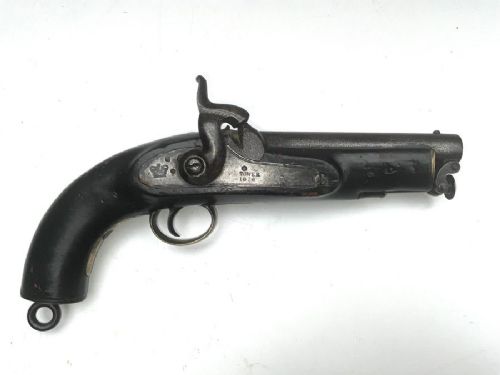

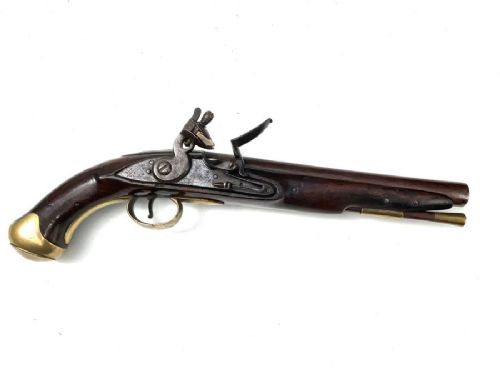


Antique Muzzle Loading Handgun
An antique muzzle loading handgun brings the mechanics of early firearms and military history directly into your collection.
Antique Muzzle Loading Handgun
When you search for an antique muzzle loading handgun, you encounter firearms shaped by centuries of military and civilian use. These pieces include flintlock pistols, percussion cap ignition systems, and pocket-sized variants originating from the eighteenth and nineteenth centuries.
The specimens appearing on this page span the Georgian and Victorian eras, encompassing British military issues, private London makers, and boxed revolver sets. You are most likely to meet nineteenth-century percussion pistols and belt pistols bearing Tower stamps or military markings.
The selection ranges from heavy cavalry arms to refined pocket pistols suited for discreet carry. Each object reflects the prevailing defensive and military needs of its period of manufacture.
How these firearms were constructed
Makers built these handguns using forged steel and iron for barrels and lock mechanisms, pairing them with stocks carved from dense walnut, oak, or general hardwoods. Brass fittings frequently reinforced trigger guards, butt caps, and ramrod pipes.
Some refined examples incorporate silver mounts and velvet-lined presentation boxes equipped with matching accessories. Metal components display period engraving or official inspection stamps denoting their military or London workshop origins.
Listings on this site feature iron, steel, brass, silver, walnut, oak, and velvet across Georgian and Victorian periods.
What separates the best examples
Quality in these firearms rests upon the crispness of the lock mechanism and the legibility of maker signatures or official stamps. Pieces produced by recognised London makers or bearing unit markings command closer attention from serious students of arms.
The integrity of the wooden stock and the retention of original finish across the steel and brass components dictate the overall desirability. Complete sets retaining their original fitted boxes and accessories represent the upper tier of survival.
HARRISON OF LONDON·Meyer and Mortimer
The Antique Muzzle Loading Handgun Glossary
- Flintlock
- An ignition mechanism utilising a piece of flint struck against a steel frizzen to create sparks that ignite the gunpowder charge. This system predates the nineteenth-century adoption of percussion caps.
- Percussion
- A later ignition system relying on a priming powder detonated when a hammer strikes a small copper percussion cap placed on a nipple. This method offered greater reliability in damp weather.
- Smoothbore
- A barrel lacking internal rifling, designed to fire spherical lead balls without spin. Many military and civilian handguns utilised this bore type before rifling became standard.
- Belt pistol
- A compact handgun equipped with a side hook for securing directly to a belt or sash. These pieces were standard equipment for officers and travellers.
- Tower stamp
- Official markings applied to British military arms indicating inspection and storage at the Board of Ordnance facilities in the Tower of London.
Antique Muzzle Loading Handgun: Frequently Asked Questions
What is an antique muzzle loading handgun?
An antique muzzle loading handgun is a firearm where powder and projectile are loaded down the front of the barrel. These include flintlock and percussion systems from the eighteenth and nineteenth centuries.
They reflect the evolution of personal defence and military sidearms before the invention of modern self-contained cartridges.
How do flintlock and percussion pistols differ?
Flintlock pistols use a flint striking a steel plate to generate sparks for ignition. Percussion pistols rely on a hammer striking a separate cap containing detonating compound.
Percussion mechanisms generally provide faster and more reliable ignition, especially in adverse weather conditions.
Were these pistols used by the military?
Many surviving examples served with British cavalry, officers, and infantry regiments. Official military arms often feature government inspection stamps and specific pattern designations.
Other pieces were privately purchased by officers or civilians for personal protection and travel.
How should I display or store my handgun?
Store these pieces in a stable environment away from excess moisture to protect the steel, iron, and wooden components. Many collectors utilise fitted wooden presentation cases or secure wall mounts.
Proper care preserves the original surface patinas and mechanical integrity of the lockwork.