





1940s Landscape Painting
These 1940s landscape painting works capture mid-century atmosphere through varied regional perspectives.
1940s Landscape Painting
A 1940s landscape painting captures rural, urban, and coastal scenes created during the mid-20th century. The selection leans heavily toward watercolours and oil paintings on canvas or paper, originating from British and European hands.
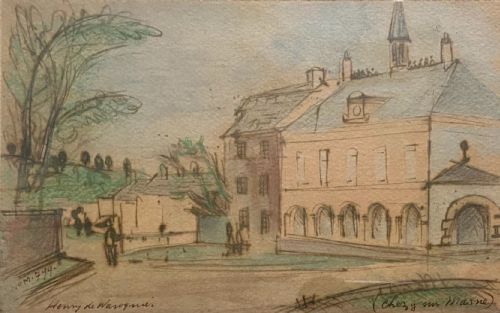
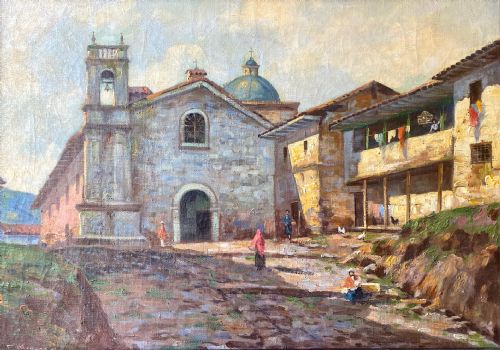
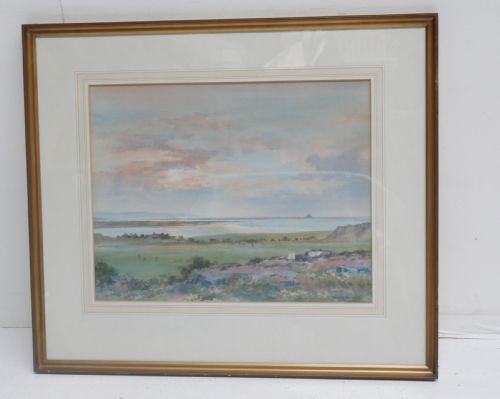
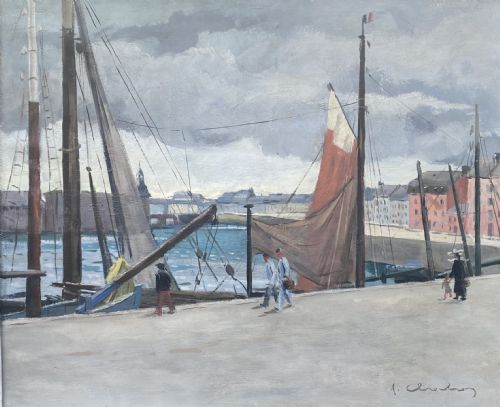
Most examples found here present specific regional views, ranging from Yorkshire watercolours to French coastal scenes and continental city views. The subjects span placid rural mills, golf courses, canals, and village streets shaped by the era.
Makers recorded in this group include established painters working in impressionist, modernist, and traditional naturalist idioms. Their works often bear dates or attribution to the early and mid-1940s.
Materials and methods
Paintings of this period rely primarily on oil paint applied to canvas or wood panels, alongside watercolours and mixed media on paper. Artists utilised standard brushes and occasionally ink or pencil to build line and tone before adding pigment.
Supports generally consist of stretched canvas or heavy watercolour paper housed behind glass within framed artwork. The physical components reflect the available materials of wartime and post-war studios.
Several wartime scenes depict daily resilience alongside quiet village streets, proving art persisted even when the paint supplies ran thin.
Markers of quality
Quality rests upon the handling of light, brushwork confidence, and the preservation of the original support. Stronger examples display a distinct compositional energy and secure pigment adhesion across canvas or paper.
The distinction between standard decorative output and a compelling work lies in the artist's command of atmosphere and tone. Pieces showing precise regional observation tend to hold greater visual weight.
Henry de Waroquier·Mercedes Legrand·Frank Wood·Fred Lawson·Arthur Bateman
The 1940s Landscape Painting Glossary
- Mixed media
- An artwork combining two or more distinct visual materials, such as watercolour, ink, and pencil on paper. This approach allows artists to layer textures within a single composition.
- Impressionism
- A style of painting focusing on transient effects of light and spontaneous brushstrokes. It prioritises overall visual impression over meticulous detail.
- Watercolour
- A paint consisting of pigment suspended in a water-soluble vehicle, typically applied to paper. It produces translucent washes of colour.
- Canvas
- A heavy woven fabric used as a surface for oil painting, usually stretched across a wooden frame. It remains the principal support for mid-century oil works.
1940s Landscape Painting: Frequently Asked Questions
What defines a 1940s landscape painting?
These works are original paintings, watercolours, and mixed media pieces produced during the 1940s, capturing urban, rural, and coastal views from Britain and Europe.
They reflect the artistic styles of the decade, including impressionism, post-impressionism, and mid-century modernism.
How were these paintings displayed originally?
Most works were framed behind glass if executed on paper, or mounted in wooden frames if painted on canvas.
Frames often varied according to the artist's location and available framing materials during and immediately after the Second World War.
How do I care for a watercolour from this era?
Watercolours on paper require protection from direct sunlight to prevent fading of the pigments. Keeping them away from excessive humidity preserves both the paper support and any accompanying ink work.
Displaying them behind conservation glass helps maintain their condition over time.
How are different regional styles told apart?
British watercolours from this period often focus on specific local topography, such as Yorkshire mills or Welsh coastal views, using transparent washes. Continental examples frequently employ bolder oil pigments to capture southern light or urban street scenes.
Signatures, dates, and recorded provenance help confirm the exact geographical origin.