


1930s Walnut Vanity Mirror
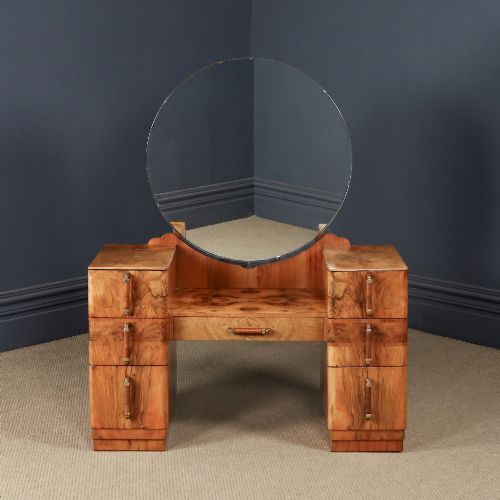
A 1930s walnut vanity mirror brings distinct Art Deco warmth to a room, offering both practical reflection and rich grain.
1930s Walnut Vanity Mirror
A 1930s walnut vanity mirror is typically encountered as part of a dressing table or as a standalone mirror piece dating from the interwar decades. The selection draws primarily from Art Deco design, often incorporating pedestal dressing tables, chests, and smaller wall mirrors.
The items span the 1910s through to the 1930s, reflecting shifts in British and Continental cabinetmaking during the early twentieth century. Buyers will frequently find pieces attributed to specific workshops or defined by the distinct aesthetic of the Cotswold School.
Most examples utilise walnut and burr walnut veneers mounted over solid carcases, paired with original or replacement mirror glass. Forms range from large dressing chest attachments to compact tabletop and wall-hung mirrors.
How they were made
Cabinetmakers of the period selected figured and burr walnut veneers to create striking grain patterns across flat surfaces and curved pedestals. These veneers were laid over secondary timbers such as oak, ensuring stability while displaying rich natural decoration.
Mirrors were cut to fit specific frames, sometimes incorporating bevelled edges or metal and brass details. Construction methods combined traditional joinery with the sleek geometric lines characteristic of Art Deco and Cotswold School furniture.
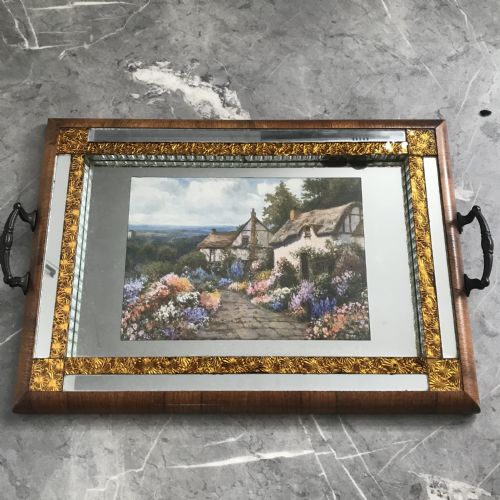
Some dressing mirrors arrived with matching glass trays to hold small personal items.
What varies in quality
The visual impact of the piece depends heavily on the selection and matching of the walnut veneer across the main surfaces. Finer examples display symmetrical burr patterns that catch the light, while simpler items rely on plain grain.
Attribution to known makers or documented workshops elevates a piece beyond standard production items of the decade. The integration of the mirror frame with the supporting dressing table or chest demonstrates the original maker's attention to proportion.
Maurice Adams·Harry and Lou Epstein·Whytock & Reid
The 1930s Walnut Vanity Mirror Glossary
- Burr walnut
- A prized timber harvested from tree growths that produces intricate, swirling grain patterns. It was frequently sliced into thin veneers for decorative furniture fronts.
- Art Deco
- A design style dominant in the 1920s and 1930s characterised by streamlined geometric forms, symmetry, and modern materials. It replaced more ornate Edwardian and Victorian styles.
- Cotswold School
- An English craft movement focused on honest construction, traditional joinery, and respect for natural materials. Pieces from this tradition often emphasise solid woodwork over heavy veneering.
- Veneer
- A thin layer of superior wood adhered to a base timber to provide an ornamental surface. This technique allowed makers to utilise rich walnut figures efficiently.
1930s Walnut Vanity Mirror: Frequently Asked Questions
Are these mirrors original to the dressing tables?
Many dressing tables retain their original pivoting or fixed mirror frames, which were designed specifically to match the proportions of the base furniture.
Because mirrors are fragile, some pieces may feature replacement glass while keeping the authentic period frame intact.
How do I clean walnut veneer?
Walnut veneer requires gentle care using a soft, dry cloth to remove dust without scratching the polished surface.
Avoid excessive moisture and harsh chemical sprays, as dampness can lift the thin veneer from its wooden substrate.
Where were these mirrors placed?
They were designed for bedrooms and dressing rooms, often sitting atop pedestal dressing tables or chests of drawers.
Some smaller formats were also made to hang directly on walls as decorative items in living spaces.
How do I identify Art Deco style?
Art Deco furniture is marked by clean geometric lines, symmetrical shapes, and a lack of excessive Victorian carving.
The heavy reliance on figured walnut grain provides the primary decorative detail rather than applied ornamentation.