
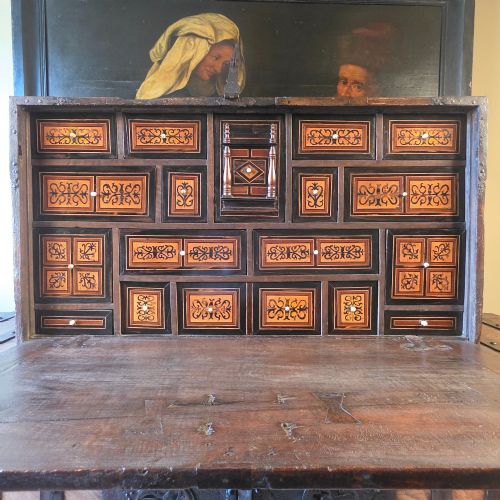
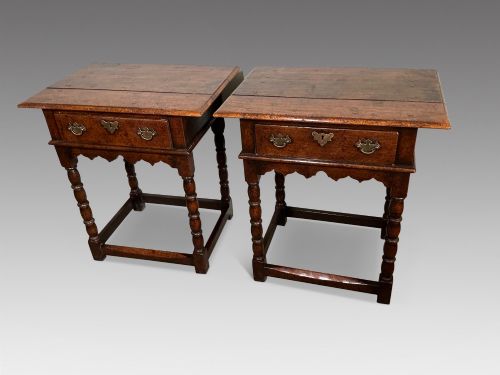


17th Century Table Cabinet
A 17th century table cabinet is a compact desk piece designed to secure correspondence and valuables, offering intricate internal drawers beneath panelled doors.
17th Century Table Cabinet
A 17th century table cabinet brings portable storage into domestic spaces, usually taking the form of a miniature architectural façade fitted with multiple internal small drawers. These pieces sit on desks or side tables, presenting panelled or decorated outer doors that conceal secret compartments and central shrines.
The evidence shows examples originating from English, Italian, Spanish, Flemish, and German workshops, with materials ranging from native oak and walnut to exotic ebony and tortoiseshell. Alongside period pieces, later revivals appear in the record, showing how cabinet makers returned to these compact forms across subsequent centuries.
Judging Quality and Execution
Quality rests in the precision of the surface parquetry and the depth of architectural detailing on the drawer fronts. Pieces enhanced with intricate bone inlay or tortoiseshell panels display a higher level of workshop skill than plain timber constructions.
The integrity of the internal drawer configuration and the retention of original brass or iron hardware determine the piece's preservation. Finer examples maintain their original hinges, locks, and fitted interior compartments without later alterations.
Many miniature cabinets contain secret drawers behind sliding panels, designed to outsmart curious visitors.
The 17th Century Table Cabinet Glossary
- Table cabinet
- A portable desk-height case piece with internal drawers enclosed by doors. These items sat on larger surfaces to store valuables.
- Marquetry
- The art of applying pieces of veneer to a structure to form decorative patterns. Craftsmen utilised various woods and bone to build pictorial scenes.
- Ebonised
- Wood treated to imitate ebony through staining or painting. This finish provides a dark, uniform contrast to inlaid bone or ivory details.
- Tortoiseshell
- Material sourced from turtle shell used as a decorative veneer. It appears on baroque cases combined with ebony moulding.
- Bone inlay
- Slices of animal bone fitted into recesses within a wooden surface. This technique creates pale geometric motifs against darker timbers.
17th Century Table Cabinet: Frequently Asked Questions
What is a 17th century table cabinet used for?
These cabinets served to store letters, documents, currency, and small precious items within a secure, lockable enclosure.
Owners placed them on tables or desks in private chambers, using the internal drawers to organise correspondence and valuables.
How do I identify period materials?
Period pieces utilise dense hardwoods like walnut, oak, and pearwood, often layered with exotic veneers such as ebony.
Decoration frequently incorporates natural bone, ivory, or tortoiseshell, secured with hand-beaten iron or brass hardware.
Where were these cabinets made?
Workshops across Europe produced these pieces, with notable centres in Italy, Spain, Antwerp, Germany, and England.
Each region developed distinct stylistic traits, from English oak carving to Italian and Flemish tortoiseshell and ebony façades.
How do I care for a wood and bone cabinet?
Keep the cabinet away from direct sunlight and fluctuating heat sources to prevent the wood and delicate veneers from warping.
Apply microcrystalline wax sparingly to nourish the timber surface without damaging antique finishes or bone inlays.