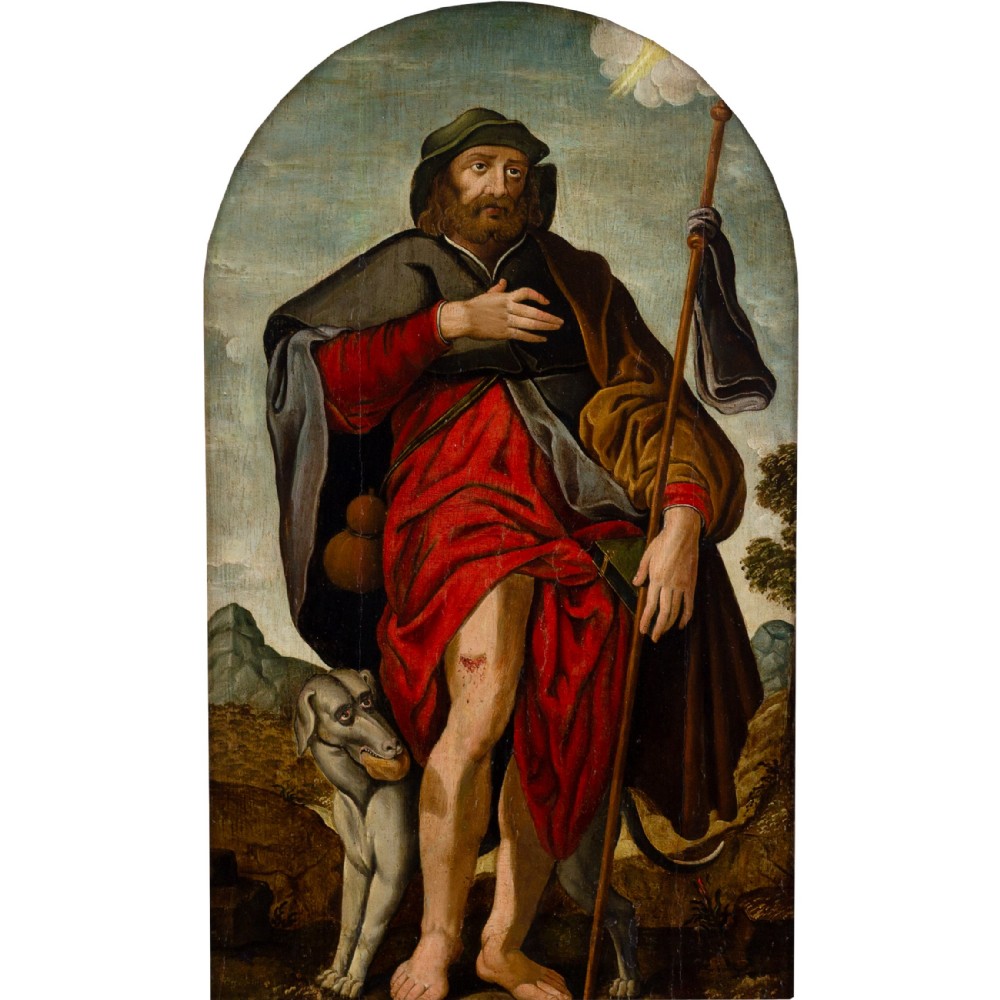
Brave Fine Art has dated this 16th Century Religious Painting to the 16th Century.
A dark cloak falls heavily across his shoulders over a vivid red tunic, while a soft cap covers his head. In one hand he holds a long pilgrim’s staff, with a cloth bundle tied near the top, while the other rests across his chest in a gesture of devotion. His right leg is deliberately exposed to reveal the plague sore associated with his legend.
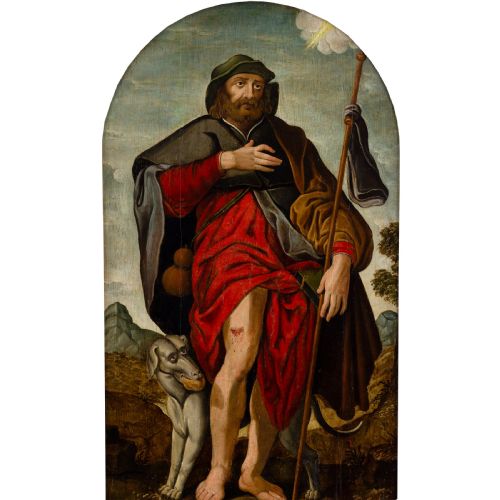
At his feet stands the faithful dog that became one of the saint’s principal attributes. According to tradition, after Roch contracted the plague and withdrew into isolation, a dog repeatedly brought him bread and helped sustain him until his recovery. Here, the animal carries a small loaf in its mouth, adding a surprisingly tender note to an otherwise solemn devotional image. Above, a shaft of divine light breaks through a bank of cloud and falls towards Roch’s head.
The composition follows closely an engraving of Saint Roch made in 1577 by Cornelis Cort after a design by Hans Speckaert. The British Museum preserves an impression of the print, in which Roch appears in the same frontal pose, with staff, exposed leg and dog carrying bread. The painter has translated this engraved model into colour, enlarging and simplifying the forms while retaining the strong verticality of the original design.
This use of printed sources was common throughout late 16th-century Europe. Engravings allowed successful compositions to travel rapidly between artistic centres and were frequently adapted by painters working far from the original designer. In Spain, such images were often reinterpreted with a more restrained and monumental character suited to Counter-Reformation devotional practice.
Devotion to San Roque was particularly strong in Spain during the later 16th century, when repeated outbreaks of plague gave his image immediate relevance. Paintings such as this served as objects of intercession, presenting Roch as a protector whose own suffering and miraculous recovery gave him special power against disease.
The support is also particularly interesting. The painting is executed across a substantial wooden panel, reinforced at the reverse. Its construction, together with the style of the painting and the engraved source, is consistent with a date in the closing decades of the 16th century. It's a wonderful survivor from the late Renaissance.
Held in an imposing carved wooden frame decorated throughout with bold scrolling foliage.
Medium
Oil on panel
Overall size
25” x 40” / 63cm x 102cm
Year of creation
c. 1590
Provenance
Private collection, Spain.
Conservation
Professionally conserved, including careful cleaning to reveal the painting’s true colouring and remove accumulated surface grime that can be harmful over time. A protective layer of conservation varnish has also been applied. The paint layer is stable.
Condition
Presentable for its age. Craquelure, as one would expect. Natural undulation to the panel. Historic repairs and reinforcements to the panel. Frame showing some minor marks and wear consistent with age and use.
Our reference
BRV2197
Brave Fine Art has dated this 16th Century Religious Painting to the 16th Century.
Exquisite antique paintings that capture the imagination.
You can view the stock and full dealer information on the Brave Fine Art Profile Page
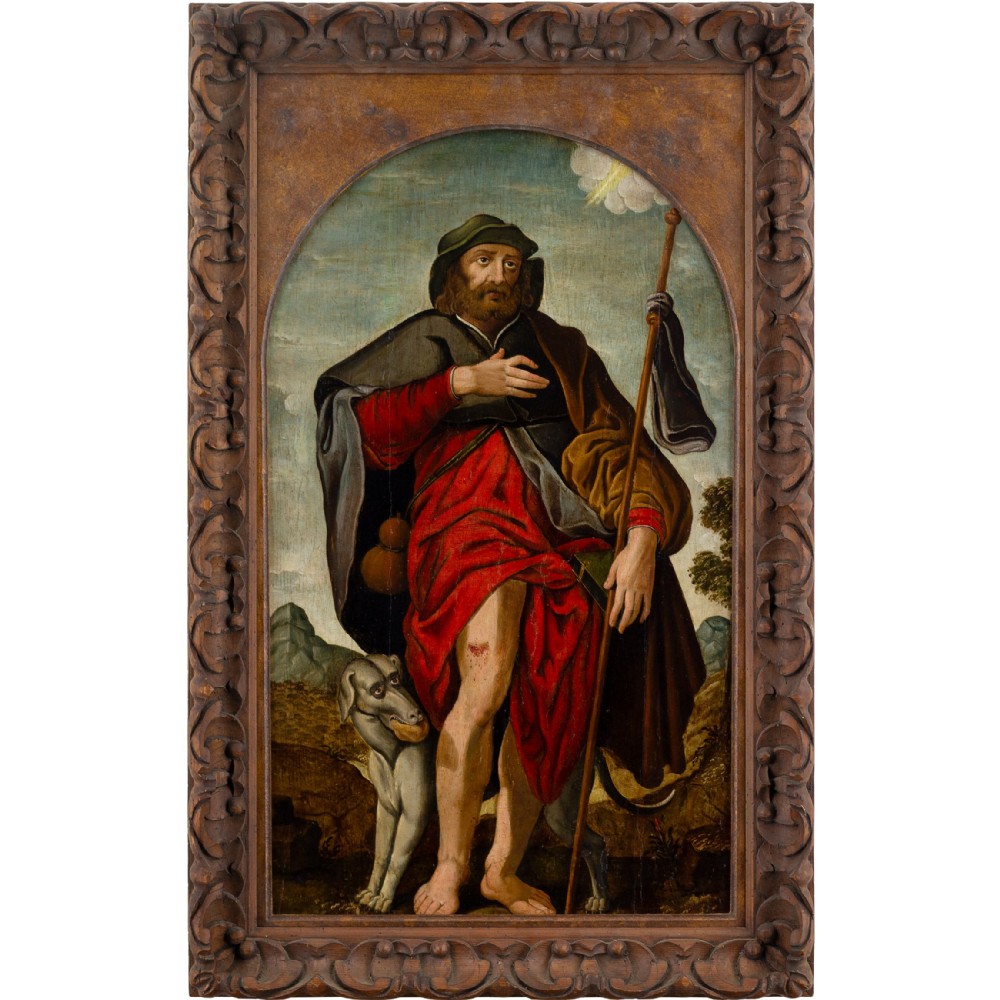
Late 16th-century Spanish School, Saint Roch as Pilgrim-healer - Antique Oil Painting