
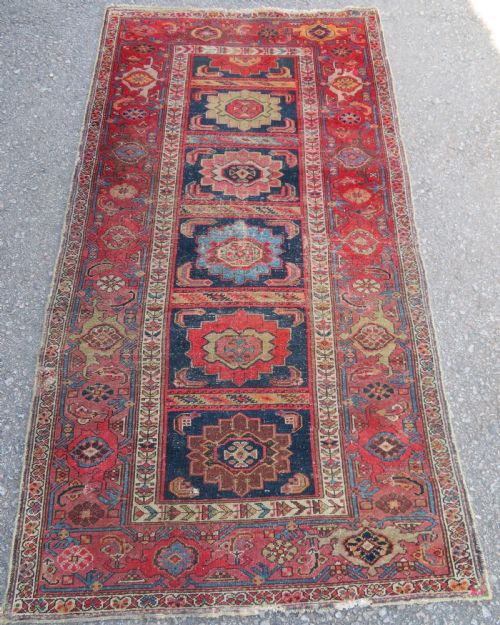


A 2026 Guide by Sellingantiques
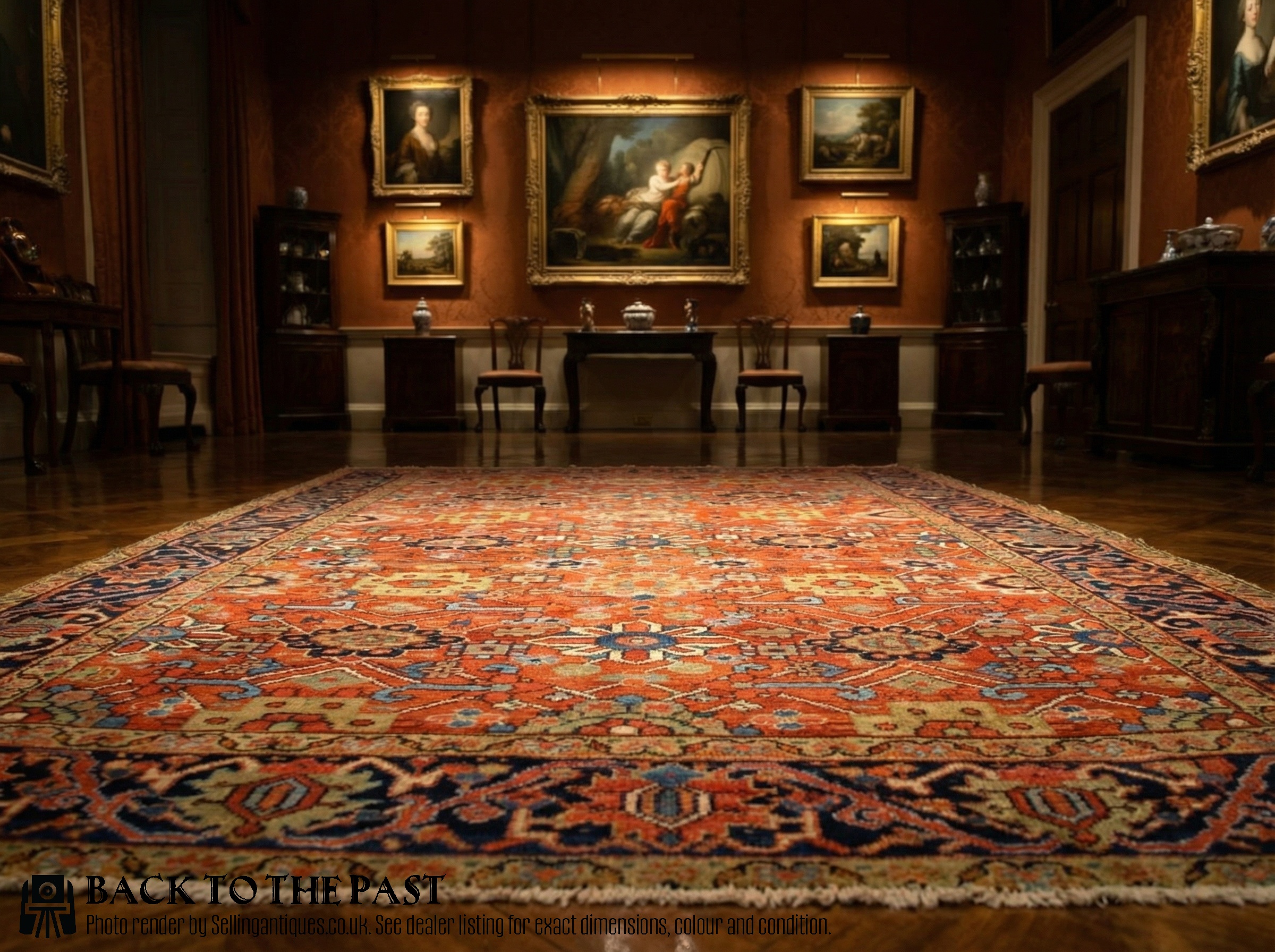
233 X 328cm Antique Heriz Carpet, 1920
Priced at £15,000 from James Cohen Antique Carpets
Production centred around Mount Sabalan in the East Azerbaijan Province of Iran.
Villagers adapted the curvilinear court designs of nearby Tabriz into sharp, geometric patterns.
Commercial demand grew sharply during the late nineteenth century as Western markets sought tough, room-sized floor coverings.
These textiles were woven on vertical village looms rather than in highly organised city workshops.
Look at the scale of the drawings to see how local weavers interpreted formal templates without strict paper blueprints.
Individual weavers rarely signed their work in this region, making specific attributions impossible for most pieces.
Surrounding villages like Bakshaish developed their own distinct weaving traits under the broader Heriz umbrella.
Trade labels sometimes use the term Serapi to identify earlier, more finely woven examples from the same district.
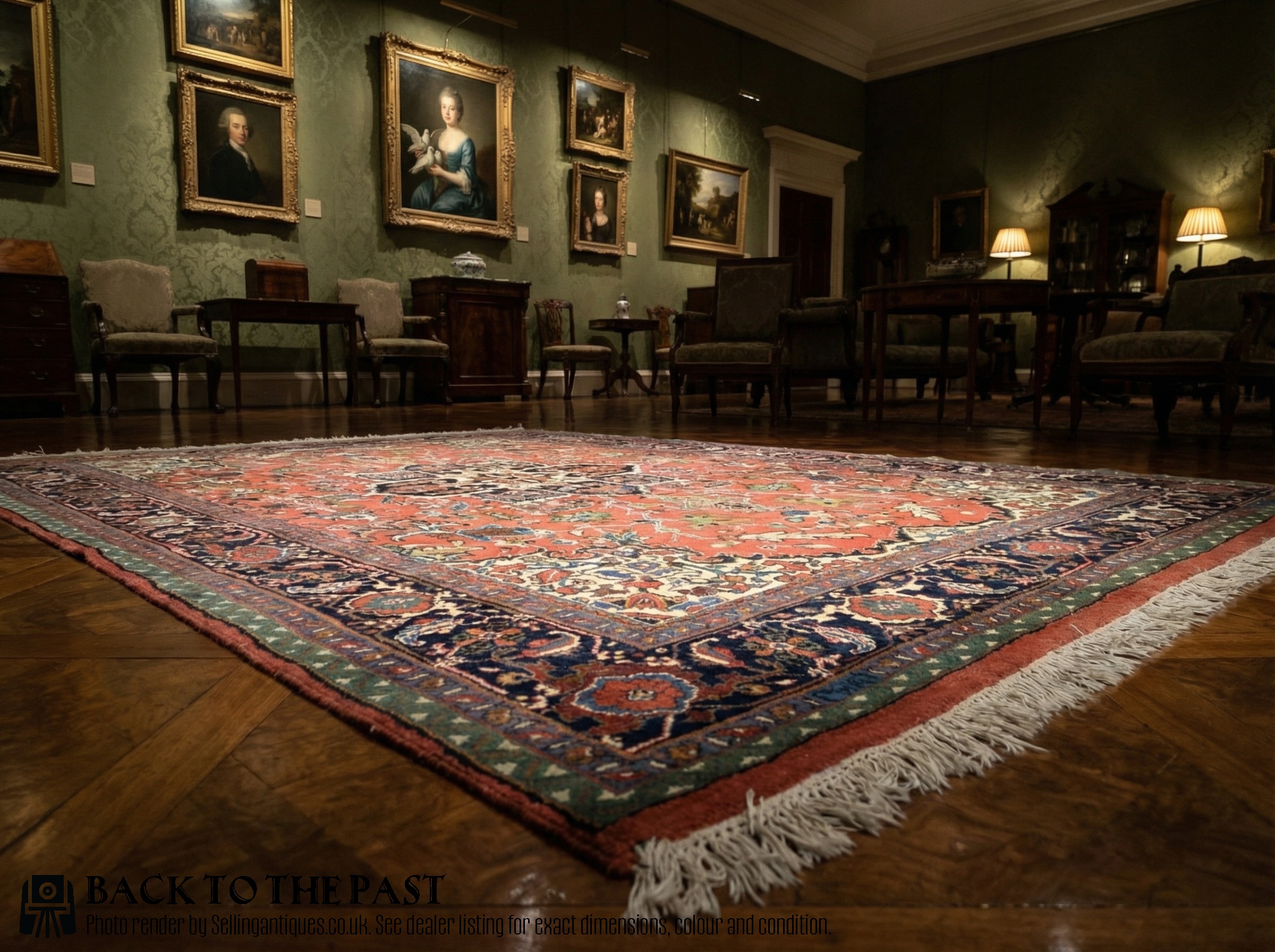
Superb Heriz Design Carpet, 1930
Priced at £895 from Fernyhough Antiques Ltd
The 2026 retail price guide for Antique Heriz Rugs is drawn from a proprietary archive of over 1.1 million retail prices indexed by Sellingantiques since 2003. This guide relies exclusively on their own internal data; no external sources or auction records are used.
Analysing nearly 25 years of UK antique market history alongside current retail values, the data indicates that typical UK retail prices for Antique Heriz Rugs range between £1,900 and £12,000. Entry-level prices generally fall under £1,900 and premium examples upwards of £12,000.
A prominent central medallion often dominates the field, framed by heavy corner spandrels in contrasting colours.
Borders usually feature a broad main band flanked by narrower guard stripes displaying geometric vines and palmettes.
The drawing is distinctly angular. Leaves, stems and floral motifs turn at sharp right angles rather than sweeping curves.

293 X 350cm Fine Antique Heriz Carpet, 1900
Priced at £9,500 from James Cohen Antique Carpets
Weavers tied symmetrical Turkish knots over thick cotton warps, creating a stout and heavy fabric.
Thick, unpressed wefts resulted in a ribbed back, making the rugs lay flat and resist bunching on wooden floors.
The pile was clipped relatively short in older examples to maintain the crispness of the geometric patterns.
"Many early examples incorporate undyed camel hair in the field to create soft, earth-toned backgrounds."
"The local water supply gave the regional wool a high lanolin content, adding a natural stain resistance."
"Weavers often threw in deliberate colour changes known as abrash, giving the flat backgrounds a textured, horizontal banding."
Based on almost 25 years of Sellingantiques UK antique market data, Antique Heriz Rugs appeared 1028 times (out of 1,100,000 antiques) which gives it a rarity score of 81/100.
This score measures scarcity within the Sellingantiques archive only and is not a survey of the entire antiques market, so these statistics may not be indicative of the general availability of Antique Heriz Rugs elsewhere.
Dust needs removing first. A vacuum cleaner works for the surface, but the heavy foundation traps grit at the base of the knots. That grit acts like sandpaper on the wool.
Professional washing uses cold water and mild soap. The rug is flushed flat on a floor, squeegeed to push out the dirt, and air-dried quickly to stop the cotton foundation from rotting.
Uneven tension during the original weaving process causes the selvedges to pull tight. Damp conditions also shrink the cotton weft cords unevenly.
Improper washing is usually the culprit. Slow drying after a wet wash warps the entire cotton frame.
That colour shift is called abrash. It happens when weavers run out of one batch of dyed wool and start using another. Dyeing wool in small village batches meant the madder root recipes rarely matched exactly from pot to pot.
Dealers expect this in an antique Heriz rug. It breaks up the solid blocks of colour and shows the piece was woven on a small scale rather than in a large commercial factory.
Constant friction will wear down any wool pile eventually. Chair legs act like pestles grinding into the foundation.
These rugs have a reputation for toughness due to their thick structure and durable local wool. Adding a proper underlay helps absorb the downward pressure, but you still need to rotate the rug occasionally to spread the wear evenly across the surface.
Please note: This Antique Heriz Rugs guide and its associated pricing data are provided for general informational purposes only. It does not constitute formal financial, investment, or appraisal advice and should not be relied upon as the sole basis for any commercial activity, purchasing, or sales decisions. Sellingantiques.co.uk accepts no liability for any actions taken in reliance on this information. Always consult with a qualified professional or independent appraiser.
