
A 2026 Guide by Sellingantiques
Essential hearth equipment in almost every home before central heating became standard.
Blacksmiths and foundries required massive versions to reach forging temperatures.
Look at the domestic examples which were scaled down for parlour fireplaces.
These antique bellows saw continuous use across Britain from the medieval period through to the late nineteenth century.
Specific documented makers rarely signed domestic antique bellows during the eighteenth and nineteenth centuries.
Local joiners often constructed the wooden boards before sending them to a saddler for the leatherwork.
Industrial production in Birmingham later standardised the brass nozzles and tacked leather edgings.
The 2026 retail price guide for Antique Bellows is drawn from a proprietary archive of over 1.1 million retail prices indexed by Sellingantiques since 2003. This guide relies exclusively on their own internal data; no external sources or auction records are used.
Analysing nearly 25 years of UK antique market history alongside current retail values, the data indicates that typical UK retail prices for Antique Bellows range between £100 and £600. Entry-level prices generally fall under £100 and premium examples upwards of £600.
A simple clack valve sits over a hole in the bottom board to draw air in on the upstroke.
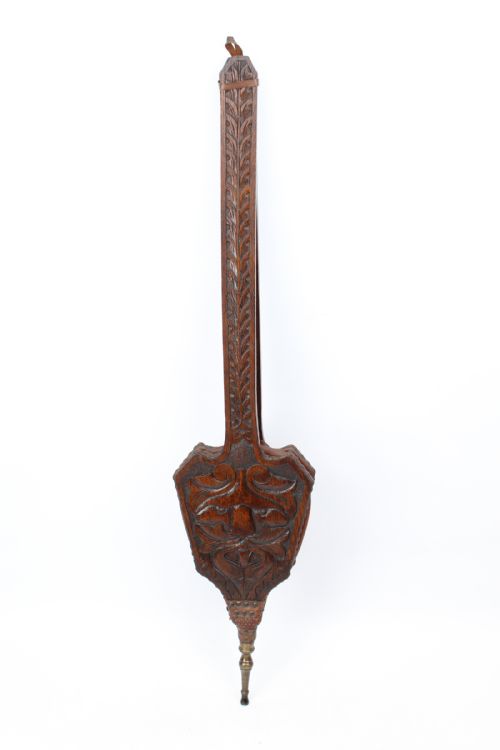
Carved upper boards often feature geometric patterns or floral motifs on better examples.
Metal pipes taper at the end to direct the draught directly into the embers.
Early domestic types relied on heavy hand-carved boards and thick hide pegged directly into the timber.
Turners later shaped the handles on a lathe for a smoother grip.
Brass tacks eventually replaced wooden pegs, securing the leather while adding a decorative border.
"Many were carved as novelty figures or faces, adding a touch of humour to the parlour hearth."
"Tartan-covered examples became highly fashionable in Scotland during the nineteenth century."
"Some high-end pieces feature intricate brass inlay or tortoiseshell veneer to match expensive drawing room cabinets."
Based on almost 25 years of Sellingantiques UK antique market data, Antique Bellows appeared 301 times (out of 1,100,000 antiques) which gives it a rarity score of 94/100.
This score measures scarcity within the Sellingantiques archive only and is not a survey of the entire antiques market, so these statistics may not be indicative of the general availability of Antique Bellows elsewhere.
Do not soak them in heavy oils. Over-oiling weakens the stitching and can cause the antique leather to tear away from the tacks.
Apply a light museum-grade wax or specialist leather conditioner sparingly. Work it in with your fingers and leave it to absorb in a warm room.
Loose nozzles are a common issue on older antique bellows. The wood around the metal often shrinks over the decades, causing the pipe to lose its tight friction fit.
A local restorer can usually pack the joint with leather shims or hide glue to secure it. They do not need to dismantle the whole piece to carry out this repair.
That hole is the main air intake. It sits beneath a simple one-way leather flap inside the lower board, known in the trade as a clack valve.
When you pull the handles apart, air rushes in through this hole. When you push them together, the internal air pressure forces the flap shut, directing the draught out through the metal nozzle.
Without it, the bellows would just pull hot smoke back up the pipe from the fire.
That is standard practice. Makers focused decorative carving on the upper board, which faces outward when hung by the fireplace.
The lower board sits against your body during use, so keeping it smooth makes it practical to handle.
Please note: This Antique Bellows guide and its associated pricing data are provided for general informational purposes only. It does not constitute formal financial, investment, or appraisal advice and should not be relied upon as the sole basis for any commercial activity, purchasing, or sales decisions. Sellingantiques.co.uk accepts no liability for any actions taken in reliance on this information. Always consult with a qualified professional or independent appraiser.
