
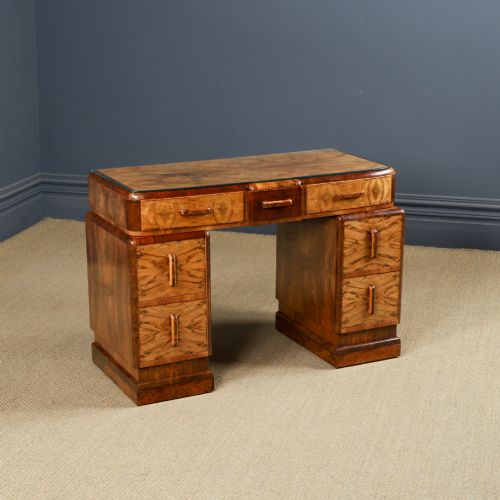


A 2026 Guide by Sellingantiques
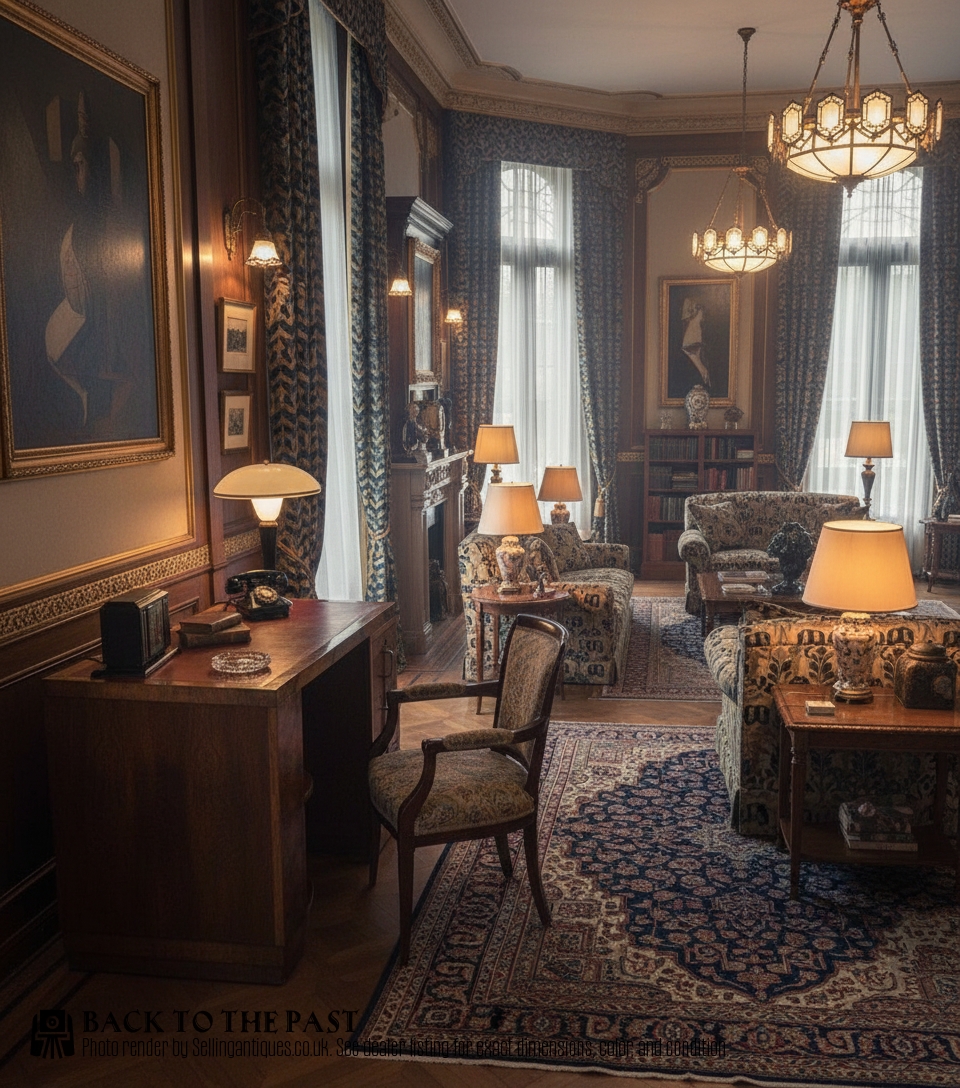
Art Deco Figured Walnut Desk, English, C1930, 1930
Priced at £2,650 from Art Deco World
The Paris 1925 exhibition launched the style. Designers moved away from the heavy carving of previous eras toward clean forms.
Demand for home workspaces grew rapidly during the interwar years.
Look at the transition in shapes over time. Early Art Deco desks often kept traditional straight legs, while later ones adopted asymmetrical profiles.
Industrial progress allowed workshops to slice exotic timbers thinner than before.
Émile-Jacques Ruhlmann produced documented Art Deco desks in Paris during the 1920s. His pieces rely on rare veneers and slender, tapered legs.
British firm H. & L. Epstein manufactured heavy walnut examples in the 1930s. Their cloud-shaped forms are highly recognisable in the London trade.
Betty Joel designed practical workspaces in Britain between 1928 and 1937. Her sweeping shapes were mostly made from oak or Queensland walnut.
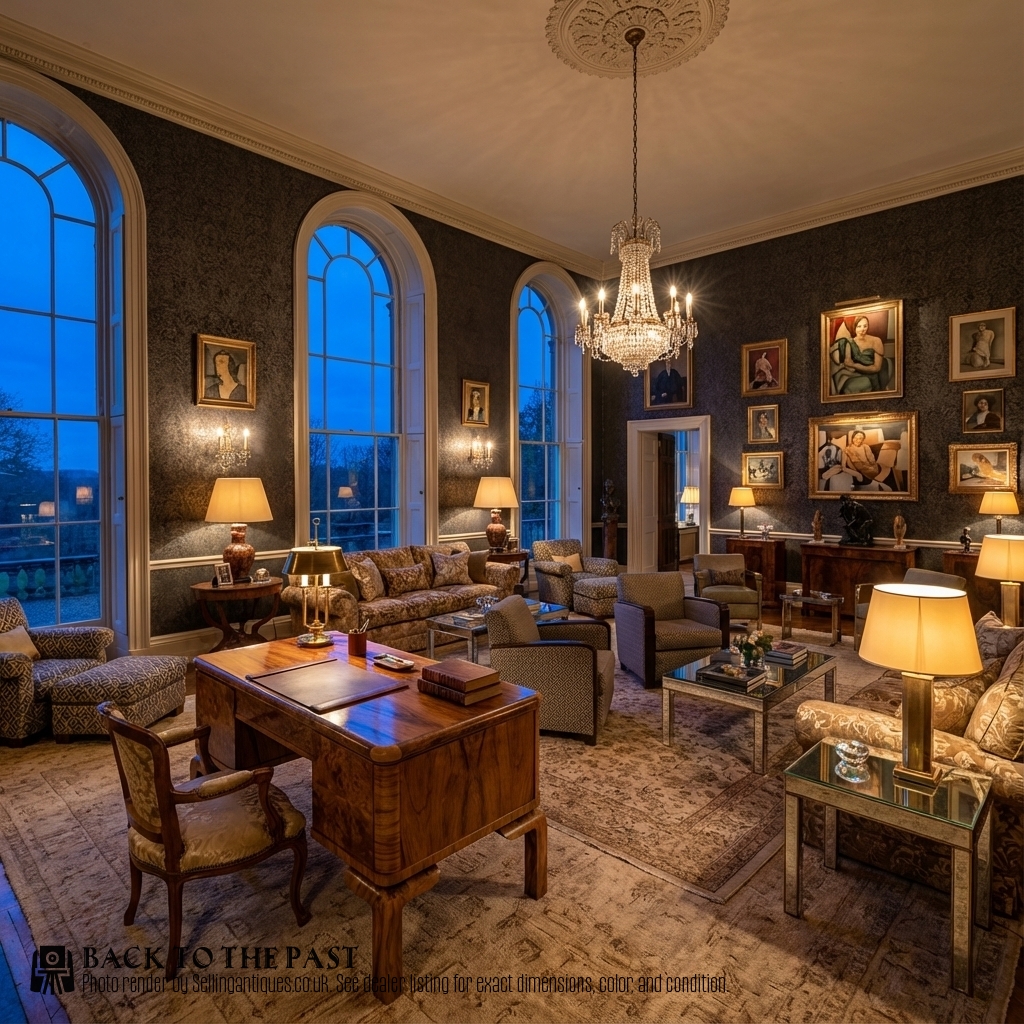
Art Deco Stylish Figured Walnut Desk, C1930, 1930
Priced at £2,550 from Art Deco World
The 2026 retail price guide for Art Deco Desks is drawn from a proprietary archive of over 1.1 million retail prices indexed by Sellingantiques since 2003. This guide relies exclusively on their own internal data; no external sources or auction records are used.
Analysing nearly 25 years of UK antique market history alongside current retail values, the data indicates that typical UK retail prices for Art Deco Desks range between £400 and £2,800. Entry-level prices generally fall under £400 and premium examples upwards of £2,800.
Asymmetry is a frequent hallmark of an Art Deco desk. You often find a pedestal of drawers on one side and an open curved support on the other.
Streamlined edges dominate the top surface. Sharp corners are frequently rounded off to echo ocean liners and early aviation.
Leather writing surfaces commonly sit flush within the veneered top. These skivers often feature blind tooling around the perimeter.
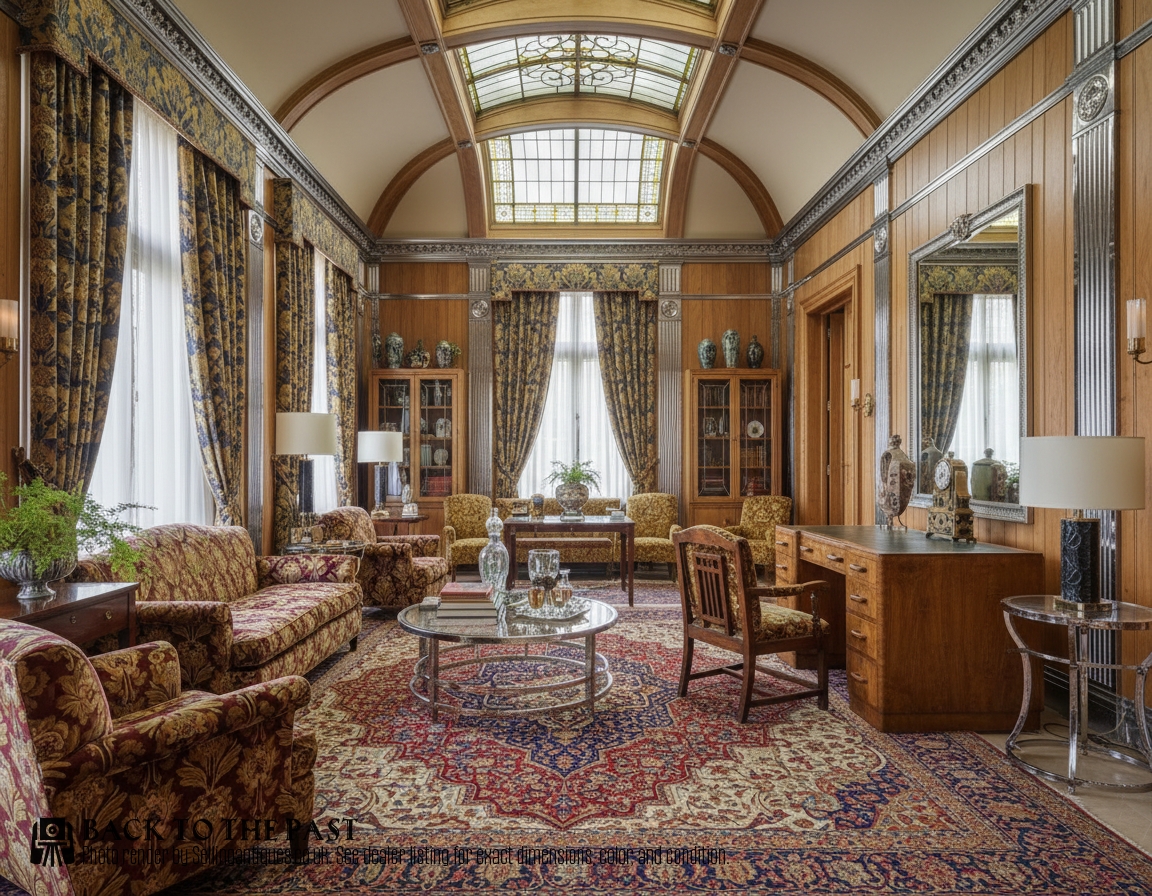
Art Deco Desk, 1930
Priced at £2,250 from Poirot Art Deco
Thick core boards form the curved bases. Cabinet makers laid thin veneers over these shaped substrates to achieve the sweeping lines.
French polishing creates that high-gloss finish. The trade applied shellac by hand in dozens of thin layers to fill the grain.
Traditional dovetails still hold the drawer boxes together. Even the most modern-looking Art Deco desks rely on standard hand-cut joints inside.
"Secret compartments are surprisingly common in these geometric forms. Makers hid shallow trays behind false drawer fronts or inside the kneehole arch."
"Many pieces were designed to stand in the centre of a room. The backs are often just as polished and veneered as the fronts."
"Hardware was sometimes painted to look like expensive metal. You can find carved wooden handles finished in silver paint to mimic solid chrome."
Based on almost 25 years of Sellingantiques UK antique market data, Art Deco Desks appeared 1812 times (out of 1,100,000 antiques) which gives it a rarity score of 70/100.
This score measures scarcity within the Sellingantiques archive only and is not a survey of the entire antiques market, so these statistics may not be indicative of the general availability of Art Deco Desks elsewhere.
Wipe the skiver with a soft dry cloth to remove loose dust. You can use a slightly damp cloth for sticky marks, but dry it immediately.
Avoid standard furniture polishes on the leather. A specialist leather cream applied once a year keeps the surface supple and stops the tooling from drying out.
Wooden drawer runners swell when the air gets damp in winter. Remove the affected drawer and look at the bottom edges.
Rub a plain wax candle along the wooden runners on the carcase and the bottom edges of the drawer. This simple lubrication usually stops the wood catching.
If the drawer still sticks, the timber might have warped slightly over the decades. A cabinet maker can plane a fraction of a millimetre off the tight spots.
Most Art Deco desks easily take a modern laptop or monitor. The main tops are deep and sturdy, originally built for heavy manual typewriters.
Just check the kneehole width before buying. Some single pedestal models have narrow seating areas that struggle to fit a modern office chair.
White rings mean moisture is trapped in the top layer of the French polish. Black rings mean the water has penetrated through to the wood itself.
For a white mark, try rubbing it gently with a dry microfibre cloth. Sometimes the friction generates enough mild heat to draw the moisture out of the shellac.
Dark marks or stubborn white rings need professional attention. A restorer will cut back the damaged shellac and re-polish that section to match the rest of the top.
Please note: This Art Deco Desks guide and its associated pricing data are provided for general informational purposes only. It does not constitute formal financial, investment, or appraisal advice and should not be relied upon as the sole basis for any commercial activity, purchasing, or sales decisions. Sellingantiques.co.uk accepts no liability for any actions taken in reliance on this information. Always consult with a qualified professional or independent appraiser.
