

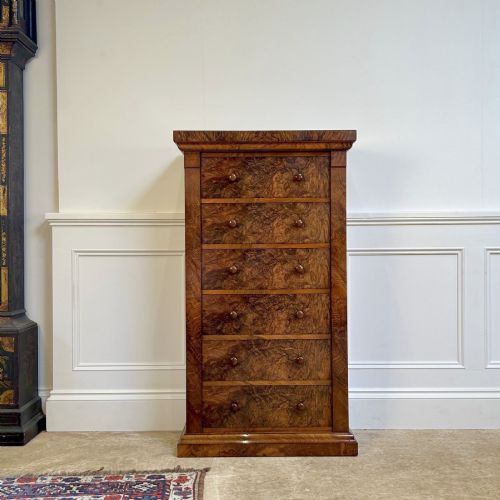
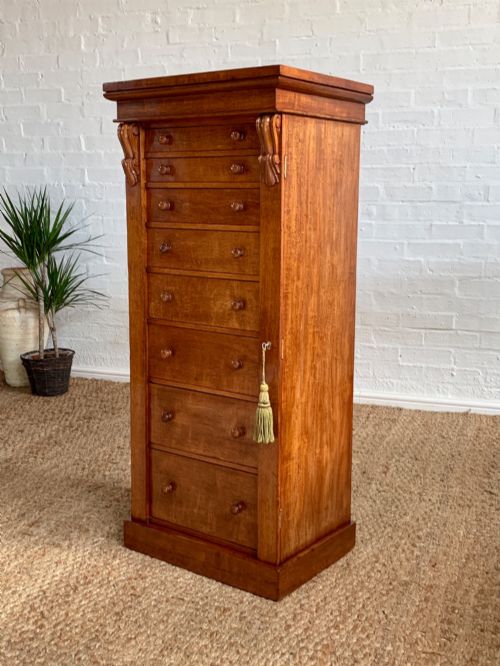
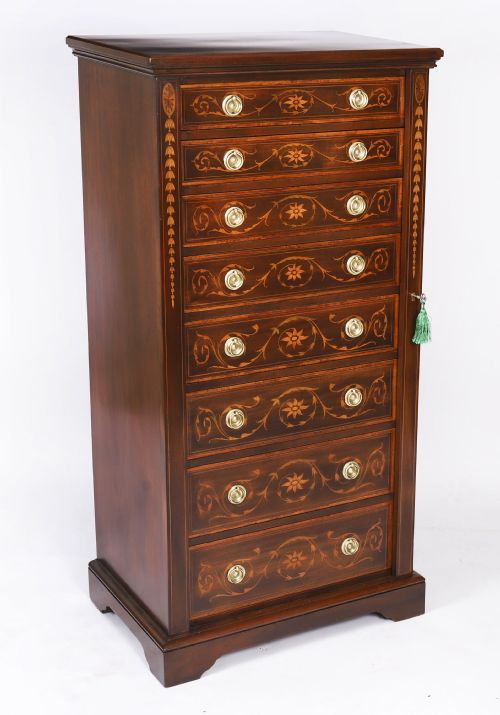
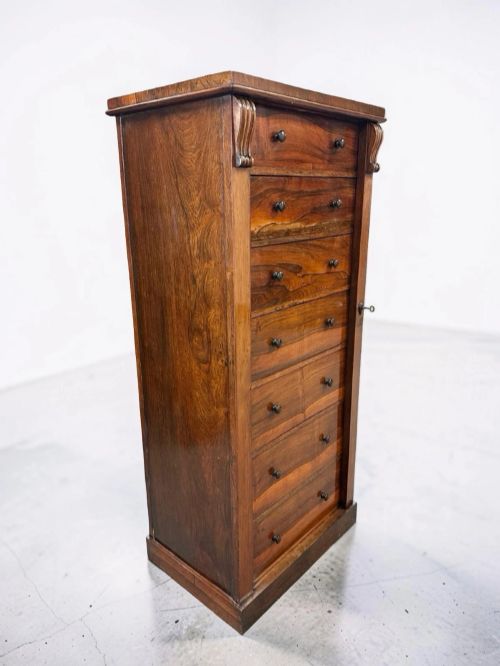
Wellington Chest of Drawers
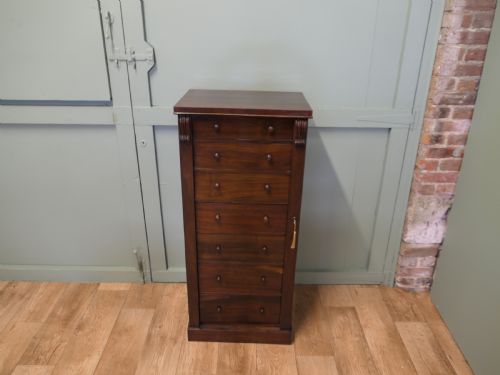
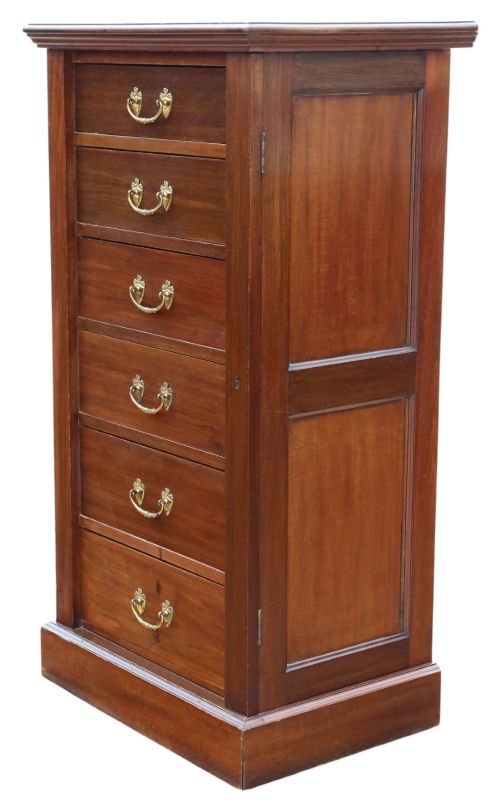
A tall, narrow chest of shallow graduated drawers with a hinged pilaster down one side that locks the whole stack with a single key, made for storing papers, coins, minerals and other small collections in a study.
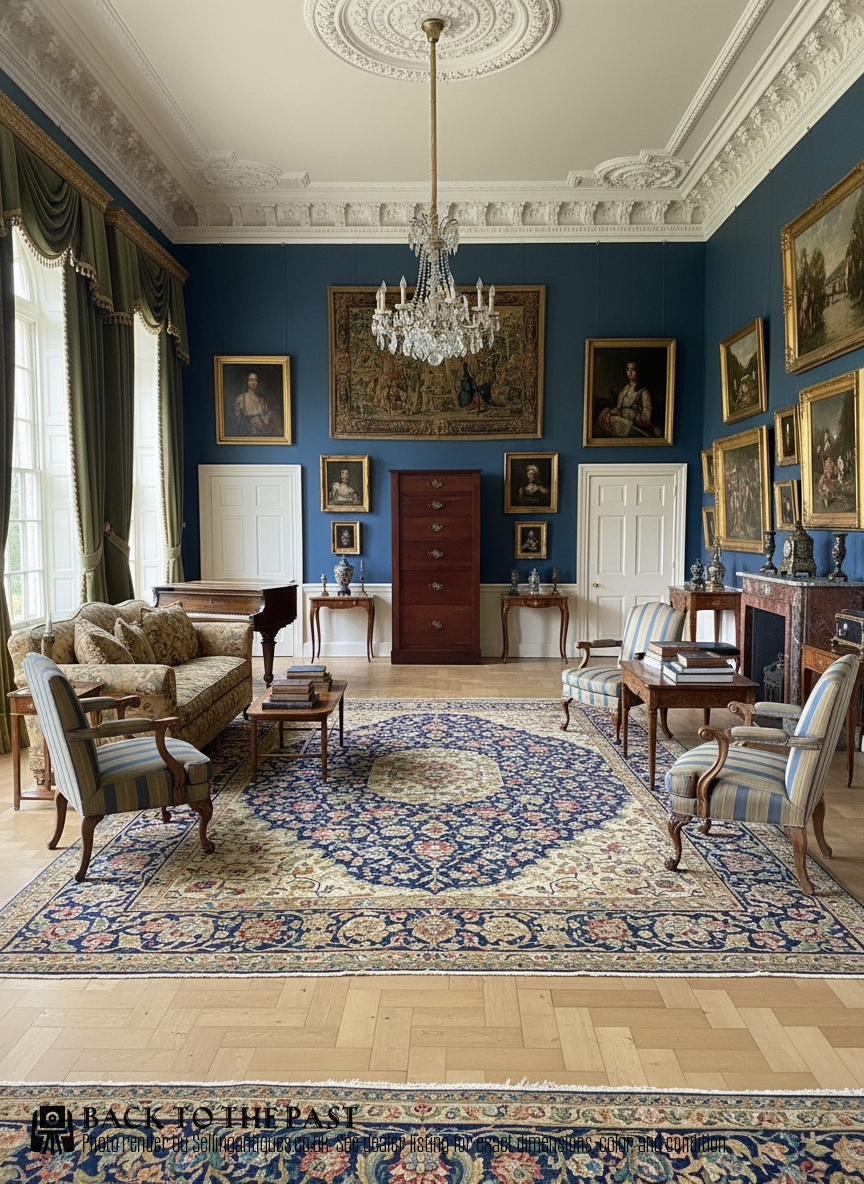
Wellington Chest of Drawers
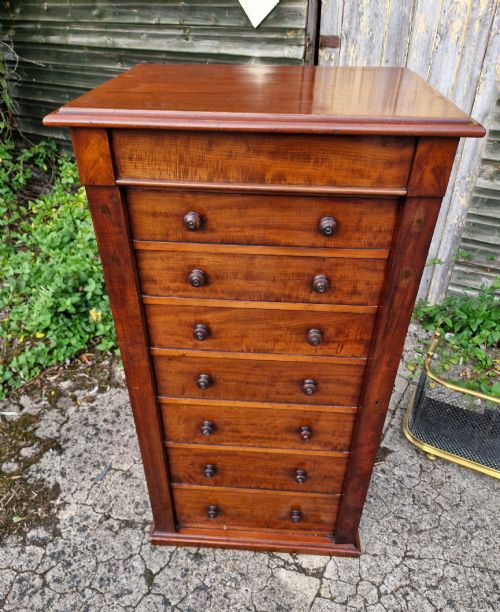
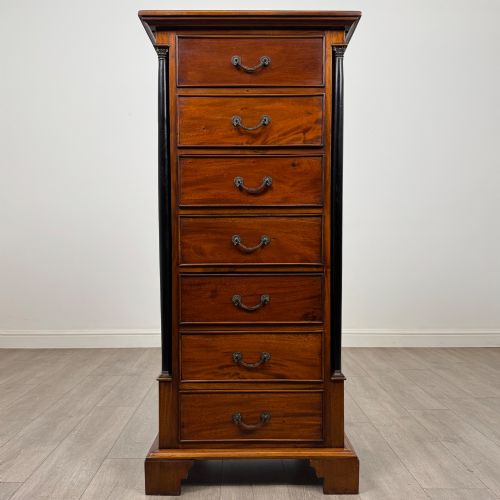
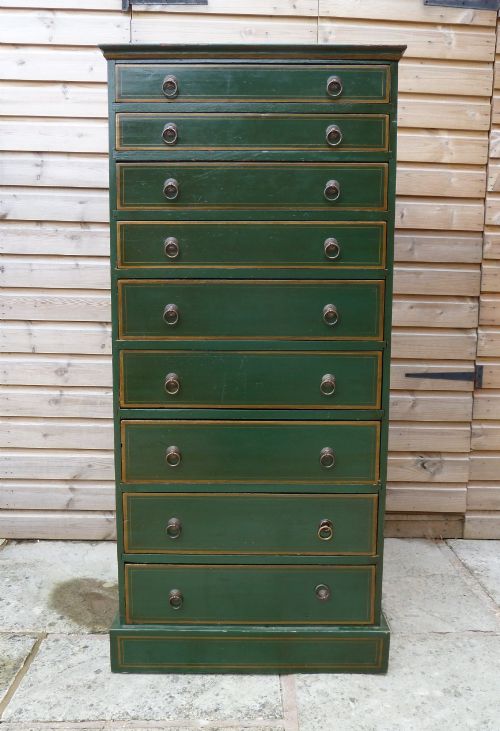
The Wellington chest is a 19th-century English form. Six, seven or eight drawers rise in a narrow column, each a little deeper than the one above, and the hinged upright at one side swings across the drawer fronts to secure them together. The name attaches to the Duke by tradition rather than any documented commission.
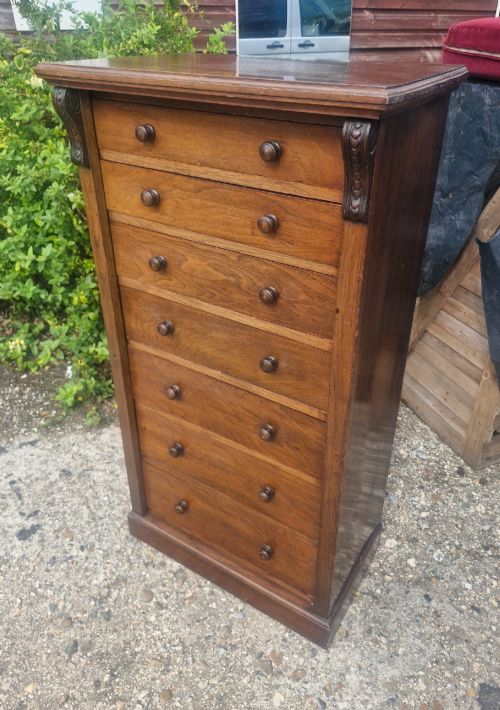
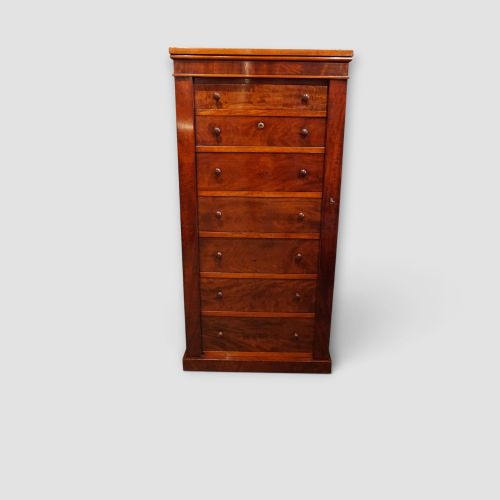
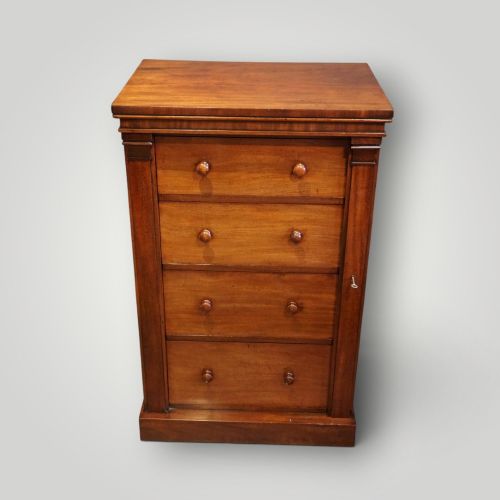
The version you're most likely to meet is a Victorian mahogany chest of seven drawers, plain-fronted, with turned knobs and nothing else by way of decoration. 'Victorian' appears in 283 of 590 titles on Sellingantiques and 'mahogany' in 223, and seven is the drawer count dealers name most often, with six and eight next behind it.
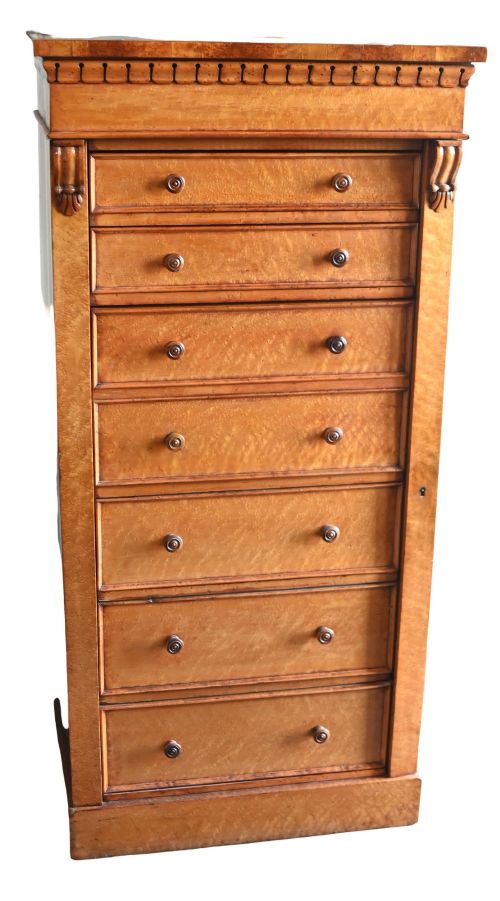
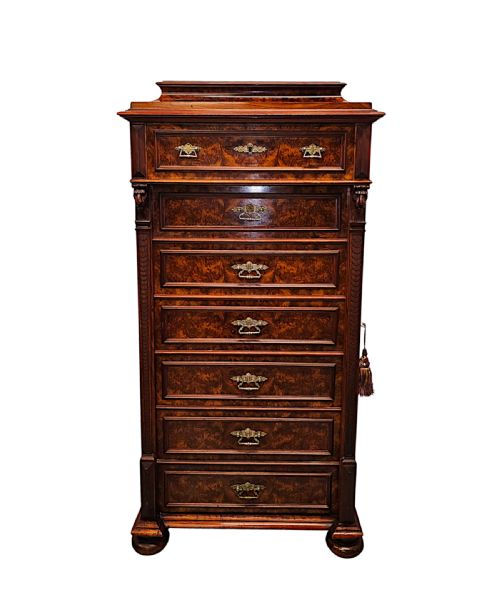
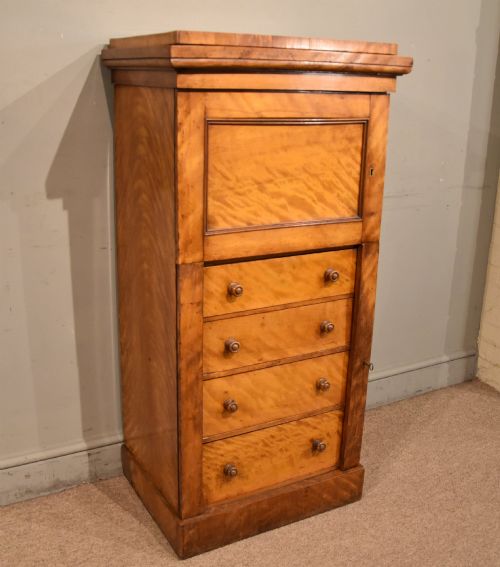
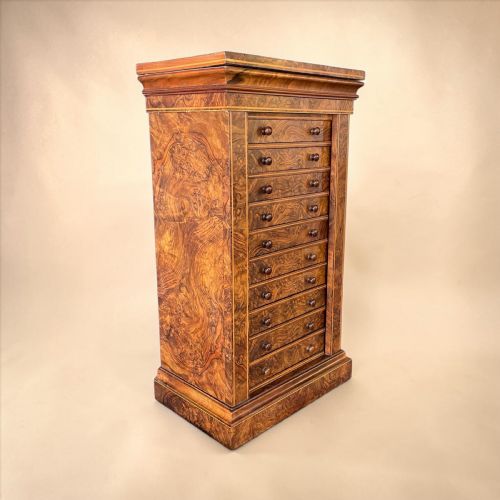
Walnut is the other main timber, often burr or figured, and oak and rosewood come along behind. Beyond that core the archive runs to satin birch, birds eye maple, pollard oak, Hungarian ash, yew, olive wood, satinwood, kingwood, pitch pine and teak. A minority carry a secretaire drawer whose front falls to make a writing surface, 45 titles in all.
Two smaller strands sit alongside the standard floor-standing chest. Miniature and table-top versions account for 21 titles, including one described as an apprentice piece and two as children's chests. Doubles, with two banks of drawers in one carcase, turn up in nine titles, and matching pairs fewer times still.
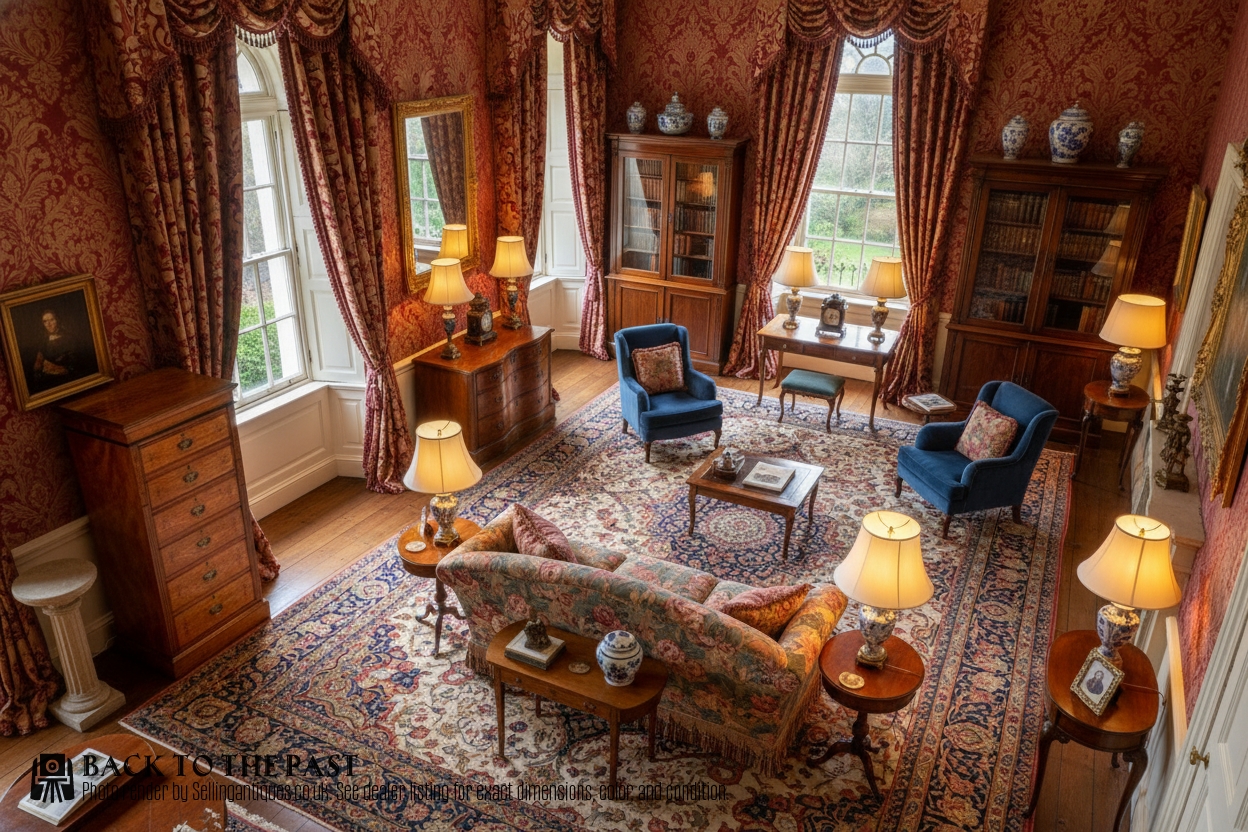
What Sets Them Apart
Timber and figure do most of the separating. The bottom of the range reads oak, pine, deal and primitive, plain-fronted with turned knobs. The top reads burr walnut, figured walnut, satinwood, birds eye maple, pollard oak and kingwood, where veneer has been chosen for the swirl and flame in the grain rather than simply covering a carcase.
A secretaire fitment lifts a chest. The fall-front drawer appears across the range but clusters heavily in the upper half, and so does decorative work of any kind: inlay, marquetry, boulle, carving, a marble top. Scale counts too, with doubles, pairs and outsized chests sitting high while small undecorated examples hold the bottom.
Then there's a name. Titles carrying a cabinetmaker's or retailer's name sit in the upper reaches, though firm names appear in single titles only across the archive, so no one workshop is typical of the form. Most chests come to market unattributed, and the majority are dated no more precisely than a reign or a century.
Wellington Chest of Drawers Retail Price Guide 2026
Typical UK retail prices for wellington chest of drawers, calculated from the Sellingantiques database of over a million retail prices indexed since 2003. This retail price guide relies exclusively on Sellingantiques data; no external sources or auction records are used, so the figures do not describe the wider market.
The double Wellington, two stacks of drawers in one carcase, turns up in only nine titles on Sellingantiques.

The Wellington Chest of Drawers Glossary
- Locking pilaster
- The hinged upright at one side that swings across the drawer fronts and secures the whole stack with one key. It's the feature that makes a chest a Wellington rather than a tall narrow chest of drawers.
- Graduated drawers
- Drawers increasing in depth toward the base. Listings write it as 'graduated' or 'graduating', and it's a standard part of the form rather than an extra.
- Secretaire
- A drawer front that falls to make a writing surface, with a fitted interior behind it. Forty-five titles carry one, in walnut and mahogany more than anything else.
- Burr walnut
- Veneer cut from a burr growth on the tree, giving a swirled, knotted figure. It runs through 48 titles and marks the smarter end of the walnut chests.
- Double Wellington
- Two banks of drawers side by side in one carcase. Nine titles use the word, and the two chests described as twelve-drawer are both double-banked.
- Pollard oak
- Timber from a pollarded tree, densely knotted in figure. It's one of the timbers that turns up when a chest was made to be looked at rather than just used.
Wellington Chest of Drawers: Frequently Asked Questions
How many drawers should a Wellington chest have?
Seven is the count dealers name most often in titles, with six and eight the next most common. That's the standard column.
The archive also holds chests described as four, five, nine, ten and twelve drawers. The twelves are both double-banked, with two stacks in one carcase.
What wood are they usually made from?
Mahogany leads, in 223 of 590 titles on Sellingantiques, followed by walnut in 131. Oak and rosewood come next.
Beyond that core the timbers run to satin birch, birds eye maple, pollard oak, ash, Hungarian ash, yew, olive wood, satinwood, kingwood, pitch pine and teak, with Gonçalo Alves appearing once.
Are Wellington chests Victorian or Georgian?
Overwhelmingly Victorian. The word appears in 283 titles, and where decades are given they concentrate on the 1860s, 1880s and 1870s.
A handful of titles claim Regency, George IV or William IV, and there's a thinner tail of Edwardian and early 20th-century chests. The dated field across the archive spans 1800 to 1930.
What is a secretaire Wellington chest?
One of the drawer fronts is hinged and falls forward to make a writing surface, with a fitted interior behind. Listings also call it a hinged fall or a locking flap.
Forty-five titles carry the feature, and they sit toward the upper end of the range. Walnut and mahogany are the timbers named most with it.
Why is it called a Wellington chest?
The name attaches to the Duke by tradition. There's no documented commission behind it.
The form itself is 19th-century English, built for secure storage of papers, coins, minerals and other small collections in a study or library.
Do miniature Wellington chests exist?
Yes, as a small steady strand. Twenty-one titles use 'miniature', and others describe table-top or dwarf chests meant to stand on furniture rather than the floor.
One is described as an apprentice piece and two as children's chests. Sixteen more titles call the form a collectors chest, and several a specimen chest.