

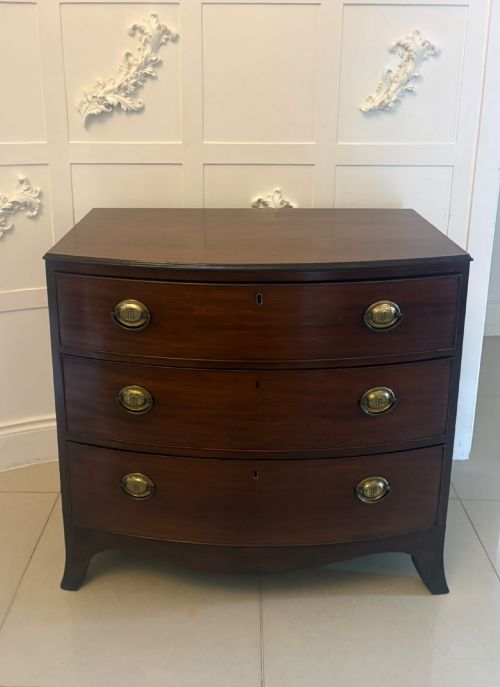
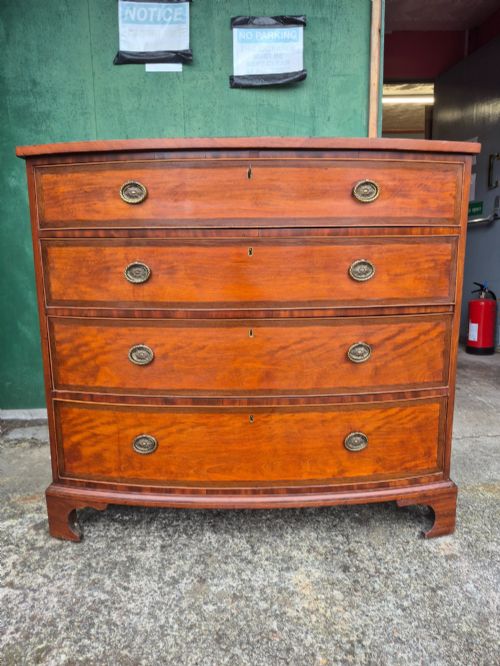
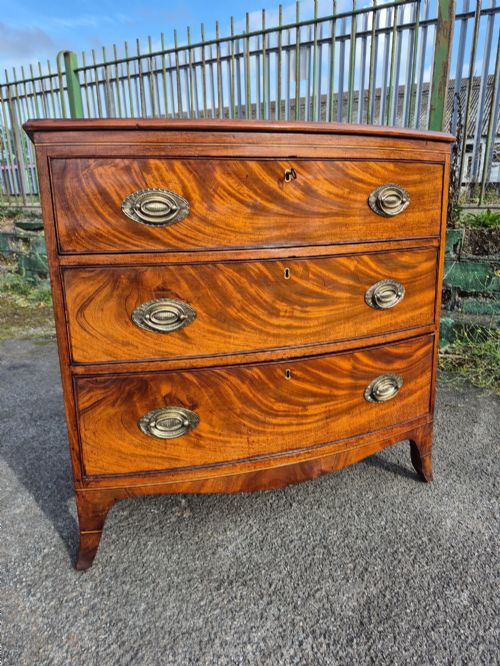
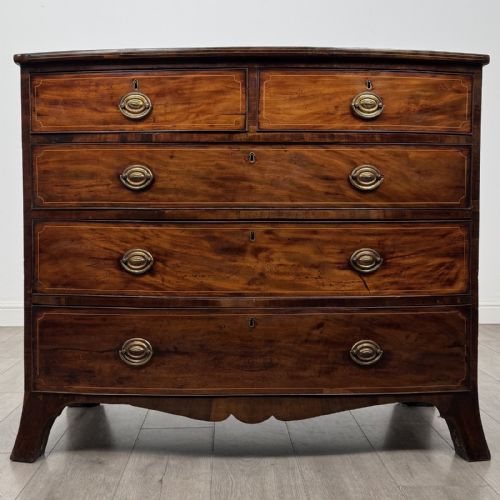
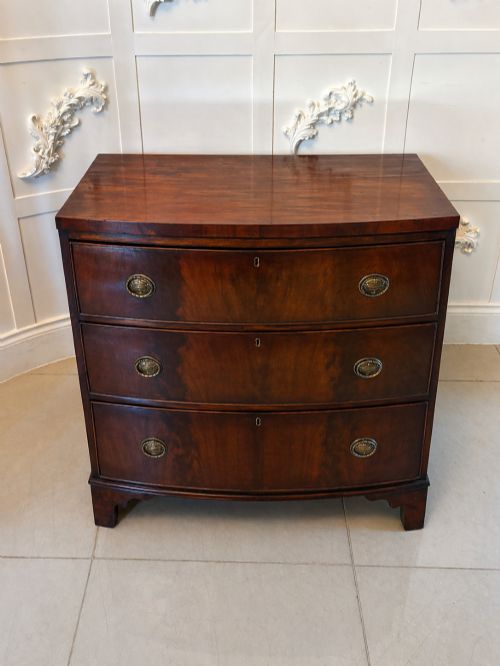
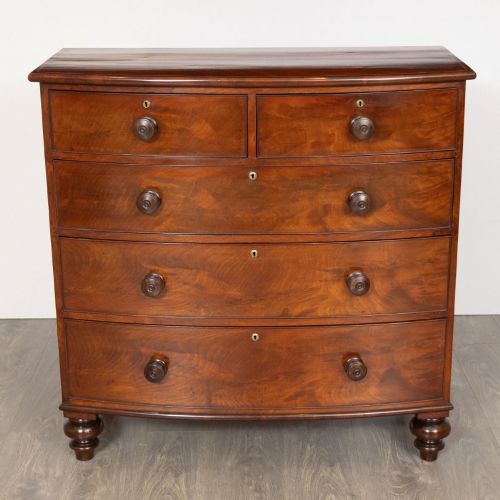
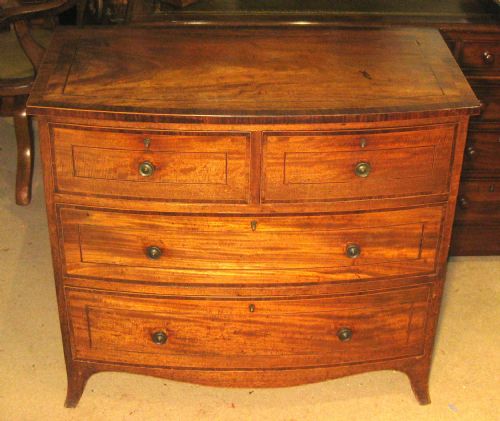
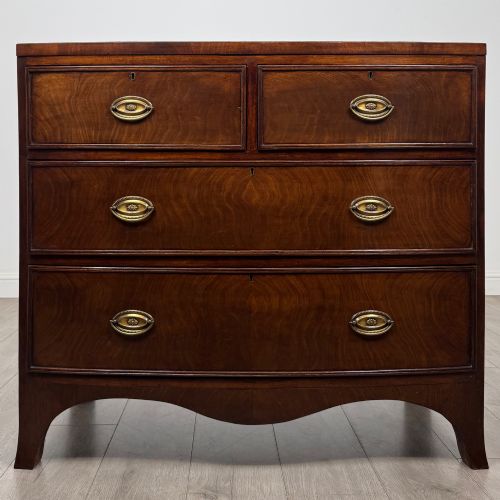
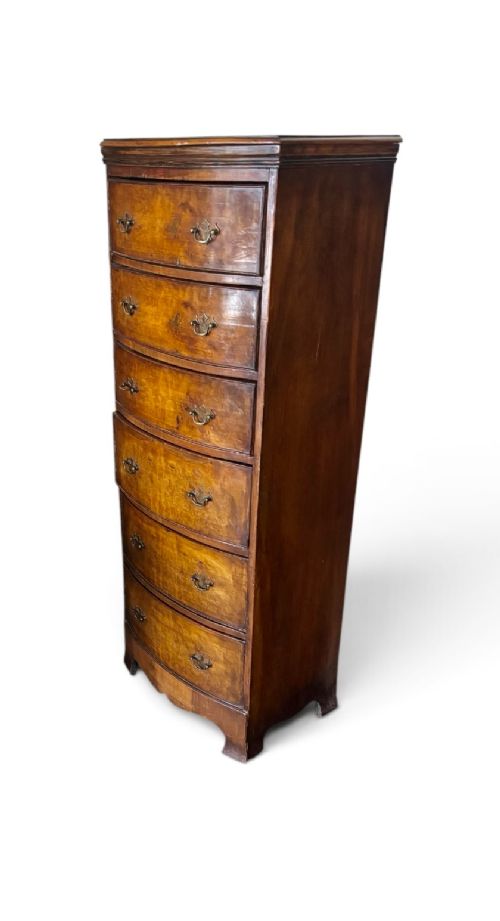
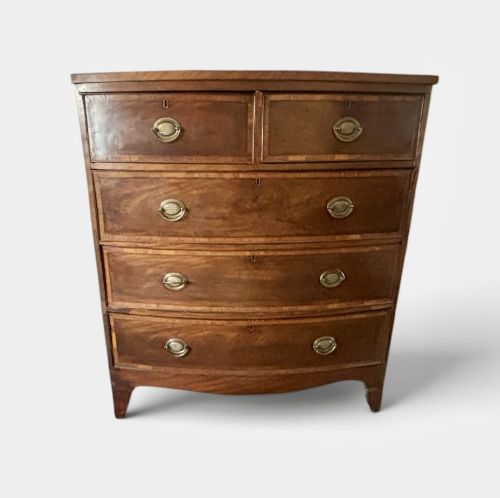
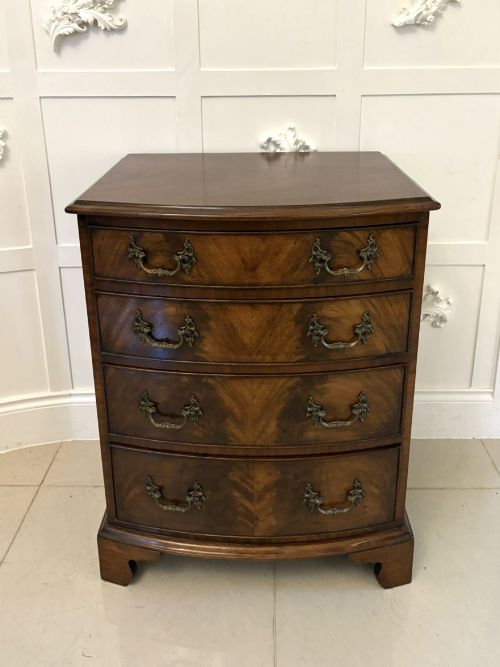
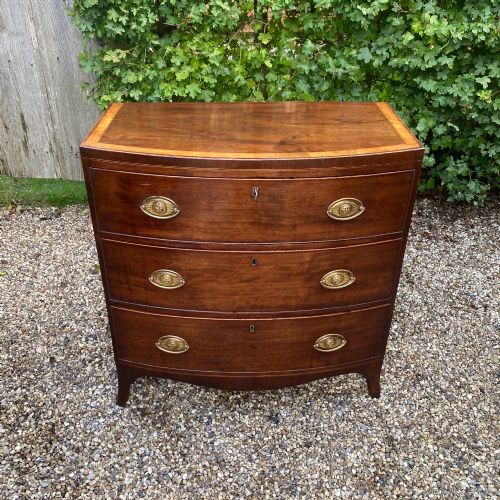
Antique Bow Front Chest of Drawers
A chest of drawers with a convex, outward-curving front, made chiefly for the bedroom and standard in English cabinet-making from the later 18th century onwards.
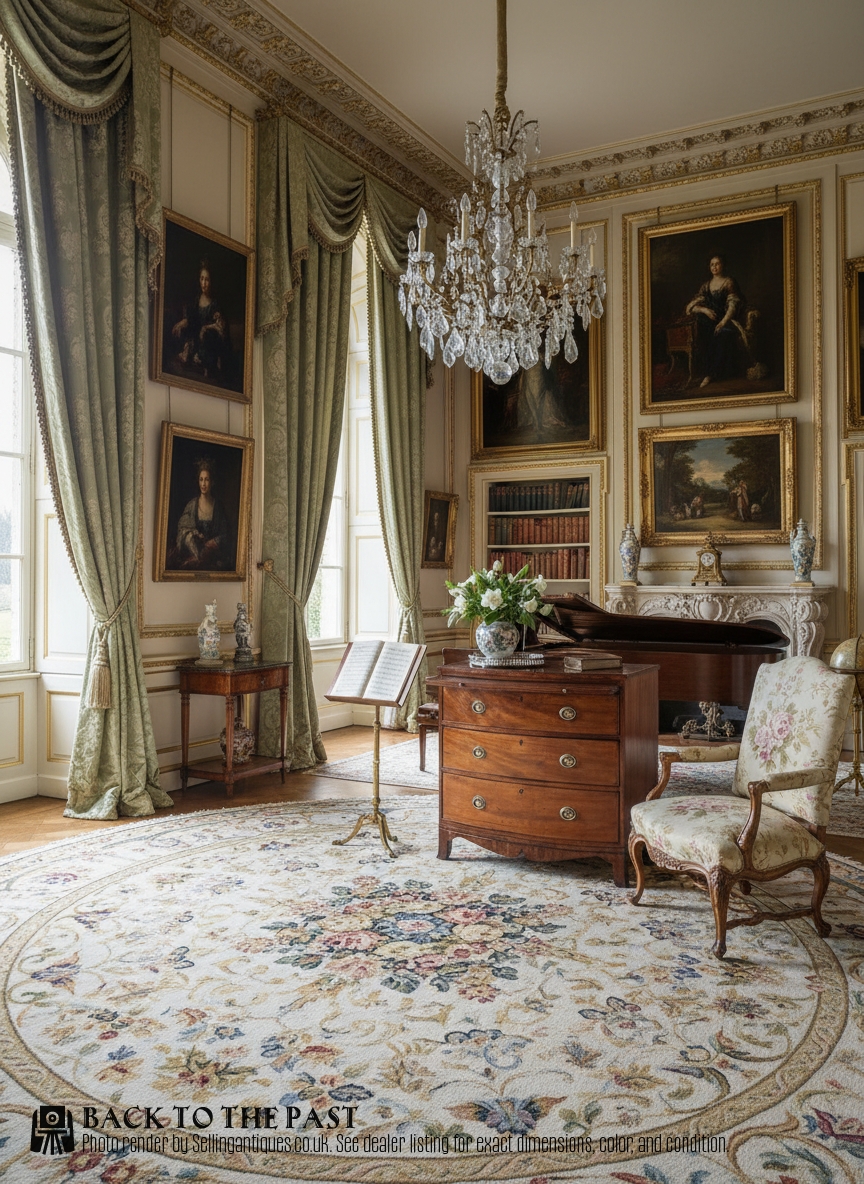
Antique Bow Front Chest of Drawers
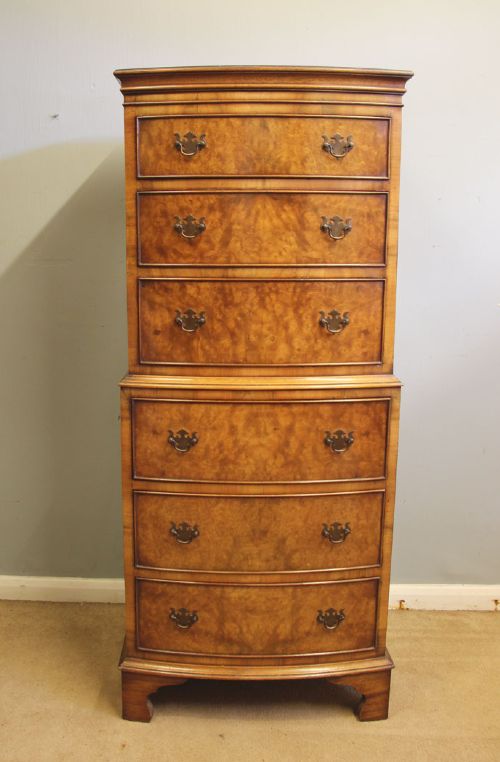
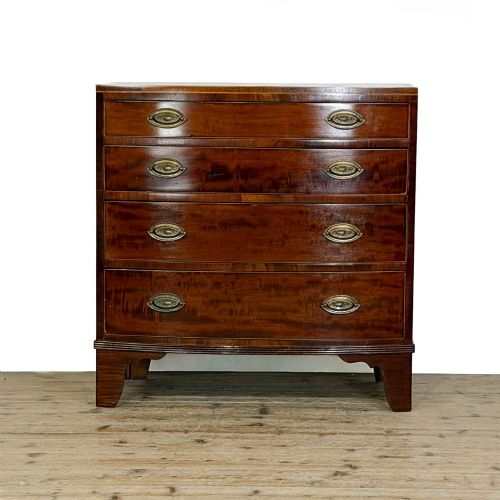
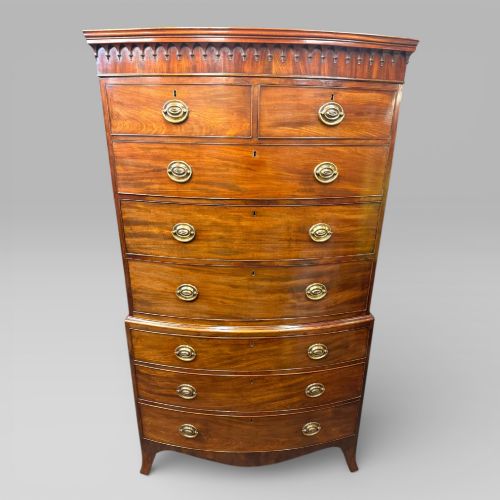
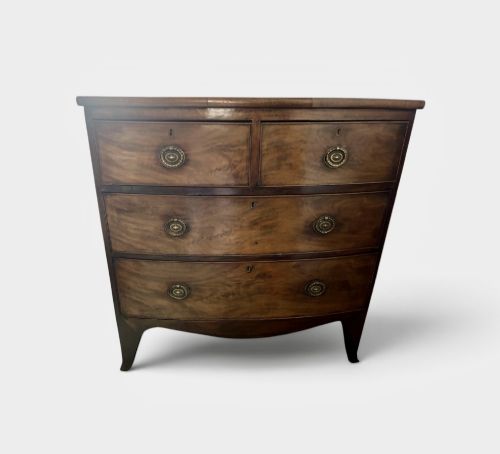
The bow front is a case of drawers whose facade curves outward across the full width, with the top and drawer fronts shaped to follow that curve. It came in during the later 18th century as a softening of the flat-fronted chest, stayed a standard bedroom form through the 19th century, and was revived in the earlier 20th.
Mahogany is close to a defining condition. Of 1,312 titles on Sellingantiques, 910 name it, so seven in ten pieces are described as mahogany before anything else is said. The usual arrangement is four or five drawers, or two short over three long, on bracket or splayed feet.
The largest group reads as Georgian or Regency: 245 titles say Regency, 220 Georgian, 105 George III. A quarter or so are Victorian and other 19th-century mahogany. Then comes a second population from the 1920s and 1930s, 153 listings between them, and that one is burr and figured walnut rather than mahogany. Edwardian mahogany, often slim or tall, makes up a smaller share, and tallboys and chest-on-chests a steady minority.
Dating is mostly by period label. Only 386 listings carry a clean year, and those run from 1750 to 1940; the rest sit under Regency, Georgian, Victorian, Edwardian, or the looser "19th Century" and "1800s". Titles also show why the 20th century is so well represented: burr walnut chests and Georgian-style reproductions.

Where The Range Splits
Timber does most of the work. Flame and figured mahogany, satinwood, and titles that name Cuban or Honduras mahogany sit toward the top; plain veneers, secondary woods and pine sit at the bottom, alongside the listings that say no more than "antique bow fronted chest of drawers". Flame appears in 51 titles, figured in 50.
Decoration follows the same line. Inlaid work is named in 53 titles, and crossbanding, satinwood banding and boxwood and ebony stringing recur in the upper half of the range, while plain veneered fronts sit lower. So does the dating language: pieces titled George III or given a circa year run above the generic "antique" and the frank "Georgian style".
Size cuts across all of it. "Small" is the commonest qualifier in the whole category, in 162 titles, and neat, well-proportioned chests are singled out at both ends of the range. Fitted features add interest where they turn up: a brushing slide is named in only 15 titles, and secret drawers and gentleman's dressing fitments in a handful more.
Antique Bow Front Chest of Drawers Retail Price Guide 2026
Typical UK retail prices for bow front chest of drawers, calculated from the Sellingantiques database of over a million retail prices indexed since 2003. This retail price guide relies exclusively on Sellingantiques data; no external sources or auction records are used, so the figures do not describe the wider market.
A brushing slide is named in only 15 titles, about one in ninety.
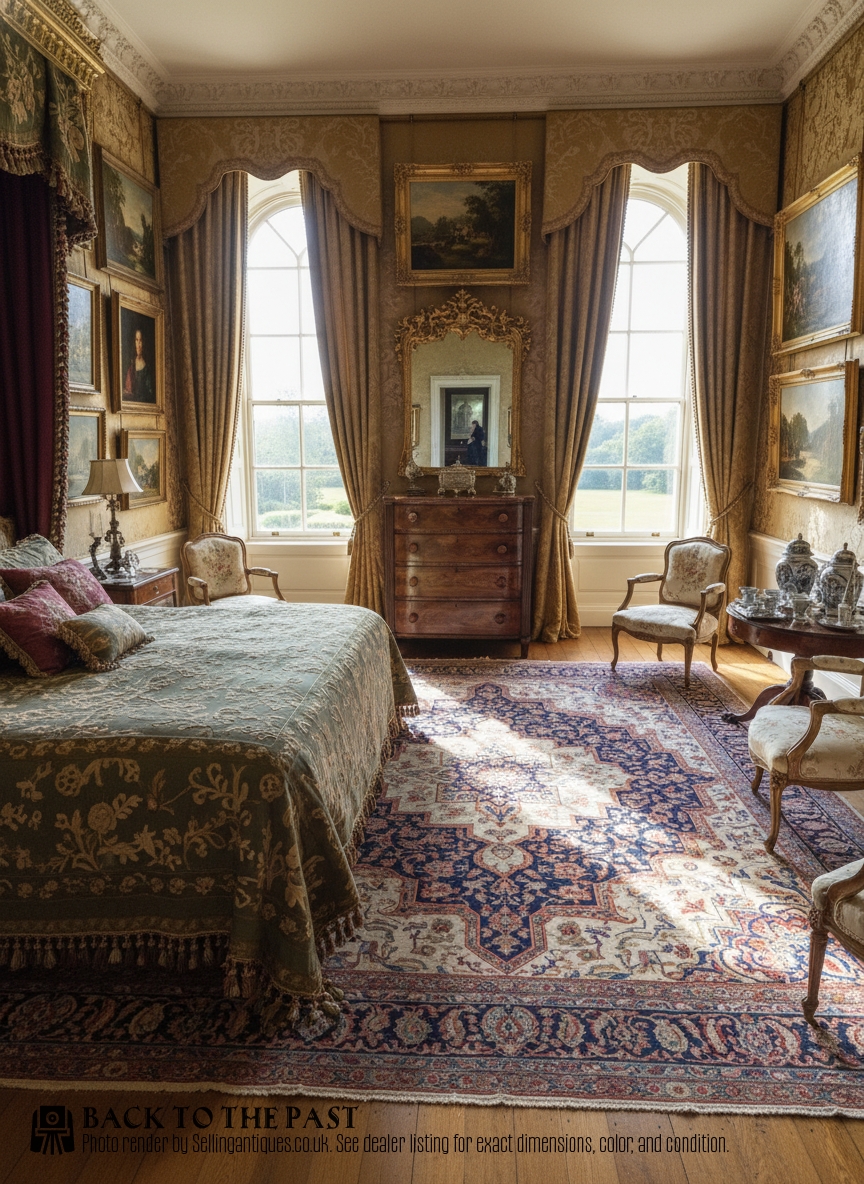
The Antique Bow Front Chest of Drawers Glossary
- Bow front / bow fronted
- The convex outward curve across the facade. "Fronted" appears in 407 titles and the two forms are used interchangeably.
- 2 over 3
- Two short drawers above three long ones, the commonest drawer layout named in titles. You will also see "4 height", "5 height" and "six height", dealer shorthand for the number of drawer tiers.
- Flame mahogany
- The plume-shaped figure of a crotch-cut veneer, named in 48 titles. Burr walnut is the swirled figure of a burr growth, in 89 titles, almost all of them pieces from 1910 to 1940.
- Crossbanded
- A border of veneer laid with the grain running across the edge of a drawer front or top, often in satinwood. Boxwood and ebony lines are the fine pale and black stringing inlaid alongside it.
- Brushing slide
- A pull-out board above the top drawer for laying out clothes, sometimes listed as a writing slide. Named in 15 titles, roughly one in ninety.
- Tallboy / chest on chest
- A two-part stacked chest, 26 titles using the first term. A bachelor's chest is a small chest, often with a fold-over top.
Antique Bow Front Chest of Drawers: Frequently Asked Questions
What wood are bow front chests usually made from?
Mahogany, in the great majority of cases. It is named in 910 of 1,312 titles on Sellingantiques, ahead of any other timber.
The main alternative is burr or figured walnut, which belongs almost entirely to the 1920s and 1930s group. Pine turns up at the plainer end, and elm, amboyna and ebonised examples surface once or twice across the whole archive.
How many drawers does a bow front chest have?
Four or five is typical where the title says. Two short drawers over three long ones is the commonest layout named outright.
Taller forms exist as chest-on-chests and tallboys, described by tier count as four, five or six height. They are a small but steady part of the category.
Are Georgian and Regency labels reliable dates?
Treat them as stylistic dating unless a circa year is given. Only 386 of the listings carry a clean year, and the rest sit under period labels.
Regency is the most frequent of those labels at 233, followed by Georgian at 225 and Victorian at 141. Where years are given they run from 1750 to 1940, with c1820, c1880 and c1920 recurring.
Why do so many date from the 1920s and 1930s?
The bow front was revived in the earlier 20th century, and 153 listings fall in those two decades.
That population is dominated by burr and figured walnut, with Georgian-style reproductions in mahogany alongside it. Titles saying "Georgian style" sit lower in the range than those naming a period.
What is a brushing slide worth looking for?
It is a pull-out board above the top drawer, used for laying out clothes, and it sometimes appears as a writing slide.
Only 15 titles name one, so it reads as a point of interest rather than a standard fitting. Secret drawers and gentleman's dressing fitments appear in a similar handful.
Do small bow front chests come up often?
Often enough that "small" is the most common adjective in the category after the wood, in 162 titles.
Neat and well-proportioned chests are singled out at both ends of the price range, which suggests the compact bedroom size is what the market asks for.