

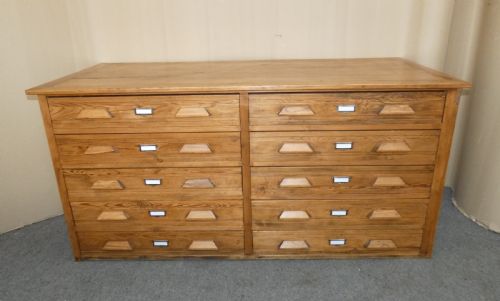


Antique Bank of Drawers
A bank of drawers is a wooden case fitted with a stack or grid of drawers, made for storing and sorting small goods at home or behind a shop counter.
Antique Bank of Drawers
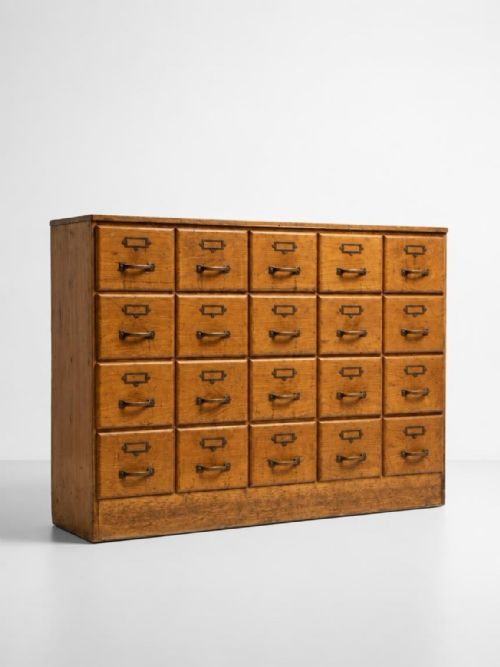
The heading covers a wide span of sizes. At one end sits a table-top nest of five or six shallow drawers; at the other, a shop or workshop fitment of twenty-four or thirty-six. What links them is the same idea: many compartments in a small footprint. Drawer counts of 4, 5, 6, 8, 9, 10, 12, 24 and 36 all turn up in titles.
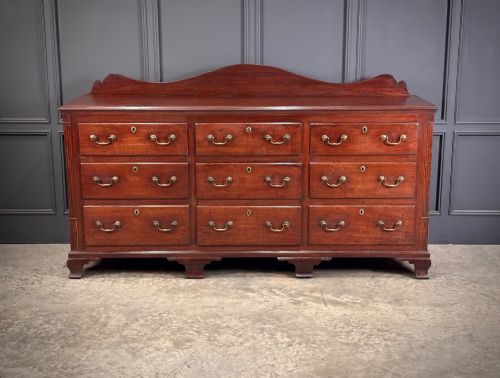
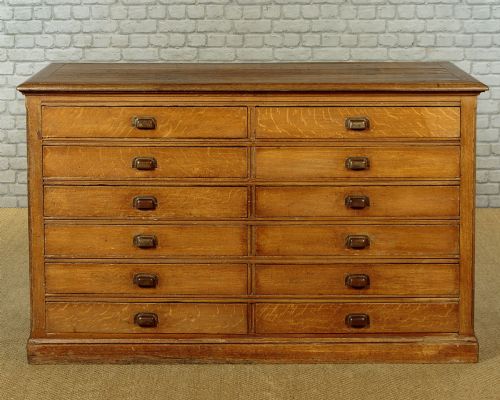
Dealers name the timber more readily than the form. Mahogany appears in 42 titles and pine in 31, with oak in 13, against 23 that use the word chest at all. The piece you are most likely to meet is a 19th-century English mahogany or pine bank, undecorated, described by wood, size and period and little else.
Roughly a sixth read as domestic chests recast as banks of drawers, often mahogany, sometimes bow fronted or laid out three over three. A substantial minority are trade fitments, and the trades get named: haberdashers, apothecary, chemist, drapers, ironmongers, gunsmiths, watchmakers, school and office. Painted and stained pine accounts for around a tenth.
Dating tends to be broad rather than precise. Forty-four listings are dated simply 19th Century, 16 Victorian and 14 Georgian, so read those as approximations. Only 58 of 145 carry a clean year, and those run from 1850 to 1930, though some titles reach back with dates of c1780, c1820 and c1830. Continental pieces are scarce: three Danish pine, three French including one Empire, plus a North Indian bank of spice drawers.
Where The Range Splits
Timber does most of the sorting. Rosewood, walnut and burr walnut, satinwood, marquetry and flame or figured mahogany sit high in the range. Plain pine and stained pine cluster at the bottom, with pitch pine named separately in a couple of titles as the denser, more resinous wood.
Scale and drawer count push the same direction. Large and tall recur near the top, each in a dozen titles; small sits at the lower end, including one at 65 cm high and the table-top collectors' banks. Banks of 9, 12, 24 and 36 drawers appear at the upper end, while four- to six-drawer chests occupy the middle.
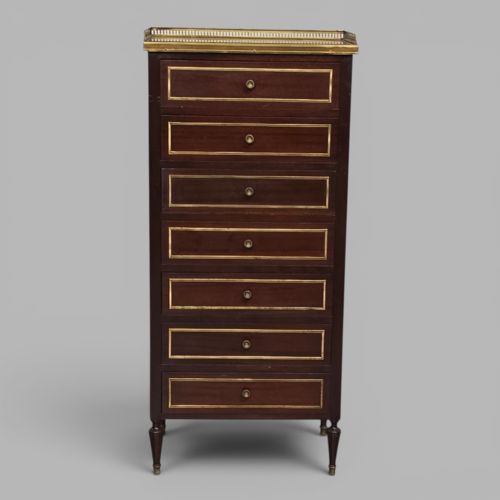
Surface and story count too. Original or period paint, including one described as Cumbrian, sits in the upper half rather than being treated as a fault, and a stated trade use lifts a piece where an unqualified bank of drawers spreads across the whole range. Marble tops appear on four examples only, and original fittings get called out: ebonized knobs, Gothic handles, Art Deco handles, a surviving key.
Antique Bank of Drawers Retail Price Guide 2026
Typical UK retail prices for bank of drawers, calculated from the Sellingantiques database of over a million retail prices indexed since 2003. This retail price guide relies exclusively on Sellingantiques data; no external sources or auction records are used, so the figures do not describe the wider market.
Among the one-offs to pass through: a bamboo and embossed leather bank of about 1900, and a North Indian bank of spice drawers.
The Antique Bank of Drawers Glossary
- Bank of drawers
- A case fitted with a stack or grid of drawers. Used on Sellingantiques for both domestic chests and shop fitments, so the phrase alone tells you little about size.
- Drawer count
- Titles usually state it outright, from four up to thirty-six. It is the quickest guide to whether a piece is a chest or a trade fitment.
- 3 over 3
- Drawer layout notation, three drawers above three. Recorded in one Georgian title, and a shorthand borrowed from the bedroom chest trade.
- Bow front
- A convex front rather than a flat one, noted on one Georgian mahogany bank of locking drawers.
- Simulated rosewood
- Pine grained in paint to imitate rosewood. One title records the practice, a cheaper wood dressed up as an expensive one.
- Base of drawers
- The drawer-fitted lower half of what was once a two-part piece, now standing alone. One painted English example uses the term.
Antique Bank of Drawers: Frequently Asked Questions
How many come up for sale each year?
Around fifteen come to market on Sellingantiques in a year, drawn from a wide pool of dealers.
Forty-nine separate dealers have listed one, so no single dealer or region defines what turns up under the heading.
What wood are they usually made from?
Mahogany leads, named in 42 titles, with pine in 31 and oak in 13. Between them they account for most of what gets listed.
Beyond those, titles name rosewood, walnut and burr walnut, satinwood and pitch pine. Marquetry appears on one piece only.
Were these made for shops or for homes?
Both. The form served domestic storage and, from the 18th and 19th centuries, shops, dispensaries and workshops that needed many small compartments without much floor space.
Trade fitments make up a substantial minority of listings, and the trade is often named in the title: haberdashers, apothecary, chemist, drapers, ironmongers, gunsmiths, watchmakers, school and office.
Are any of them signed or stamped by a maker?
No maker names come through in this category. A scan of the descriptions returned none at all, stamped, labelled or attributed.
Dealers describe these pieces by timber, size, drawer count and period instead, and that is what the titles carry.
Does painted pine sell for less than bare wood?
Not as a rule. Painted appears in eight titles, several qualified as original, period or Cumbrian paint, and those sit toward the top of the range.
Plain and stained pine is where the lower end of the range sits. The distinction is between a surface treated as original and one treated as just a finish.
What are the more unusual examples listed?
A bamboo and embossed leather bank of about 1900, a North Indian bank of spice drawers, and a pine bank grained in paint to simulate rosewood.
Non-English pieces are thin on the ground overall: three Danish pine and three French, one of them Empire.
Marble tops turn up on four examples, three of them narrow or tall.