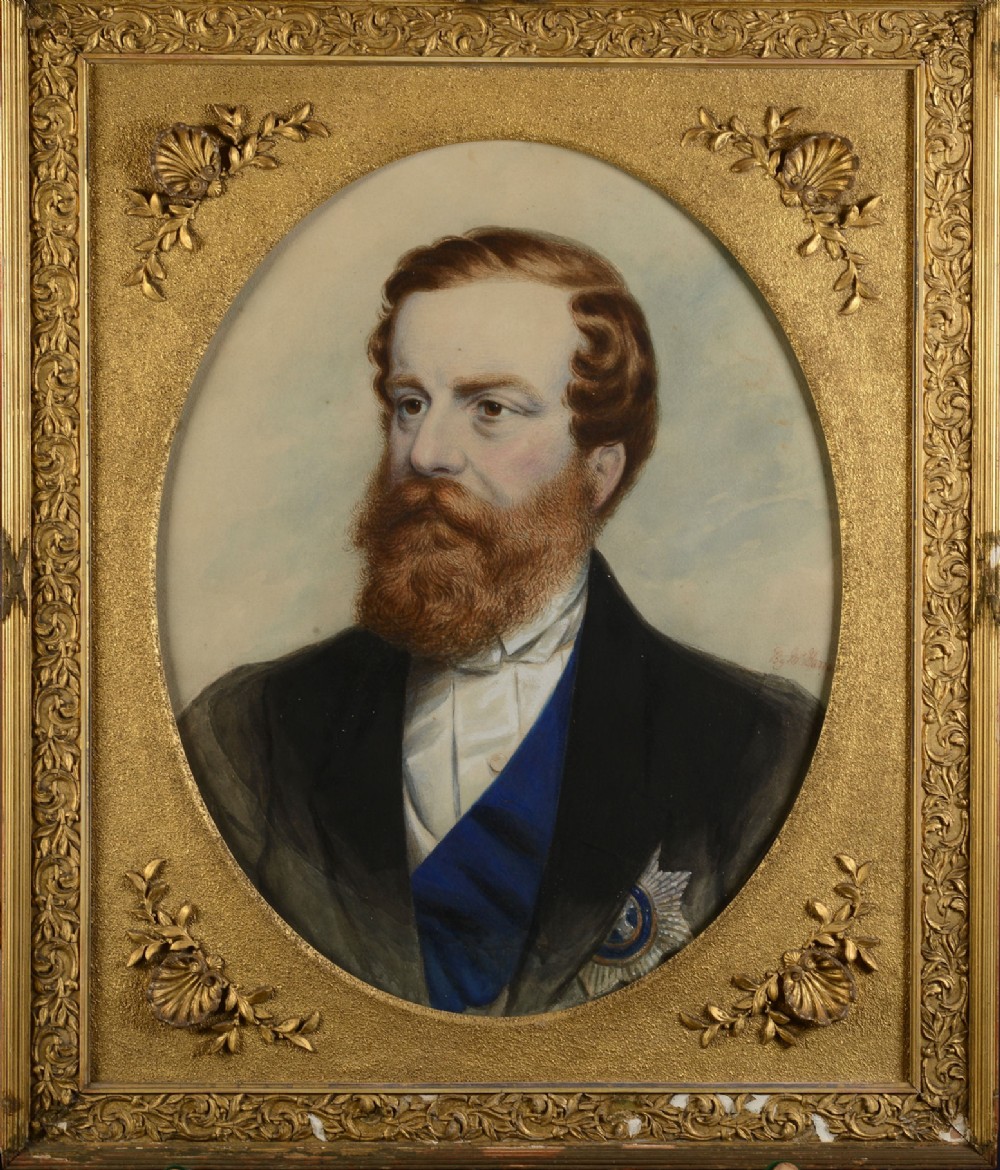
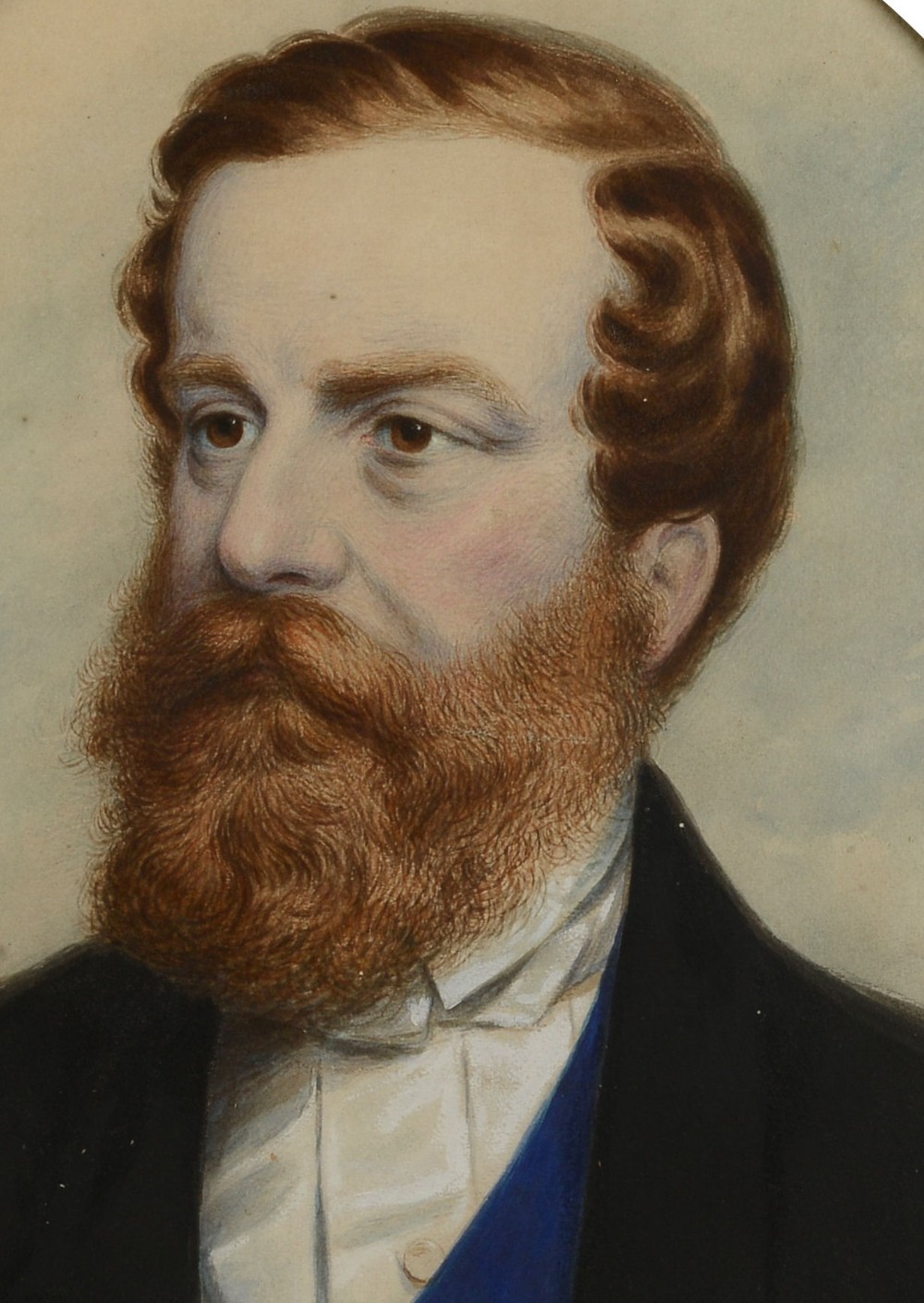
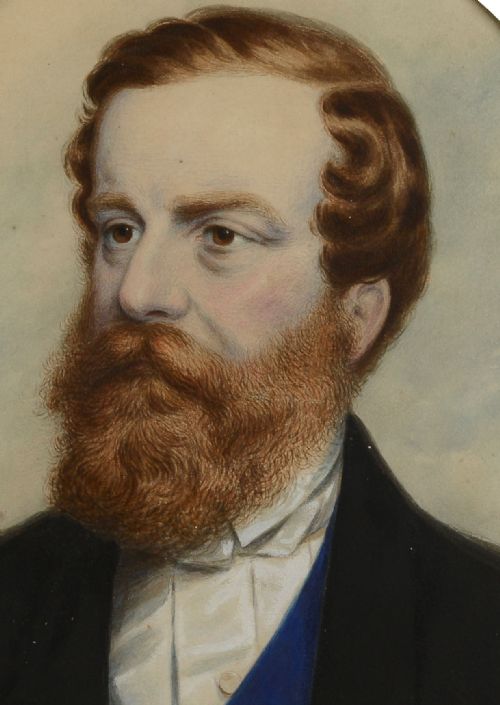
Artware Fineart has dated this Victorian Oval Portrait Miniature to the 19th Century.
Henry Pelham Fiennes Pelham-Clinton, fifth duke of Newcastle under Lyme 1811–1864
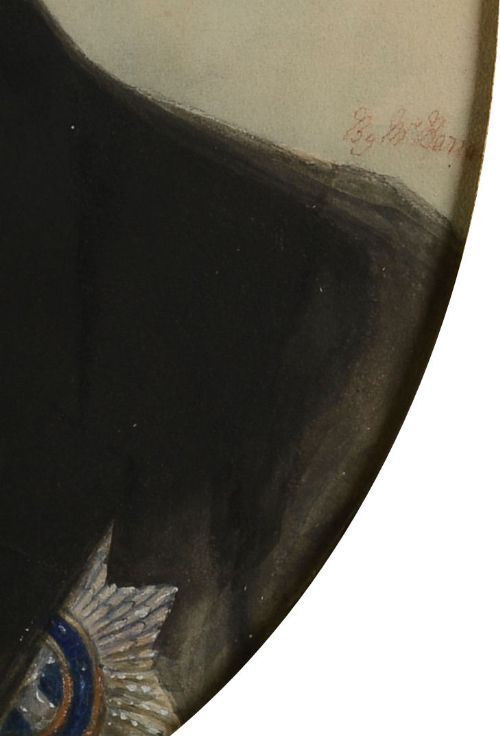
Signed/Inscribed:
middle right "By Mr Barrable"
pencil coloured chalks and watercolour
58 x 46 cm. (23 x 18 in.)
Henry Pelham Fiennes Pelham-Clinton, , fifth duke of Newcastle under Lyme (1811–1864), politician, was born on 22 May 1811 at 39 Charles Street, Berkeley Square, London, the third child but eldest son of Henry Pelham Fiennes Pelham-Clinton, fourth duke of Newcastle under Lyme (1785–1851), and his wife, Georgiana Elizabeth (1789–1822), daughter of Edward Miller Mundy of Shipley, Derbyshire.
While at Oxford he became a close friend of William Ewart Gladstone; both belonged to the Union Debating Society, each serving as president, and both were members of the Essay Club, founded as an Oxford equivalent to the Cambridge Apostles. He also shared Gladstone's high-church Anglicanism.
Both Lincoln and Gladstone entered parliament as Conservatives in December 1832 through the influence of the fourth duke of Newcastle, the former, without a contest, for South Nottinghamshire and the latter for Newark. On 27 November 1832, shortly before his election, Lincoln married Susan Harriet Catherine (1814–1889), daughter of Alexander Douglas-Hamilton, tenth duke of Hamilton, granddaughter of William Beckford, and sister of William Douglas-Hamilton, later the eleventh duke, an Eton and Oxford friend of Lincoln. He served as a lord of the Treasury from 31 December 1834 to 20 April 1835 in Sir Robert Peel's first ministry. It was at this time that a lasting bond of friendship was established between Peel and his young subordinate colleagues, whom he had introduced to official life.
Lincoln became first commissioner of woods and forests on 15 April 1841 when Peel formed his second administration. As commissioner he performed a myriad of tasks, including providing more public accessibility to royal buildings and parks; enacting the major recommendations of the metropolitan improvements commission, over which he served as chairman; enlarging Buckingham Palace; and superintending the work of the British Geological Survey. Following Gladstone's resignation over the Maynooth College grant early in 1845, Peel appointed Lincoln to the cabinet; and on 14 February 1846 he was made chief secretary for Ireland in Peel's reconstituted administration. The potato famine had become catastrophic by the time he arrived in Ireland. Despite opposition to large-scale state assistance from Treasury officials, especially Charles Edward Trevelyan, he helped to set in motion famine relief measures that included a programme of public works to create employment to enable the Irish people to purchase imported grain. He also became a principal proponent for larger measures to stimulate economic growth and reconstruct Irish society. Although modest, the famine relief measures prevented exceptional suffering during the first half of 1846; but his tenure as chief secretary ended when the Peel ministry resigned in June 1846.
By the time of his appointment as chief secretary Lincoln had modified his earlier protectionist views and was in complete agreement with Peel over the necessity of repealing the corn laws. Peel acknowledged the support he received from Lincoln during the contest over corn law repeal, and the obloquy and sacrifice which this had involved. He suffered his father's wrath for supporting repeal, having already angered him by his support for the Maynooth grant. When he had to seek re-election for his South Nottinghamshire seat on accepting the Irish chief secretaryship, he was defeated by a protectionist candidate backed by his father. His father-in
Artware Fineart has dated this Victorian Oval Portrait Miniature to the 19th Century.
You can view the stock and full dealer information on the Artware Fineart Profile Page

George Hamilton Barrable, Fl 1873 - 1887 Henry Pelham Fiennes Pelham-clinton, Fifth Duke of Newcastle Under Lyme 1811–1864