16,374  PAGES BROWSED TODAY PAGES TODAY 36  ANTIQUES UPLOADED TODAY NEW ARRIVALS
ID #SA575399
FOR SALE
£3,000
Email
Save
Sir William John Newton, 1785-1869 Portrait of Field Marshal Sir Samuel Hulse, Gch, (1746-1837)
Artware Fineart
for sale €3,510     $3,810
£3,000

Artware Fineart

Sellingantiques Verified Since Sep 2008
View Dealers Stock Page
Id #SA575399
PDF SHARE
SAVE

Sir William John Newton, 1785-1869 Portrait of Field Marshal Sir Samuel Hulse, Gch, (1746-1837)

19th century
For Sale by Artware Fineart
Description

Sir William John Newton, 1785-1869

Portrait of Field Marshal Sir Samuel Hulse, GCH, (1746-1837)

Field Marshal Sir Samuel Hulse

18 x 15.5 cm. (7 x 6 in.)

Sir Samuel Hulse (1747/8–1837), army officer and court official, was the second son of Sir Edward Hulse, second baronet (d. 1800), and his wife, Hannah, the daughter of Samuel Vanderplank, a merchant, and the grandson of the physician Sir Edward Hulse. He entered the army in the 1st foot guards as ensign on 17 December 1761. As captain and lieutenant-colonel he was present with his battalion during the Gordon riots in 1780. In 1793, as brevet-colonel and regimental first major, he commanded the 1st battalion of his regiment with the duke of York at the siege of Valenciennes, in the brilliant affair under Major-General Gerard Lake at Lincelles, and during the operations before Dunkirk, until October, when he returned home on promotion. After returning to Flanders as major-general in May 1794, he commanded a brigade in some minor affairs near Tournai and in the retreat to Bremen. Early in 1795 he was appointed to the home staff, and commanded at Brighton for three years.
In 1798 Hulse became lieutenant-general and was dispatched to Ireland with reinforcements, including a brigade of guards. He returned to his command at Brighton in November of that year, served under the duke of York in the expedition to The Helder in 1799, and afterwards succeeded Lord Grey in command of the south-eastern district. He became a full general in 1803, and was appointed lieutenant-governor of Chelsea Hospital in 1806 and governor in 1820. One of the first to be appointed by George III to the suite of the young prince of Wales (afterwards George IV), he was for many years the prince's treasurer and receiver-general. At the prince's coronation as George IV, Hulse, one of the two eldest generals, was created field marshal. He became treasurer of George IV's household, and was vice-chamberlain from 1827 until the king's death three years later. Hulse was a GCH and a privy councillor and colonel successively of the 56th, 19th, and 62nd foot. He died at his residence in Chelsea Hospital on 1 January 1837, aged eighty-nine, and was buried in the family vault at Erith, Kent. He was survived by his widow, Charlotte, who died on 5 February 1842.
H. M. Chichester, revised by Philip Carter Oxford DNB

Artist Biography

Sir William John Newton (1785–1869) was an English miniature-painter, in fashion in the early part of the 19th century.

Born in London, he was the son of James Newton the engraver, and nephew of Willam Newton (1735–1790) the architect. He began his career as an engraver, and executed a few plates, including a portrait of Joseph Richardson, M.P., after Martin Archer Shee. Concentrating then on miniature-painting, he became one of the most fashionable artists of his day, and for many years his only real rival was Sir William Ross. In 1831 he was appointed miniature-painter in ordinary to William IV and Queen Adelaide, and from 1837 to 1858 held the same post under Queen Victoria. He was knighted in 1837.

Though popular, Newton was never elected to the Royal Academy. He long resided in Argyll Street, London; after his retirement he moved to 6 Cambridge Terrace, Hyde Park, where he died 22 January 1869.

Scottish Child and Dog (1839) by William John Newton

Newton was a constant contributor to Royal Academy exhibitions, from 1808 to 1863. He found a method for joining several pieces of ivory to form a large surface, and was then able to paint some larger groups. Three of these were: The Coronation of the Queen, 1838; The Marriage of the Queen, 1840; and The Christening of the Prince of Wales, 1842.

Many of Newton's portraits were engraved, including those of Stephen Lushington, Joanna Baillie, Sir Herbert Taylor, Joseph Hume, Lady Byron, Mary Ann Paton, and Lady Soph

Physical Dimensions
Height
18cm (7.09")
Width
16cm (6.30")
Depth
0.5cm (0.20")
Declaration

Artware Fineart has dated this Regency Portrait Miniature Painting to the 19th Century.

Reference Numbers
Sellingantiques Reference
SA575399
Dealers Internal Reference
4012
Description
Sir William John Newton, 1785-1869

Portrait of Field Marshal Sir Samuel Hulse, GCH, (1746-1837)

Field Marshal Sir Samuel Hulse

18 x 15.5 cm. (7 x 6 in.)

Sir Samuel Hulse (1747/8–1837), army officer and court official, was the second son of Sir Edward Hulse, second baronet (d.
Artware Fineart

1800), and his wife, Hannah, the daughter of Samuel Vanderplank, a merchant, and the grandson of the physician Sir Edward Hulse. He entered the army in the 1st foot guards as ensign on 17 December 1761. As captain and lieutenant-colonel he was present with his battalion during the Gordon riots in 1780. In 1793, as brevet-colonel and regimental first major, he commanded the 1st battalion of his regiment with the duke of York at the siege of Valenciennes, in the brilliant affair under Major-General Gerard Lake at Lincelles, and during the operations before Dunkirk, until October, when he returned home on promotion. After returning to Flanders as major-general in May 1794, he commanded a brigade in some minor affairs near Tournai and in the retreat to Bremen. Early in 1795 he was appointed to the home staff, and commanded at Brighton for three years.

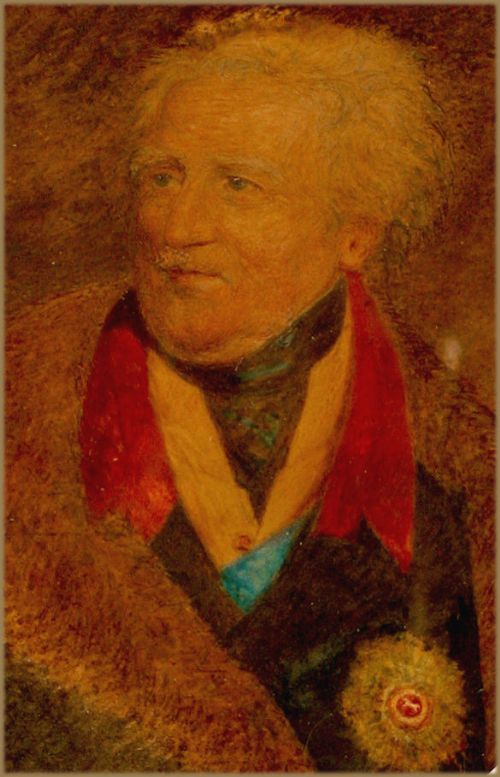
fig 1. An oval Regency portrait miniature depicting an elderly man with white hair, a fur collar, and a military star medal against a dark brown background.
fig 1. Sir William John Newton, 1785-1869 Portrait of Field Marshal Sir Samuel Hulse, Gch, (1746-1837)

In 1798 Hulse became lieutenant-general and was dispatched to Ireland with reinforcements, including a brigade of guards. He returned to his command at Brighton in November of that year, served under the duke of York in the expedition to The Helder in 1799, and afterwards succeeded Lord Grey in command of the south-eastern district. He became a full general in 1803, and was appointed lieutenant-governor of Chelsea Hospital in 1806 and governor in 1820. One of the first to be appointed by George III to the suite of the young prince of Wales (afterwards George IV), he was for many years the prince's treasurer and receiver-general. At the prince's coronation as George IV, Hulse, one of the two eldest generals, was created field marshal. He became treasurer of George IV's household, and was vice-chamberlain from 1827 until the king's death three years later. Hulse was a GCH and a privy councillor and colonel successively of the 56th, 19th, and 62nd foot. He died at his residence in Chelsea Hospital on 1 January 1837, aged eighty-nine, and was buried in the family vault at Erith, Kent. He was survived by his widow, Charlotte, who died on 5 February 1842.

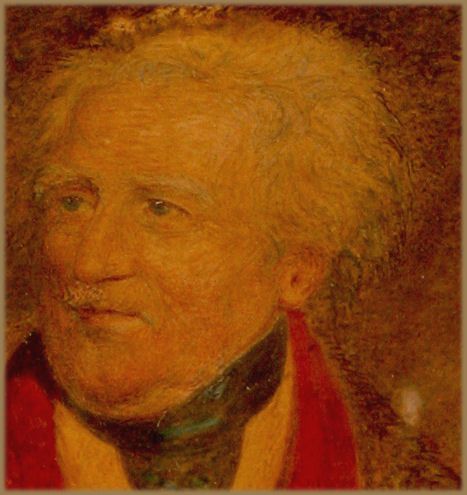
fig 2. An oval Regency portrait miniature depicting an elderly man with white hair, a fur collar, and a military star medal against a dark brown background.
fig 2. Sir William John Newton, 1785-1869 Portrait of Field Marshal Sir Samuel Hulse, Gch, (1746-1837)

H. M. Chichester, revised by Philip Carter Oxford DNB

Artist Biography

Sir William John Newton (1785–1869) was an English miniature-painter, in fashion in the early part of the 19th century.

Born in London, he was the son of James Newton the engraver, and nephew of Willam Newton (1735–1790) the architect. He began his career as an engraver, and executed a few plates, including a portrait of Joseph Richardson, M.P., after Martin Archer Shee. Concentrating then on miniature-painting, he became one of the most fashionable artists of his day, and for many years his only real rival was Sir William Ross. In 1831 he was appointed miniature-painter in ordinary to William IV and Queen Adelaide, and from 1837 to 1858 held the same post under Queen Victoria. He was knighted in 1837.

Though popular, Newton was never elected to the Royal Academy. He long resided in Argyll Street, London; after his retirement he moved to 6 Cambridge Terrace, Hyde Park, where he died 22 January 1869.

Scottish Child and Dog (1839) by William John Newton

Newton was a constant contributor to Royal Academy exhibitions, from 1808 to 1863. He found a method for joining several pieces of ivory to form a large surface, and was then able to paint some larger groups. Three of these were: The Coronation of the Queen, 1838; The Marriage of the Queen, 1840; and The Christening of the Prince of Wales, 1842.

Many of Newton's portraits were engraved, including those of Stephen Lushington, Joanna Baillie, Sir Herbert Taylor, Joseph Hume, Lady Byron, Mary Ann Paton, and Lady Soph

Height
18cm (7.09")
Width
16cm (6.30")
Depth
0.5cm (0.20")
Date of Manufacture

Artware Fineart has dated this Regency Portrait Miniature Painting to the 19th Century.

Reference Numbers
Sellingantiques Ref
SA575399
Dealers Internal Ref
4012
Artware Fineart
Sellingantiques verified Since Sep 2008
Dealer Profile

You can view the stock and full dealer information on the Artware Fineart Profile Page

PDF SHARE
SAVE
An oval Regency portrait miniature depicting an elderly man with white hair, a fur collar, and a military star medal against a dark brown background.
1 / 3
Archive I An oval Regency portrait miniature depicting an elderly man with white hair, a fur collar, and a military star medal against a dark brown background.

Sir William John Newton, 1785-1869 Portrait of Field Marshal Sir Samuel Hulse, Gch, (1746-1837)

Archive II An oval Regency portrait miniature depicting an elderly man with white hair, a fur collar, and a military star medal against a dark brown background. View II
Archive III An oval Regency portrait miniature depicting an elderly man with white hair, a fur collar, and a military star medal against a dark brown background. View III
Enlarged Archival View
Telephone 07958 699 645
Location
18 La Gare
51 Surrey Row
London
SE1 0BZ
United Kingdom
Verified Since Sep 2008
Items For Sale 243
Items Sold 223
Artware Fineart
Verified Since Sep 2008
View Dealer Info
Location: 18 La Gare , 51 Surrey Row , London , SE1 0BZ , United Kingdom
Verified
Sep 2008
For Sale
243
Sold
223
An oval Regency portrait miniature depicting an elderly man with white hair, a fur collar, and a military star medal against a dark brown background.
Sir William John Newton, 1785-1869 Portrait of Field Marshal Sir Samuel Hulse, GCH, (1746-1837)
Ref: SA575399
An oval Regency portrait miniature depicting an elderly man with white hair, a fur collar, and a military star medal against a dark brown background.
Detail View 1
Detail View 2
Archival Detail
Every single antique dealer on our platform is individually approved by our internal team. We verify their professional trade history, ethical standards, and photographic quality to ensure a secure, high-standard buying environment. Upon joining, every dealer agrees to a strict 9-point code of conduct. While issues can occasionally arise, our dealers typically resolve them swiftly and directly with the buyer. In fact, since our founding in 2002, Sellingantiques has only had to step in to help resolve an issue on roughly five occasions—a true testament to the quality of our dealers and their dedication to your happiness.
Our dealers are highly experienced in packing and shipping fragile, high-value antiques. Because you are in direct contact with the dealer, you will be able to easily go through all available shipping and insurance options together to ensure your item arrives safely.
Antiques are the ultimate green purchase. By choosing historical pieces over newly manufactured goods, you completely eliminate the carbon footprint of modern mass production while preserving exceptional, timeless craftsmanship.

Portrait miniatures in the Regency era were small-scale, detailed likenesses, typically executed in watercolour, created as personal keepsakes or tokens of status prior to the invention of photography.

Nineteenth-century portrait miniatures were standardly painted using watercolour or gouache applied with precise technique onto thin wafers of ivory, vellum, or prepared card stock.

Authentic miniatures show hand-painted stippling or hatching under magnification, age-appropriate glass and casing, period backing paper, and documented provenance or artist signatures.

These small artworks are best styled as part of a framed gallery wall layout, rested on a mantlepiece stand, or displayed on a library bookshelf alongside historical volumes.

Keep watercolour miniatures out of direct daylight to prevent fading, maintain stable relative humidity to protect organic substrates, and keep the protective glass sealed against dust.
items
Add keywords to the filter
Price
£100
£250000
Era
Movements
Material
Origin
Stock Location
Freshness
Online Payments
Categories