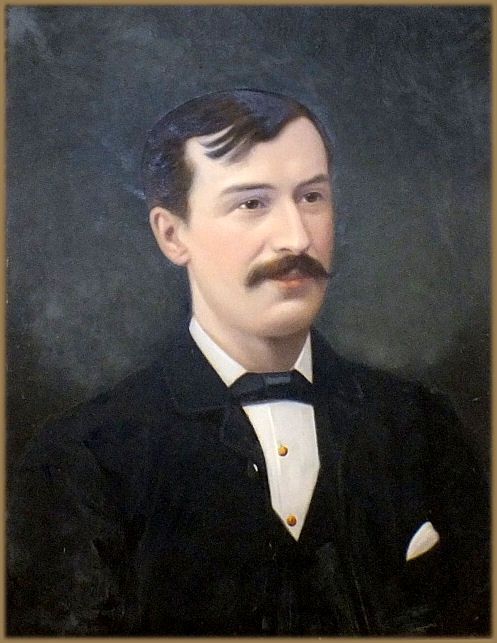
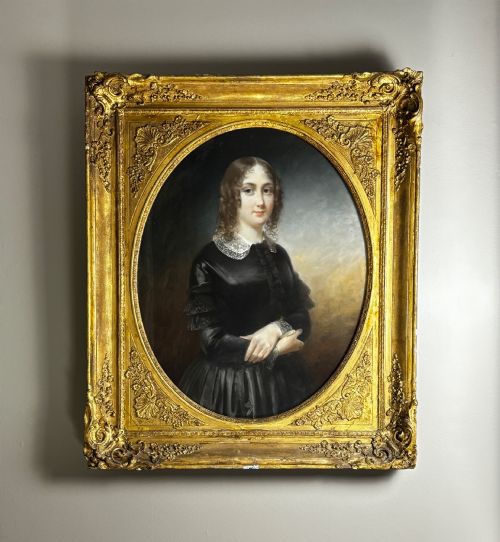
Artware Fineart has dated this 19th Century Oil Portrait to the 19th Century.
Portrait of the Reverend John Angell James 1785–1859
Signed/Inscribed:
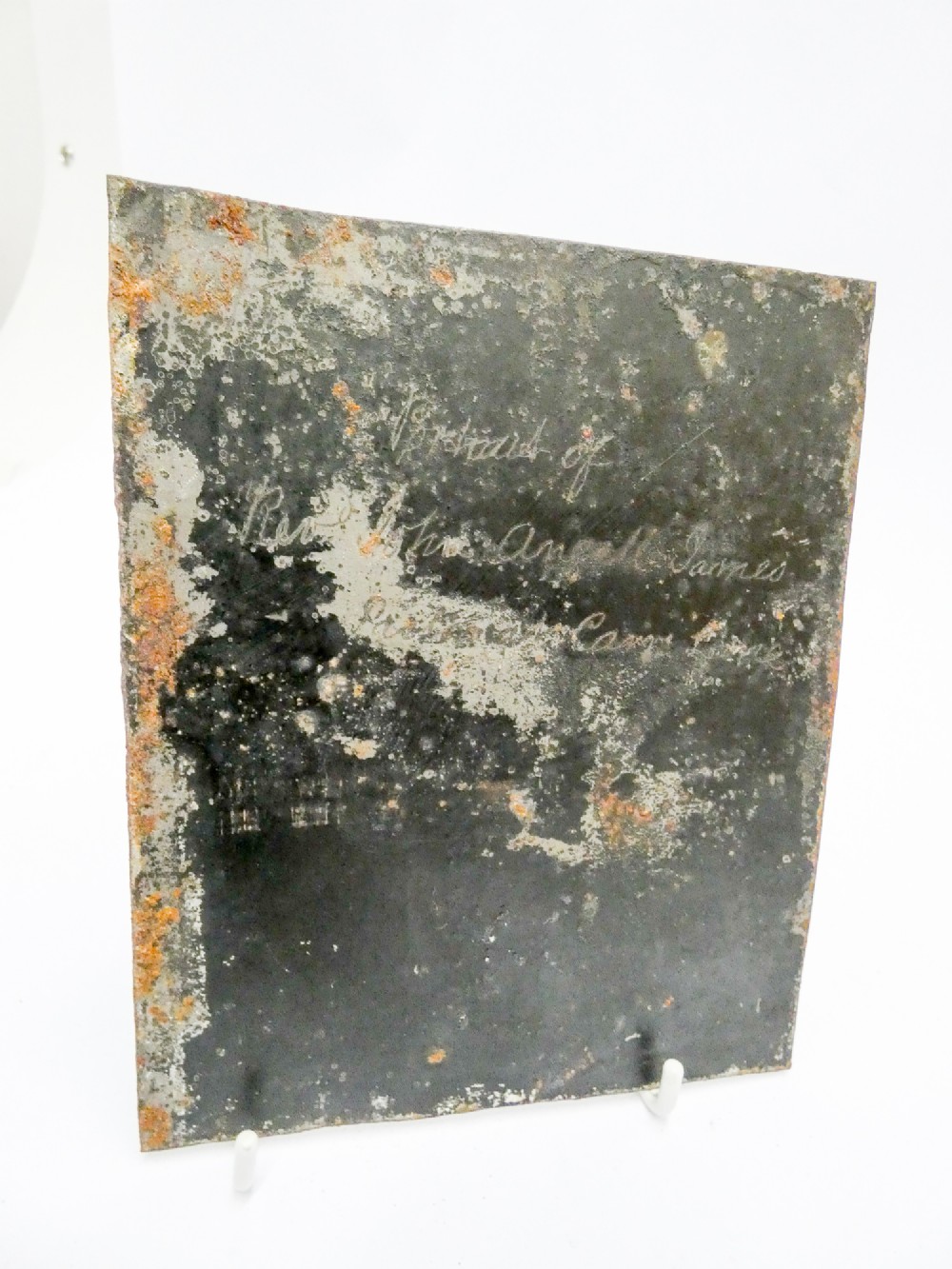
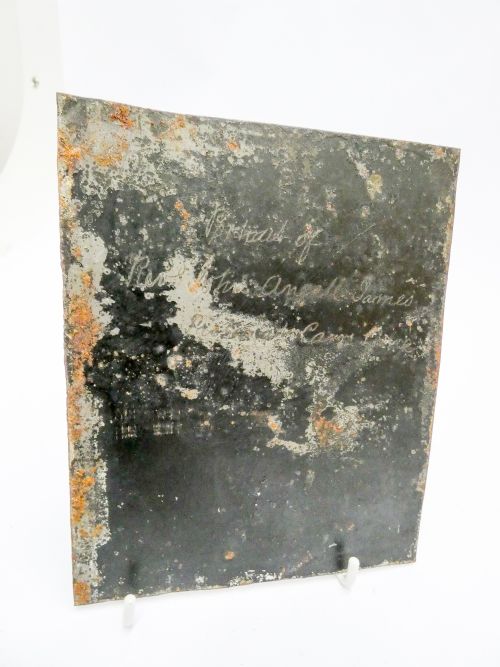
on the reverse " Portrait of / rev John Angell James/…….."
oil on metal
18 x 14 cm. (7.1/4 x 5.1/2 in.)
John Angell James, (1785–1859), Congregational minister and author, was born on 6 June 1785 at Salisbury Street, Blandford Forum, Dorset, the fourth child and eldest son of the eight children of Joseph James (1753?–1812), linen draper and button maker, and his wife, Sarah (1748?–1807). Another son of theirs, Thomas (1789–1873), became an influential Congregational minister.
John received his elementary education at Blandford and a school conducted by Robert Kell of Wareham, a presbyterian. He was subsequently apprenticed to Bailey, a draper at Poole. It was here that he experienced religious conviction and was encouraged by James Bennett (1774–1862) to undergo preparation for the ministry. In 1802 he entered the academy conducted by David Bogue (1750–1825) at Gosport, supported by a bursary of £30 from the fund provided by Robert Haldane (1764–1842). Since his mother was a General Baptist he had not been baptized in infancy and submitted to the ordinance while at Gosport. In later life James complained that his education had been insufficient to prepare him for his pastoral work. On 18 July 1803, in accordance with the provisions of the Toleration Act, he received at Winchester his licence to preach. In August 1804 he preached at Carrs Lane Chapel, Birmingham, and after receiving a formal call to become its pastor he was ordained on 8 May 1806. He remained minister there until his death. Because of increasing ill health he secured the assistance of R. W. Dale (1825–1895), who became his co-pastor in August 1854 and his successor. On 7 July 1806 James married Frances Charlotte Smith at Edgbaston parish church. She died on 27 January 1819, having had a son and two daughters. On 19 February 1822 John Angell James married Anna Maria, the widow of Benjamin Neale of St Paul's Churchyard. She died on 3 June 1841. Both his wives were wealthy.

James was a significant figure in nineteenth-century nonconformity because his ministry exemplifies the developments that made it a power in the land. The first seven years of his ministry were uneventful, but from 1813 his influence increased and the new chapel that was opened in 1820 was designed to accommodate 2000 worshippers. The membership when he was ordained was forty, with a congregation of 200, but by 1850 it numbered over 1000. This was due both to his impressive preaching and the changes which he introduced into the life of the church. In 1805 its only meetings were the Sunday services and a Sunday school. Over the years an astonishing number of activities were initiated devoted to missionary and evangelistic work, the promotion of philanthropy among the poor, and the education of over 2000 children. Women took a prominent part in the life of the church as, for example, in the Maternal Society, the Dorcas Society, and the Female Benevolent Society for visiting the sick. Among the fruits of these activities were the founding of two new churches in Birmingham. It was quite usual for the church to raise £1200 a year for these and other good causes, while £23,000 was spent on the buildings during James's ministry. All this shows how Carrs Lane Chapel sought to meet the social and cultural needs of Birmingham and how it had attracted those who had profited from the wealth that was produced by its industries.
In his book Christian Fellowship (1822) James argued for closer co-operation between the Congregational churches, and so became one of the founders of the Congregational Union of England and Wales in 1832, a substantial modification of the strict traditi
Artware Fineart has dated this 19th Century Oil Portrait to the 19th Century.
You can view the stock and full dealer information on the Artware Fineart Profile Page

English School 19th, Century portrait of the Reverend John Angell James 1785–1859