9,761  PAGES BROWSED TODAY PAGES TODAY 36  ANTIQUES UPLOADED TODAY NEW ARRIVALS
ID #SA486040
FOR SALE
£6,500
Email
Save
Allan Ramsay, 1713 - 1784 Portrait of William Sandeman 1722-1790 of Luncarty Perthshire
Artware Fineart
for sale €7,605     $8,255
£6,500

Artware Fineart

Sellingantiques Verified Since Sep 2008
View Dealers Stock Page
Id #SA486040
PDF SHARE
SAVE

Allan Ramsay, 1713 - 1784 Portrait of William Sandeman 1722-1790 of Luncarty Perthshire

18th century
For Sale by Artware Fineart
Description

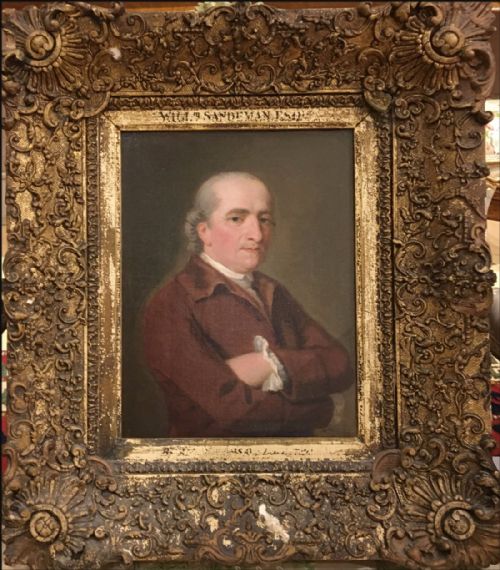
Allan Ramsay, 1713 - 1784

Portrait of William Sandeman 1722-1790 of Luncarty Perthshire

Signed/Inscribed:

on the frame " WILLm SANDEMAN ESQ / By All.....R..MSAY La....t."

oil on canvas

32 x 24 cm. (12.3/4 x 9.3/4in.)
Provenance

Private Collection New York, USA

Notes

William Sandeman (1722 in Luncarty, Scotland – 1790 in Perth, Scotland) was a leading Perthshire linen and later cotton manufacturer. For instance in 1782 alone, Perthshire produced 1.7 million yards of linen worth £81,000. Linen manufacture became by the 1760s a major Scottish industry, second only to agriculture. He was one of the pillars of the Scottish enlightenment.

William was born in 1722 in Luncarty just north of Perth, Scotland the fifth child of David Sandeman and his second wife Margaret Ramsay. David Sandeman was a merchant and magistrate (1735–63) of Perth .William with his first wife Christina Fleming had two children. With his second wife Mary Anderson he had a further 14 children (five of whom married five of the 20 children of Hector Turnbull, his bleachfield's business partner). In 1740, Robert and William Sandeman started a weaving business together, though Robert's expanding church duties in Dundee and Edinburgh removed him from the family business.William was exposed to the Glasite faith after the Perth meeting house first opened in 1733. He was later elected an elder of the Perth congregation for several years. In this position, he was expected to lead the congregation in both the worship and community service. As part of his Glasite obligations, he journeyed with his brother Robert in the first attempt to form a London Sandemanian congregation in 1761. When Robert extracted himself from the family business, William found another willing partner in Hector Turnbull. He was buried in the Greyfriars graveyard Perth with the inscription "William Sandeman manufacturer Perth and bleacher at Luncarty".

He manufactured linen in Perth and nearby Luncarty, for instance with an order of 12,000 to 15,000 yards of "Soldiers' shirting". In 1752 he leveled 12 acres (49,000 m2) of bleachfields in Luncarty. By 1790 when William died, the Luncarty bleachfields covered 80 acres (320,000 m2) and processed 500,000 yards of cloth annually. Second only to agriculture, linen manufacture was a major Scottish industry in the late 18th century — linen then became less important with the introduction of cotton.From an initial 12 acres, the works expanded, for nearly 250 years to occupy around 130 acres. In the 19th century the Luncarty Bleachfield works was the largest linen bleachfield in Scotland, supporting fine linen manufacture from the central belt of the country. Approximately 500,000 square yards of linen was bleached and finished at the works every year.

The bleaching at Luncarty was done by laying linen cloth out on grass in a Bleachfield in the sun. Chemical bleaching may have been introduced after the commercialisation of chlorine bleaches in the late 1800sThe bleaching at Luncarty was done by laying linen cloth out on grass in a Bleachfield in the sun. Chemical bleaching may have been introduced after the commercialisation of chlorine bleaches in the late 1800s.

In the early 1760s, William Sandeman opened two further linen centres: Milntown (now Milton) in Easter Ross and Fortrose on the Black Isle near Inverness. By 1765, these had almost 1000 spinners.

By the 1780s, cotton was replacing linen. In November 1784, Sandeman visited Lancashire cotton mills and Richard Arkwright the inventor who had pioneered cotton-spinning machinery in Derbyshire. Sandeman, Arkwright and others established the Tay River–powered cotton mill in Stanley (just north of Luncarty, Perthshire) in 1786/7 with 3200 spindles. The mill was originally water-powered but was later converted to steam and finally to electric power. For most of its histo

Physical Dimensions
Height
32cm (12.60")
Width
24cm (9.45")
Depth
2cm (0.79")
Declaration

Artware Fineart has dated this 18th Century Portrait Painting to the 18th Century.

Reference Numbers
Sellingantiques Reference
SA486040
Dealers Internal Reference
3905
Description
Allan Ramsay, 1713 - 1784

Portrait of William Sandeman 1722-1790 of Luncarty Perthshire

Signed/Inscribed:

on the frame " WILLm SANDEMAN ESQ / By All.....R..MSAY La....t."

oil on canvas

32 x 24 cm. (12.3/4 x 9.3/4in.)

fig 1. An 18th-century oil portrait painting depicting a gentleman with folded arms wearing a brown coat against an olive background.
fig 1. Allan Ramsay, 1713 - 1784 Portrait of William Sandeman 1722-1790 of Luncarty Perthshire

Provenance

Private Collection New York, USA

Notes

William Sandeman (1722 in Luncarty, Scotland – 1790 in Perth, Scotland) was a leading Perthshire linen and later cotton manufacturer.
Artware Fineart

For instance in 1782 alone, Perthshire produced 1.7 million yards of linen worth £81,000. Linen manufacture became by the 1760s a major Scottish industry, second only to agriculture. He was one of the pillars of the Scottish enlightenment.

William was born in 1722 in Luncarty just north of Perth, Scotland the fifth child of David Sandeman and his second wife Margaret Ramsay. David Sandeman was a merchant and magistrate (1735–63) of Perth .William with his first wife Christina Fleming had two children. With his second wife Mary Anderson he had a further 14 children (five of whom married five of the 20 children of Hector Turnbull, his bleachfield's business partner). In 1740, Robert and William Sandeman started a weaving business together, though Robert's expanding church duties in Dundee and Edinburgh removed him from the family business.William was exposed to the Glasite faith after the Perth meeting house first opened in 1733. He was later elected an elder of the Perth congregation for several years. In this position, he was expected to lead the congregation in both the worship and community service. As part of his Glasite obligations, he journeyed with his brother Robert in the first attempt to form a London Sandemanian congregation in 1761. When Robert extracted himself from the family business, William found another willing partner in Hector Turnbull. He was buried in the Greyfriars graveyard Perth with the inscription "William Sandeman manufacturer Perth and bleacher at Luncarty".

He manufactured linen in Perth and nearby Luncarty, for instance with an order of 12,000 to 15,000 yards of "Soldiers' shirting". In 1752 he leveled 12 acres (49,000 m2) of bleachfields in Luncarty. By 1790 when William died, the Luncarty bleachfields covered 80 acres (320,000 m2) and processed 500,000 yards of cloth annually. Second only to agriculture, linen manufacture was a major Scottish industry in the late 18th century — linen then became less important with the introduction of cotton.From an initial 12 acres, the works expanded, for nearly 250 years to occupy around 130 acres. In the 19th century the Luncarty Bleachfield works was the largest linen bleachfield in Scotland, supporting fine linen manufacture from the central belt of the country. Approximately 500,000 square yards of linen was bleached and finished at the works every year.

The bleaching at Luncarty was done by laying linen cloth out on grass in a Bleachfield in the sun. Chemical bleaching may have been introduced after the commercialisation of chlorine bleaches in the late 1800sThe bleaching at Luncarty was done by laying linen cloth out on grass in a Bleachfield in the sun. Chemical bleaching may have been introduced after the commercialisation of chlorine bleaches in the late 1800s.

In the early 1760s, William Sandeman opened two further linen centres: Milntown (now Milton) in Easter Ross and Fortrose on the Black Isle near Inverness. By 1765, these had almost 1000 spinners.

By the 1780s, cotton was replacing linen. In November 1784, Sandeman visited Lancashire cotton mills and Richard Arkwright the inventor who had pioneered cotton-spinning machinery in Derbyshire. Sandeman, Arkwright and others established the Tay River–powered cotton mill in Stanley (just north of Luncarty, Perthshire) in 1786/7 with 3200 spindles. The mill was originally water-powered but was later converted to steam and finally to electric power. For most of its histo

Height
32cm (12.60")
Width
24cm (9.45")
Depth
2cm (0.79")
Date of Manufacture

Artware Fineart has dated this 18th Century Portrait Painting to the 18th Century.

Reference Numbers
Sellingantiques Ref
SA486040
Dealers Internal Ref
3905
Artware Fineart
Sellingantiques verified Since Sep 2008
Dealer Profile

You can view the stock and full dealer information on the Artware Fineart Profile Page

PDF SHARE
SAVE
An 18th-century oil portrait painting depicting a gentleman with folded arms wearing a brown coat against an olive background.
1 / 2
Archive I An 18th-century oil portrait painting depicting a gentleman with folded arms wearing a brown coat against an olive background.

Allan Ramsay, 1713 - 1784 Portrait of William Sandeman 1722-1790 of Luncarty Perthshire

Archive II An 18th-century oil portrait painting depicting a gentleman with folded arms wearing a brown coat against an olive background. View II
FURTHER BROWSING

Visitors also looked at these ⇣

Enlarged Archival View
Telephone 07958 699 645
Location
18 La Gare
51 Surrey Row
London
SE1 0BZ
United Kingdom
Verified Since Sep 2008
Items For Sale 243
Items Sold 223
Artware Fineart
Verified Since Sep 2008
View Dealer Info
Location: 18 La Gare , 51 Surrey Row , London , SE1 0BZ , United Kingdom
Verified
Sep 2008
For Sale
243
Sold
223
An 18th-century oil portrait painting depicting a gentleman with folded arms wearing a brown coat against an olive background.
Allan Ramsay, 1713 - 1784 Portrait of William Sandeman 1722-1790 of Luncarty Perthshire
Ref: SA486040
An 18th-century oil portrait painting depicting a gentleman with folded arms wearing a brown coat against an olive background.
Detail View 1
Archival Detail
Every single antique dealer on our platform is individually approved by our internal team. We verify their professional trade history, ethical standards, and photographic quality to ensure a secure, high-standard buying environment. Upon joining, every dealer agrees to a strict 9-point code of conduct. While issues can occasionally arise, our dealers typically resolve them swiftly and directly with the buyer. In fact, since our founding in 2002, Sellingantiques has only had to step in to help resolve an issue on roughly five occasions—a true testament to the quality of our dealers and their dedication to your happiness.
Our dealers are highly experienced in packing and shipping fragile, high-value antiques. Because you are in direct contact with the dealer, you will be able to easily go through all available shipping and insurance options together to ensure your item arrives safely.
Antiques are the ultimate green purchase. By choosing historical pieces over newly manufactured goods, you completely eliminate the carbon footprint of modern mass production while preserving exceptional, timeless craftsmanship.

Georgian portraiture is defined by its focus on status, character, and classical composure. Artists utilised refined glazing techniques, subtle lighting contrasts, and formal drapery to capture prominent figures of the era.

Works from this period were typically executed in oil pigments ground with linseed or walnut oil, applied onto hand-stretched linen canvas or wood panels primed with a gesso base layer.

Authentic pieces generally display age-appropriate craquelure patterns across the varnish and paint layers, hand-cut wooden stretcher frames, oxidation on the reverse of the canvas, and visible hand-woven linen threads.

Integrate historical portraits into contemporary spaces by hanging them as focal points above minimalist furniture, layering them inside a gallery wall, or placing them within modern brass lighting schemes to highlight texture.

Maintain a stable room climate with steady humidity levels and keep the artwork out of direct sunlight. Clean dust gently using a soft, dry camel-hair brush and consult a professional conservator for varnish restoration.
items
Add keywords to the filter
Price
£100
£250000
Era
Movements
Material
Origin
Stock Location
Freshness
Online Payments
Categories