17,773  PAGES BROWSED TODAY PAGES TODAY 32 ANTIQUES UPLOADED TODAYNEW ARRIVALS
32 ITEMS ADDED TODAY
Sort Order
Items Per Page
Browse Categories
Sort order
Relevant Links
Items per page
ID #SA1187151
FOR SALE
£75,000
Email
Save
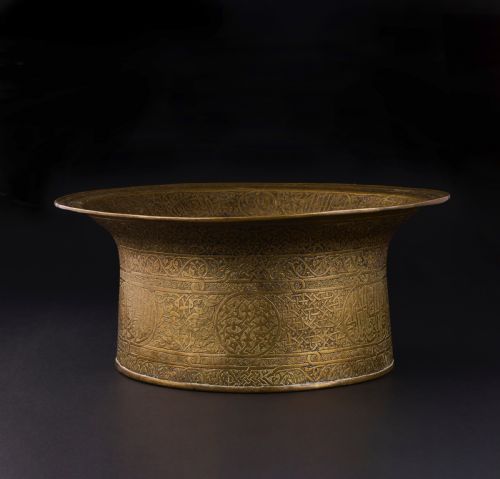
A Mamluk Engraved Brass Basin, Egypt or Syria, Early 16th Century
H & H Gallery
for sale €87,750     $95,250
£75,000
H & H Gallery

H & H Gallery

Sellingantiques Verified Since Nov 2020
View Dealers Stock Page
  • About Us
    European and islamic art
  • Trade Associations
    H & H Gallery is a registered member of LAPADA 
Id #SA1187151
PDF SHARE
SAVE

A Mamluk Engraved Brass Basin, Egypt or Syria, Early 16th Century

16th century
For Sale by H & H Gallery
Description

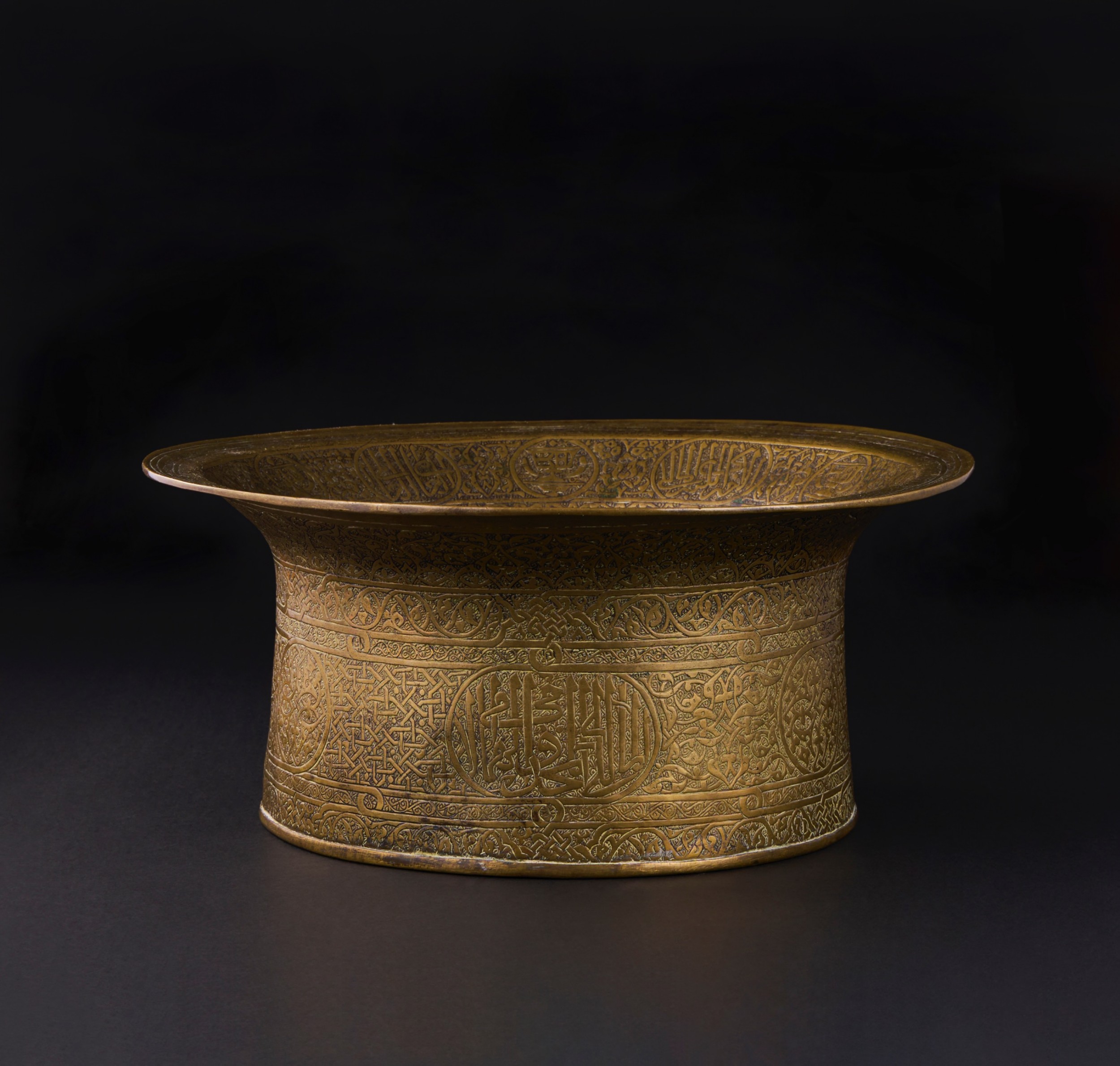
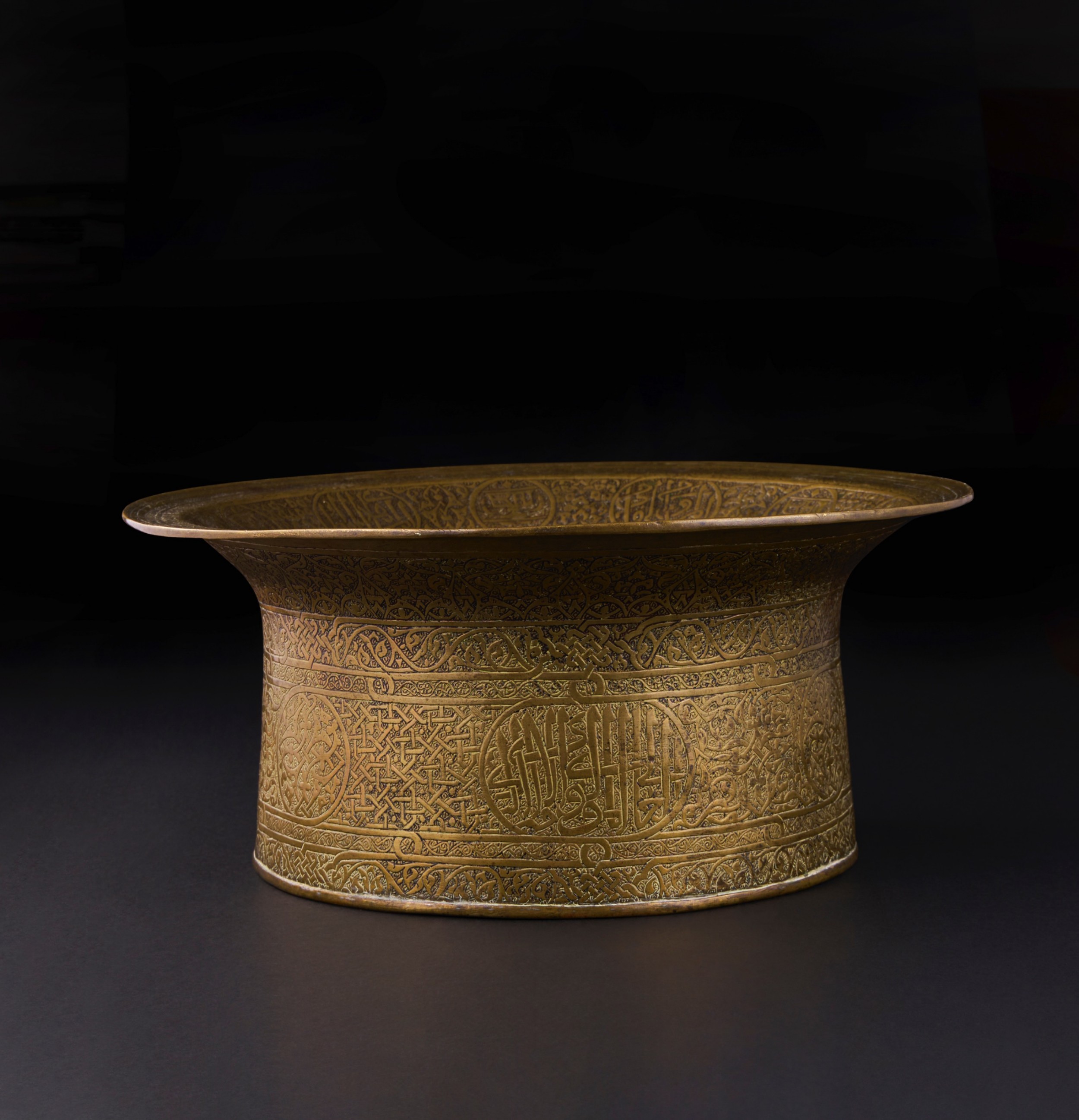
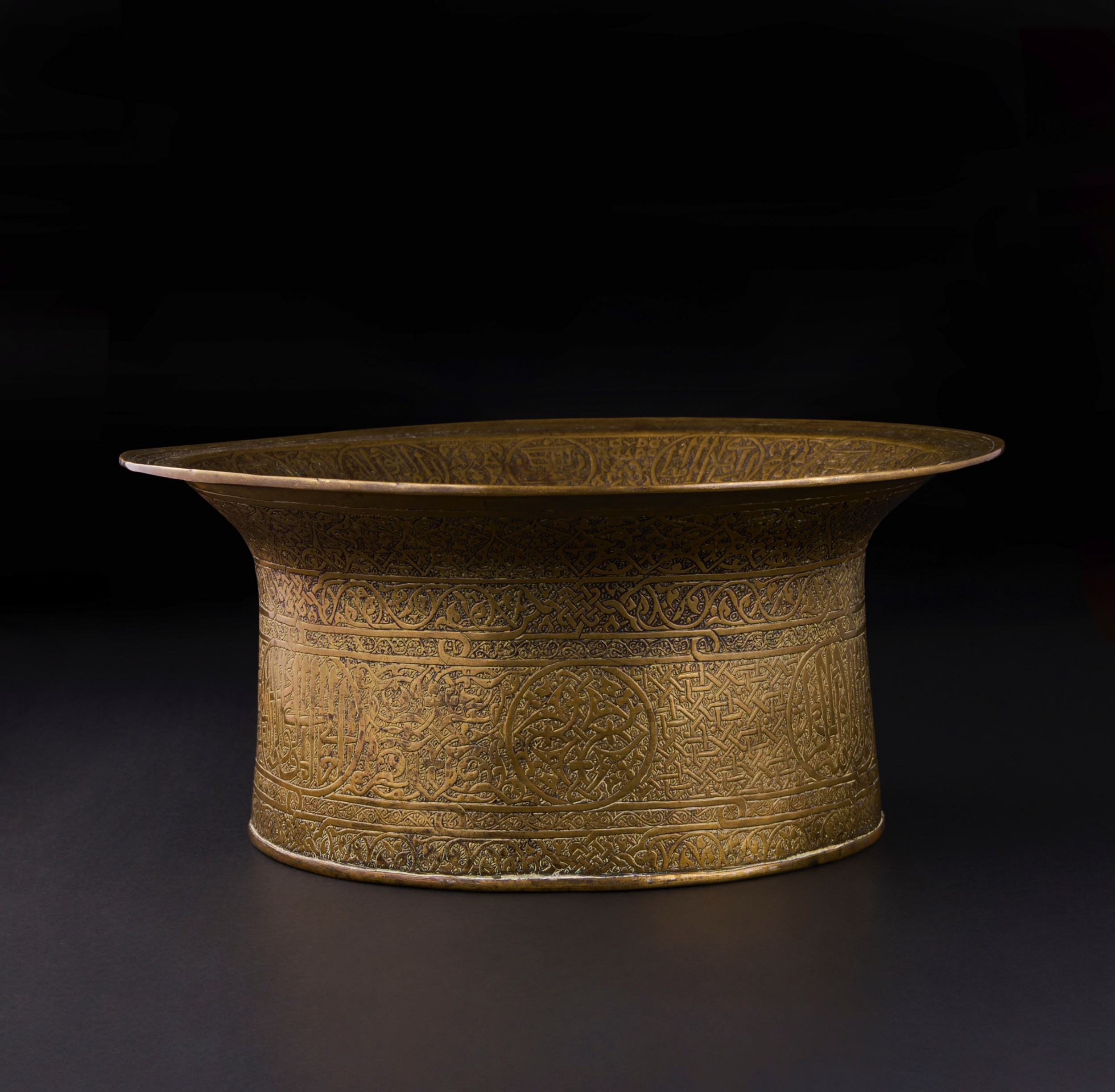
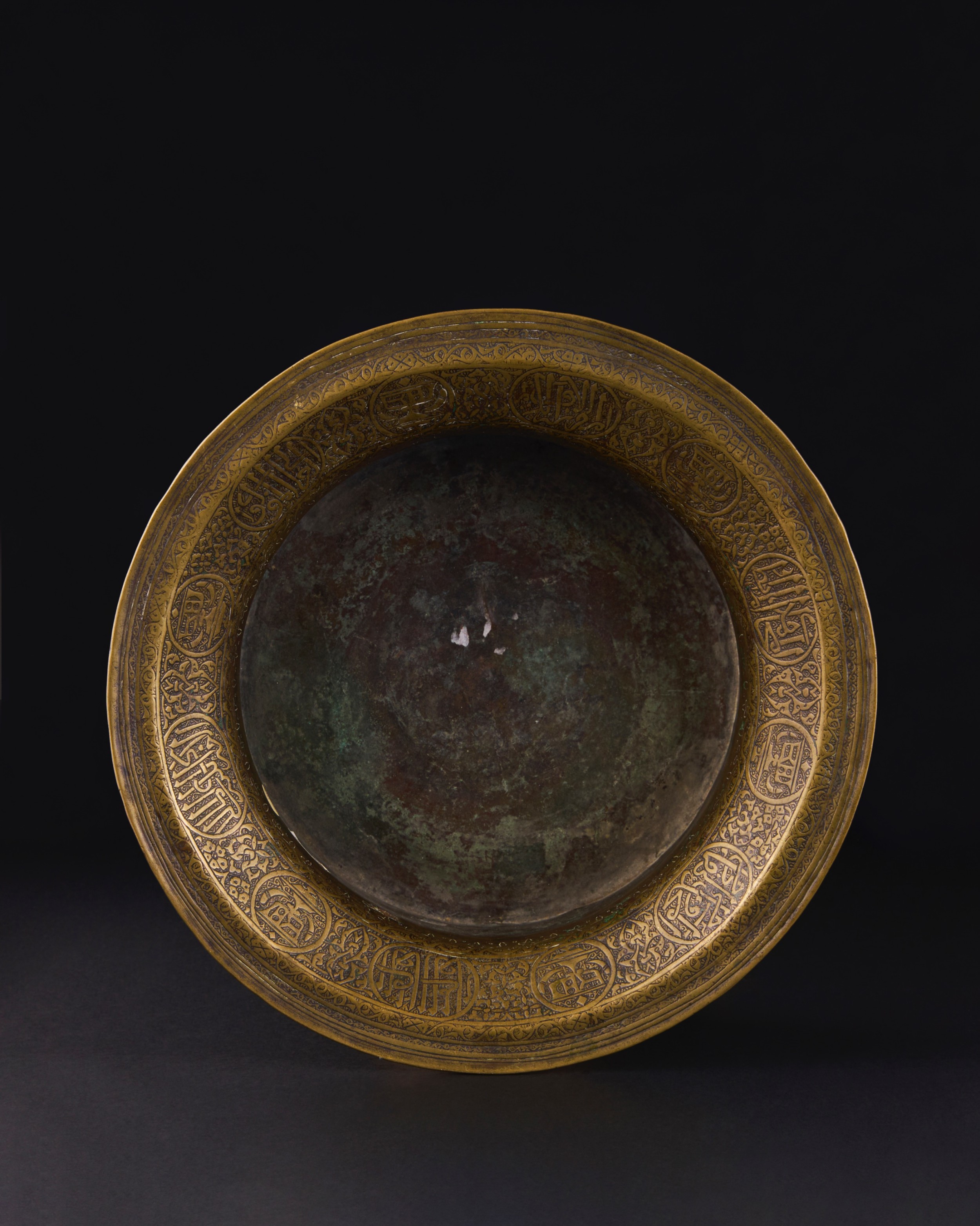
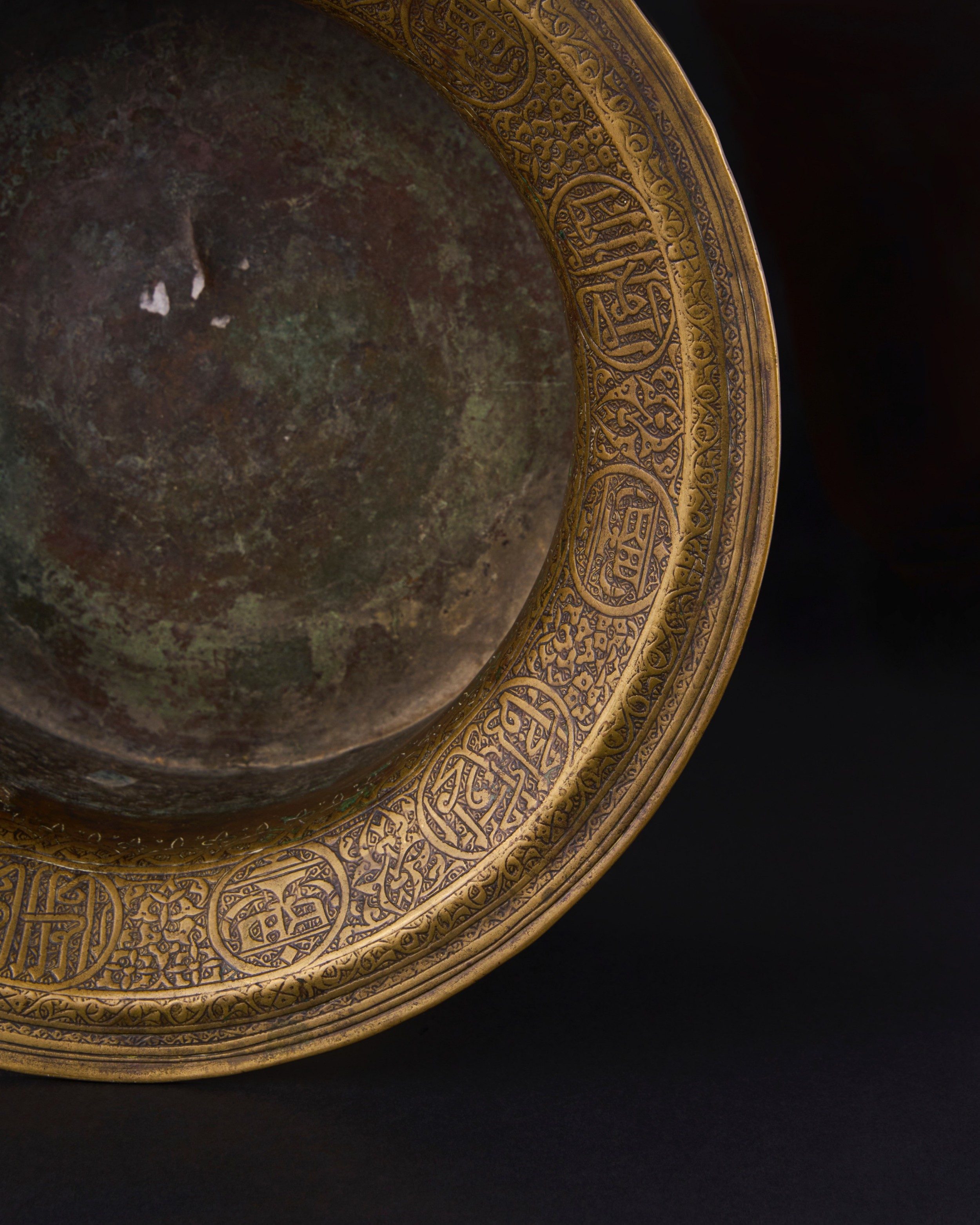
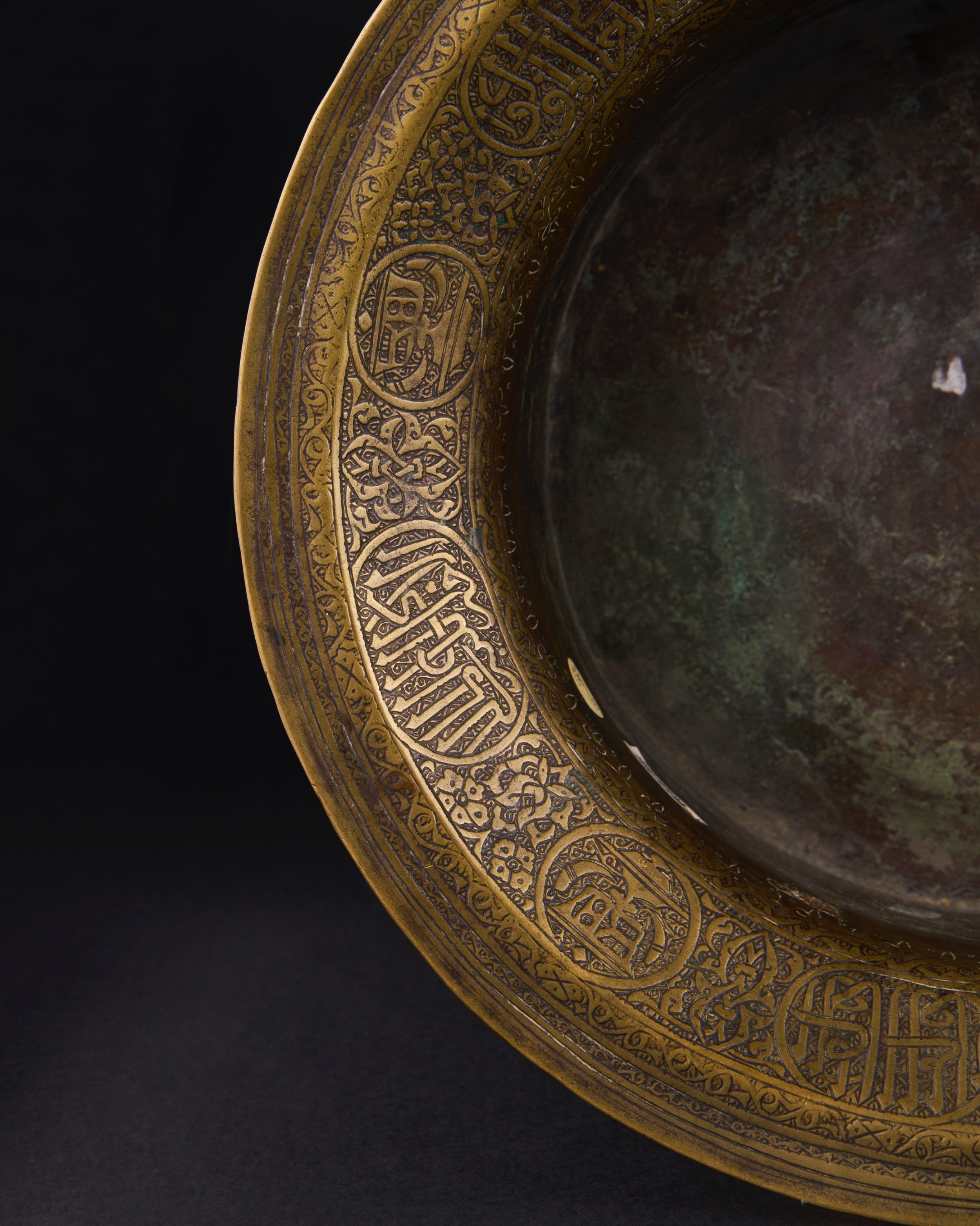
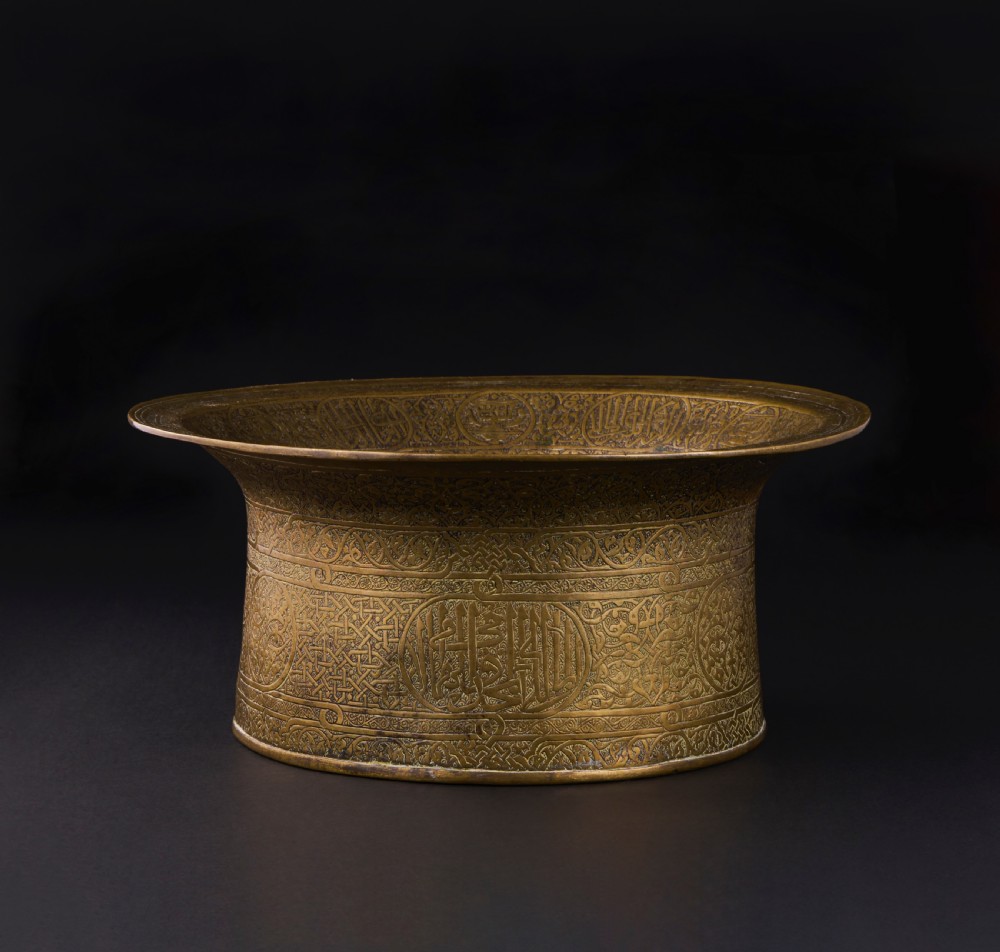
of waisted form with flaring everted rim, engraved with a series of cartouches filled with inscriptions in thuluth interspersed with roundels containing vegetal interlace on a floral or geometric ground, above and below bands of undulating vines and vegetal motifs, the rim with a band of alternating roundels containing heraldic blazons and inscriptions in thuluth interspersed by floral and vegetal interlace, the engraved areas with inlaid black composition.

39 cm. diam.

Provenance: Private UK Collection

Inscriptions: to the body mimma 'umila bi-rasm al-maqarr al-ashraf al-karim/al-'ali al-mawlawi al-amiri ... /al-maliki al-makhdumi al-humami al-a/, 'One of what was made for the noble authority, the honourable, the high, the lordly, the commander ... the possessing, the masterful, the valiant'; to the rim al-maqarr al-ashraf al-karim / al-'ali al-mawlawi / al-amiri al-kabiri al-maliki / al-'alimi al-'amili a / al-makhdumi al-humami / al-mujahidi al-murabit[i], 'The honourable authority, the high, the lordly, the great commander, the possessing, the learned, the diligent, the masterful, the holy warrior, the defender'.

The blazons on the present lot are similar to those on a basin sold at Christie's (Art of the Islamic and Indian Worlds, lot 131) which is attributed to the period of the penultimate Mamluk Sultan, Al-Ashraf Qansuh al-Ghuri (r. 1501-16). Whilst the form of the basin is typically Mamluk, the decoration takes on a more dense and small scale form which is reminiscent of Veneto-Saracenic metalwork produced in Syria. Related examples are in the Musée des Beaux-Arts in Lyon (Rémi Labrusse, Islamophilies. L'Europe moderne et les arts de l'Islam, exhibition catalogue, Paris, 2011, cat.358, p.354), and the Poldi Pezzoli Museum in Milan (inv.1657, published in Doris Behrens-Abouseif, 'Veneto-Saracenic Metalware, a Mamluk Art', Mamluk Studies Review, vol.9, no.2, Chicago, 2005, fig.4, pp.149 and 162).

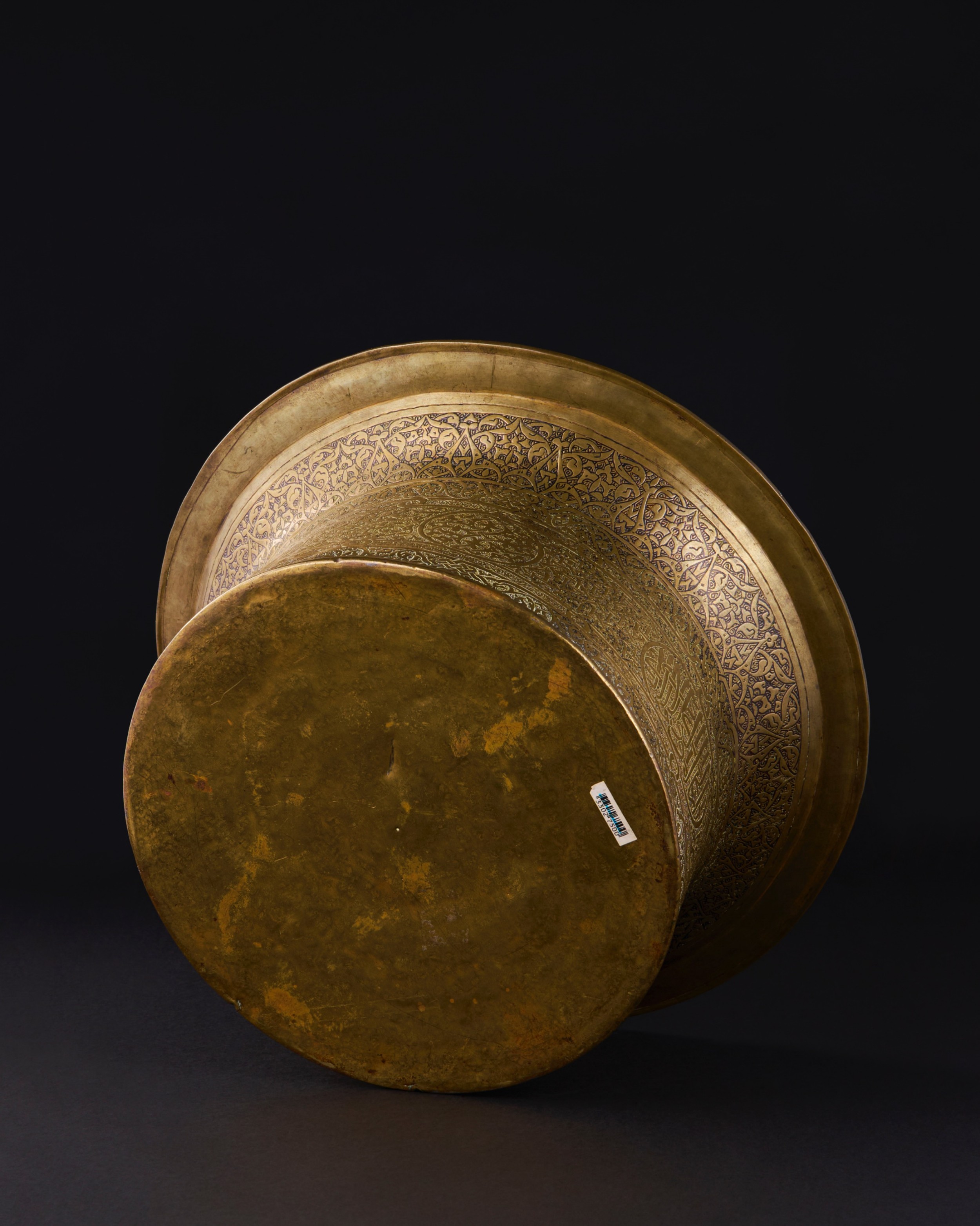
Unlike earlier Mamluk vessels which tended to be inlaid with silver, the present lot displays a new technique which was becoming increasingly popular at the time where a black bituminous material was applied to the recesses of the decoration. The global shortage of precious metals in the 15th and early 16th century ensured that this new fashion became predominant in the ensuing years and eventually replaced inlaid metalwork. For a further discussion see Esin Atil, Renaissance of Islam, Art of the Mamluks, exhibition catalogue, Washington D.C., 1981, no.26, pp.88-89 and 101.

Physical Dimensions
Height
35cm (13.78")
Width
39cm (15.35")
Depth
39cm (15.35")
Declaration

H & H Gallery has dated this Mamluk Engraved Brass Basin to the 16th Century.
Reference Numbers
Sellingantiques Reference
SA1187151
Dealers Internal Reference
H1392
Description
Of waisted form with flaring everted rim, engraved with a series of cartouches filled with inscriptions in thuluth interspersed with roundels containing vegetal interlace on a floral or geometric ground, above and below bands of undulating vines and vegetal motifs, the rim with a band of alternating roundels containing heraldic blazons and inscriptions in thuluth interspersed by floral and vegetal interlace, the engraved areas with inlaid black composition.
fig 1. A 16th-century Mamluk brass basin featuring a wide flared rim, intricate hand-engraved Arabic calligraphy, arabesques, and geometric patterns.
fig 1. A Mamluk Engraved Brass Basin, Egypt or Syria, Early 16th Century

39 cm. diam.

Provenance: Private UK Collection

Inscriptions: to the body mimma 'umila bi-rasm al-maqarr al-ashraf al-karim/al-'ali al-mawlawi al-amiri.
H & H Gallery

... /al-maliki al-makhdumi al-humami al-a/, 'One of what was made for the noble authority, the honourable, the high, the lordly, the commander ... the possessing, the masterful, the valiant'; to the rim al-maqarr al-ashraf al-karim / al-'ali al-mawlawi / al-amiri al-kabiri al-maliki / al-'alimi al-'amili a / al-makhdumi al-humami / al-mujahidi al-murabit[i], 'The honourable authority, the high, the lordly, the great commander, the possessing, the learned, the diligent, the masterful, the holy warrior, the defender'.
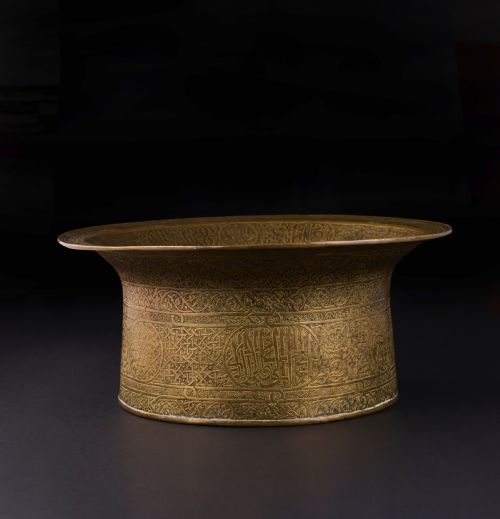
fig 2. A 16th-century Mamluk brass basin featuring a wide flared rim, intricate hand-engraved Arabic calligraphy, arabesques, and geometric patterns.
fig 2. A Mamluk Engraved Brass Basin, Egypt or Syria, Early 16th Century

The blazons on the present lot are similar to those on a basin sold at Christie's (Art of the Islamic and Indian Worlds, lot 131) which is attributed to the period of the penultimate Mamluk Sultan, Al-Ashraf Qansuh al-Ghuri (r. 1501-16). Whilst the form of the basin is typically Mamluk, the decoration takes on a more dense and small scale form which is reminiscent of Veneto-Saracenic metalwork produced in Syria. Related examples are in the Musée des Beaux-Arts in Lyon (Rémi Labrusse, Islamophilies. L'Europe moderne et les arts de l'Islam, exhibition catalogue, Paris, 2011, cat.358, p.354), and the Poldi Pezzoli Museum in Milan (inv.1657, published in Doris Behrens-Abouseif, 'Veneto-Saracenic Metalware, a Mamluk Art', Mamluk Studies Review, vol.9, no.2, Chicago, 2005, fig.4, pp.149 and 162).
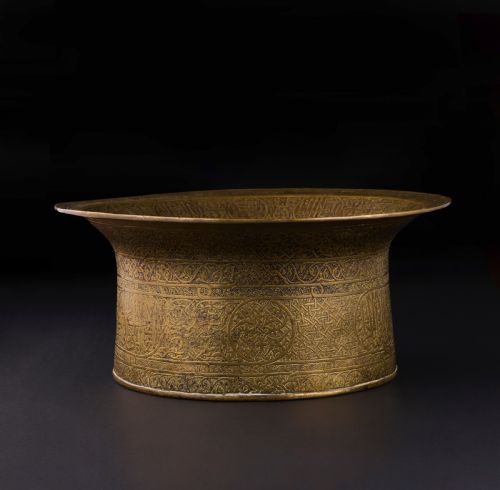
fig 3. A 16th-century Mamluk brass basin featuring a wide flared rim, intricate hand-engraved Arabic calligraphy, arabesques, and geometric patterns.
fig 3. A Mamluk Engraved Brass Basin, Egypt or Syria, Early 16th Century

Unlike earlier Mamluk vessels which tended to be inlaid with silver, the present lot displays a new technique which was becoming increasingly popular at the time where a black bituminous material was applied to the recesses of the decoration. The global shortage of precious metals in the 15th and early 16th century ensured that this new fashion became predominant in the ensuing years and eventually replaced inlaid metalwork. For a further discussion see Esin Atil, Renaissance of Islam, Art of the Mamluks, exhibition catalogue, Washington D.C., 1981, no.26, pp.88-89 and 101.

Height
35cm (13.78")
Width
39cm (15.35")
Depth
39cm (15.35")
Date of Manufacture

H & H Gallery has dated this Mamluk Engraved Brass Basin to the 16th Century.

Reference Numbers
Sellingantiques Ref
SA1187151
Dealers Internal Ref
H1392
H & H Gallery
H & H Gallery
Sellingantiques verified Since Nov 2020

European and islamic art

Dealer Profile

You can view the stock and full dealer information on the H & H Gallery Profile Page

Trade Associations

H & H Gallery is a registered member of LAPADA 
PDF SHARE
SAVE
A 16th-century Mamluk brass basin featuring a wide flared rim, intricate hand-engraved Arabic calligraphy, arabesques, and geometric patterns.
1 / 8
Archive I A 16th-century Mamluk brass basin featuring a wide flared rim, intricate hand-engraved Arabic calligraphy, arabesques, and geometric patterns.

A Mamluk Engraved Brass Basin, Egypt or Syria, Early 16th Century
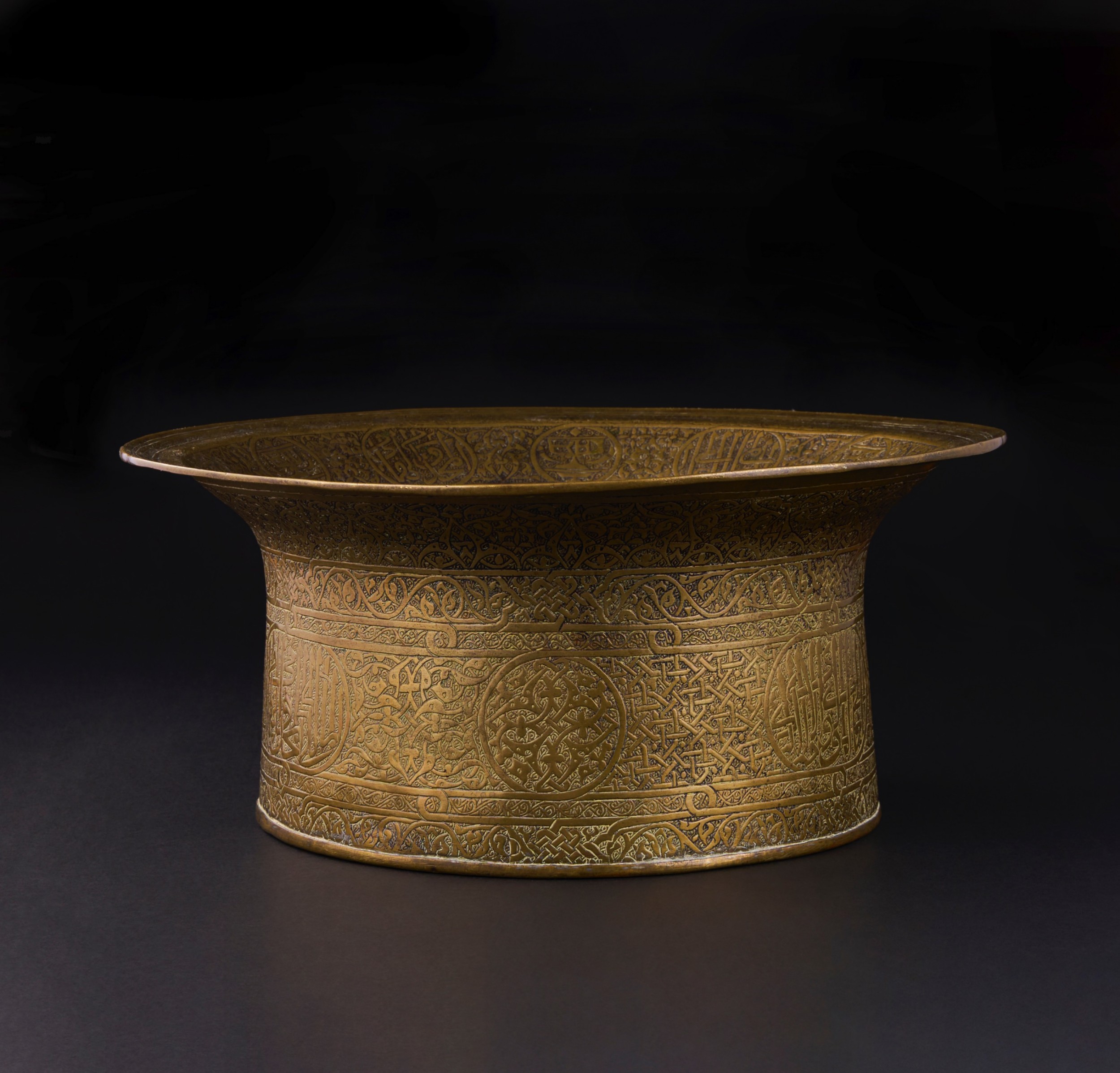
Archive II A 16th-century Mamluk brass basin featuring a wide flared rim, intricate hand-engraved Arabic calligraphy, arabesques, and geometric patterns. View II
Archive III A 16th-century Mamluk brass basin featuring a wide flared rim, intricate hand-engraved Arabic calligraphy, arabesques, and geometric patterns. View III
Archive IV A 16th-century Mamluk brass basin featuring a wide flared rim, intricate hand-engraved Arabic calligraphy, arabesques, and geometric patterns. View IV
Archive V A 16th-century Mamluk brass basin featuring a wide flared rim, intricate hand-engraved Arabic calligraphy, arabesques, and geometric patterns. View V
Archive VI A 16th-century Mamluk brass basin featuring a wide flared rim, intricate hand-engraved Arabic calligraphy, arabesques, and geometric patterns. View VI
Archive VII A 16th-century Mamluk brass basin featuring a wide flared rim, intricate hand-engraved Arabic calligraphy, arabesques, and geometric patterns. View VII
Archive VIII A 16th-century Mamluk brass basin featuring a wide flared rim, intricate hand-engraved Arabic calligraphy, arabesques, and geometric patterns. View VIII
Enlarged Archival View
Telephone 020 8951 9319
Location
8 Chase Road
Unit 1
The Chase Centre
London
NW10 6QD
United Kingdom
Verified Since Nov 2020
Items For Sale 114
Items Sold 197
H & H Gallery
H & H Gallery
Verified Since Nov 2020
View Dealer Info
Location: 8 Chase Road, Unit 1, The Chase Centre, London, NW10 6QD, United Kingdom
Verified
Nov 2020
For Sale
114
Sold
197
A 16th-century Mamluk brass basin featuring a wide flared rim, intricate hand-engraved Arabic calligraphy, arabesques, and geometric patterns.
A MAMLUK ENGRAVED BRASS BASIN, EGYPT OR SYRIA, EARLY 16TH CENTURY
Ref: SA1187151
A 16th-century Mamluk brass basin featuring a wide flared rim, intricate hand-engraved Arabic calligraphy, arabesques, and geometric patterns.
Detail View 1
Detail View 2
Detail View 3
Detail View 4
Detail View 5
Detail View 6
Detail View 7
Archival Detail
Every single antique dealer on our platform is individually approved by our internal team. We verify their professional trade history, ethical standards, and photographic quality to ensure a secure, high-standard buying environment. Upon joining, every dealer agrees to a strict 9-point code of conduct. While issues can occasionally arise, our dealers typically resolve them swiftly and directly with the buyer. In fact, since our founding in 2002, Sellingantiques has only had to step in to help resolve an issue on roughly five occasions—a true testament to the quality of our dealers and their dedication to your happiness.
Our dealers are highly experienced in packing and shipping fragile, high-value antiques. Because you are in direct contact with the dealer, you will be able to easily go through all available shipping and insurance options together to ensure your item arrives safely.
Antiques are the ultimate green purchase. By choosing historical pieces over newly manufactured goods, you completely eliminate the carbon footprint of modern mass production while preserving exceptional, timeless craftsmanship.

Mamluk metalwork typically features high-quality brass or bronze construction adorned with intricate hand-engraved arabesques, geometric knotwork, and bold Arabic calligraphy, often executing Thuluth script within circular or lobed roundels.

Vessels of this era were cast or raised from brass and subsequently detailed using hand-chiselling, engraving, and occasionally inlaying with precious metals such as silver or gold.

Authentication relies on examining the surface oxidisation, tool marks from manual engraving, specific epigraphic styles, and the iconography of geometric interlace and calligraphic inscriptions characteristic of the period.

An antique brass basin functions well as a prominent sculptural centrepiece on a sideboard top, console table, or deep windowsill, introducing historical depth and rich metallic texture to modern interiors.

To preserve the historical surface finish and natural oxidisation, dust gently with a soft microfibre cloth and avoid harsh chemical polishes or abrasive scrubbers that can strip delicate engraving.
items
Add keywords to the filter
Price
£100
£250000
Era
Movements
Material
Origin
Stock Location
Freshness
Online Payments
Categories