



Antique Toleware
Toleware is painted and varnished tinplate, decorated by hand and made for the kitchen, the shop counter and the hearth.

Antique Toleware
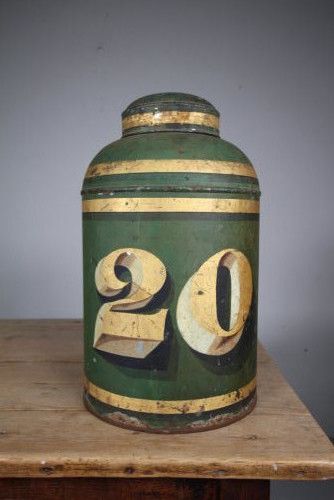
Toleware is sheet metal, usually tinplate, given a hard varnished finish and decorated by hand, commonly a dark ground with gilt or polychrome ornament. The technique is often called japanning, and the ware gave cheap iron sheet the look of lacquer. It was made across Europe and North America from the eighteenth century on, for tea and coffee storage, urns and other household vessels, standing in for painted wood or silver.
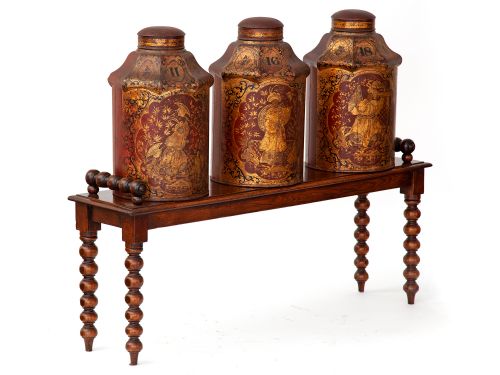
On Sellingantiques the category is containers rather than trays or furniture. Tea storage dominates: tea appears in a quarter of titles, as tins, canisters and caddies, and the largest of them are described as grocer's or shop display canisters rather than domestic pieces. Pairs and sets of three recur throughout.
The second cluster is decorative vessels, mainly chestnut urns and vases, again usually in pairs. After that come kitchen and pantry tins (spice, coffee, graduating sets, a grain measure marked to Ontario), and hearth and hall pieces such as coal bins, scuttles, a stick stand, a waste bin and a hot water can. One-offs turn up too: a mustard shop display barrel, an altar stand, a lidded wine cooler, gaming counter trays, decanter coasters.
Dating runs from 1800 to 1930. Seventeen listings carry a clean year, while thirteen are dated only as 19th Century, so a good part of the category sits inside a hundred-year span and no closer. Twentieth-century entries are thin, and the 1930s pieces are planters and a waste bin rather than early forms. Titles name French, Chinese, Spanish, Dutch and Canadian origins alongside British ones. This is a slow category, about four listings a year across 27 dealers, so few dealers have handled more than one piece.
Where The Range Sits
Number counts for more here than in most metalware. Sets of three tea canisters, pairs of chestnut urns, pairs of vases and a set of six gaming counter trays all sit well above single tins in the sampled range. The top of the whole archive is a set of three pagoda-style maroon tea canisters, several times anything else recorded, and it isn't a British piece.
Form separates the range next. Urns, vases and wine coolers hold the upper positions; spice tins, waste bins and hot water cans the lowest. Scale pushes the same way, with titles using "Large" attached to tea tins and shop display canisters that outrun their standard-size equivalents.
Decoration named in the title tends to travel upward. Handpainted work, gilt vine decoration on a green ground, a coat of arms crest: all appear above the lower quarter. The two pieces invoking the Pontypool and Usk japanning tradition, along with William IV and Empire attributions, likewise sit in the upper half.
Antique Toleware Retail Price Guide 2026
Typical UK retail prices for toleware, calculated from the Sellingantiques database of over a million retail prices indexed since 2003. This retail price guide relies exclusively on Sellingantiques data; no external sources or auction records are used, so the figures do not describe the wider market.
The most expensive toleware ever sold on Sellingantiques was a pair of Regency chestnut urns and covers, in May 2021.
The Antique Toleware Glossary
- Toleware
- Painted and varnished sheet metal, usually tinplate, decorated by hand.
- Japanned
- Finished with layers of dark varnish stoved hard, the technique behind toleware. Two titles in the archive use the word directly.
- Tin plate
- Thin iron or steel sheet coated with tin, the usual body under the paint.
- Canister
- A lidded cylindrical container, here almost always for tea. The largest were grocer's shop display pieces rather than domestic ones.
- Chestnut urn
- A covered urn-shaped vessel for serving hot chestnuts, appearing in this category mostly in pairs.
- Ground
- The background colour of the painted surface, described in these listings as green or maroon.
Antique Toleware: Frequently Asked Questions
What sort of toleware turns up most?
Tea storage. A quarter of the titles mention tea, in the form of tins, canisters and caddies, and several of those are sold as pairs or sets of three.
The biggest examples are described as grocer's or shop display canisters, so they were counter pieces rather than domestic caddies.
Are toleware trays common in this category?
No. Trays are the form most associated with toleware in general writing, but they don't appear as a group in this archive.
The only trays recorded are small gaming counter trays, sold as a set of six. What dominates instead is containers and vessels.
How old is most of it?
The dated field runs from 1800 to 1930, with seventeen listings carrying a clean year.
Thirteen more are dated only as 19th Century, and 19th appears in a quarter of all titles. Twentieth-century entries are present but thin, and the 1930s pieces are planters and a waste bin.
Nothing in the archive is dated to the eighteenth century.
Is toleware always British?
Not in this category. Titles name French, Chinese, Spanish, Dutch and Canadian pieces alongside British ones.
The Canadian entry is a quart grain measure marked to Ontario, and the highest-priced piece recorded is a set of three pagoda-style maroon tea canisters.
Why do pairs and sets come up so often?
Pairs are unusually common for a metalware category. Chestnut urns, vases, tea tins and decanter coasters all appear in twos, and canisters in threes.
Grouped lots sit well above single tins in the sampled range.
What does japanning mean on a toleware listing?
Japanning is the varnishing technique behind toleware: layers of dark varnish over tinplate, giving cheap sheet iron a hard finish in imitation of lacquer.
Two listings in this archive invoke the Pontypool and Usk japanning tradition by name. It's the only decorative tradition cited anywhere in the category.