29,612  PAGES BROWSED TODAY PAGES TODAY • 122 ANTIQUES UPLOADED TODAYNEW ARRIVALS
GIFTS
122 ITEMS ADDED TODAY
Sort Order
Items Per Page
Antiques dealer?
Join as a Seller
Browse Categories
Sort order
Relevant Links
Items per page
sold SA1115377
Sorry, but this item has been sold.
Regent Antiques

Regent Antiques

Sellingantiques Verified Since Sep 2016
Browse dealers 639 items
  • About Us
    We specialise in english and continental furniture, silver, porcelain and decorative items.
  • Trade Associations
    Regent Antiques is a registered member of LAPADA  CINOA
Id #SA1115377
SHARE
SAVE

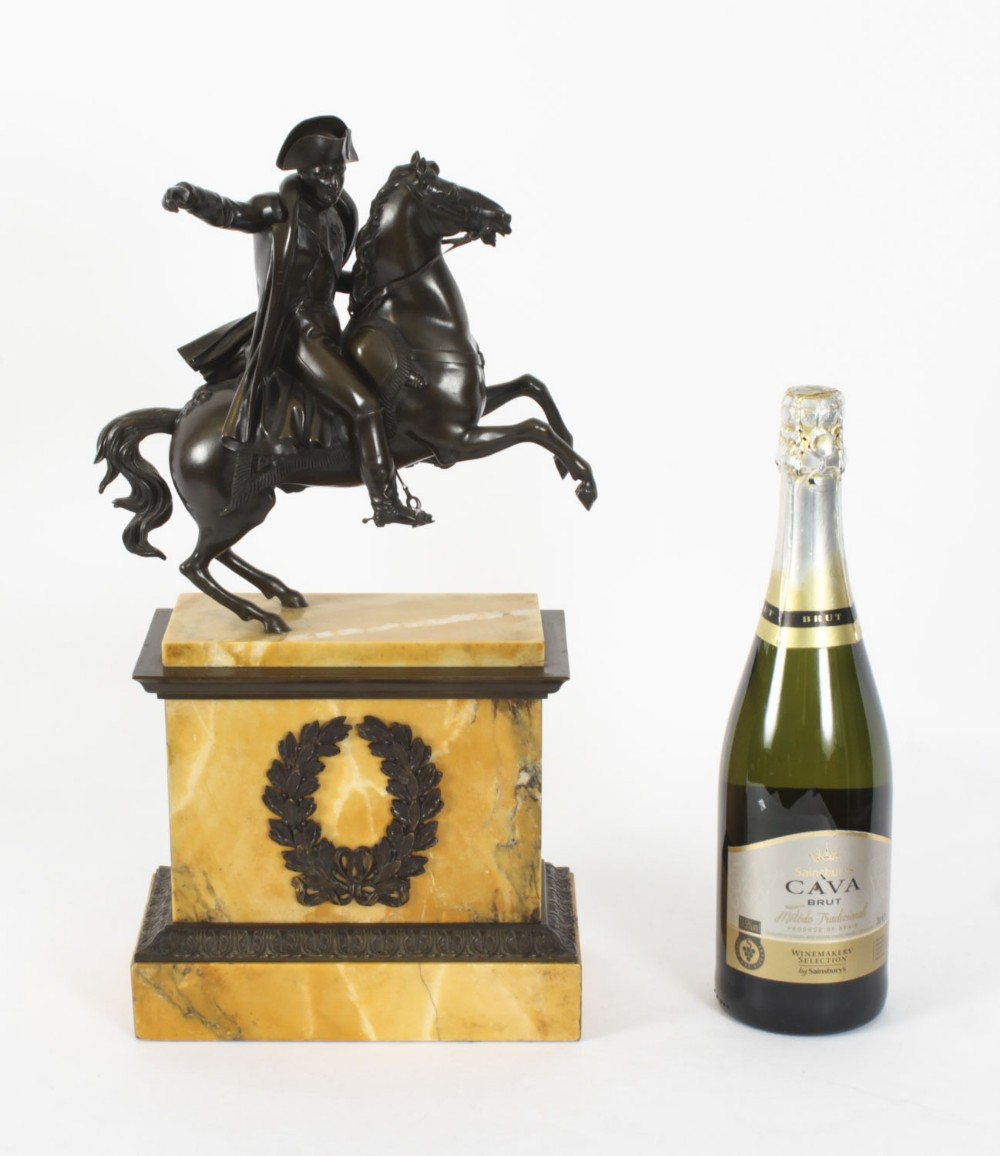
Antique Patinated Bronze Equestrian Statue of Napoleon Bonaparte C1870 19th C

19th century
Sold 29 December 2024 · Regent Antiques
This “Antique Patinated Bronze Equestrian Statue of Napoleon Bonaparte C1870 19th C” found a buyer.

It was listed by Regent Antiques. Sold pieces stay on Sellingantiques as a record of what has passed through, and the next one is rarely far away.

Description

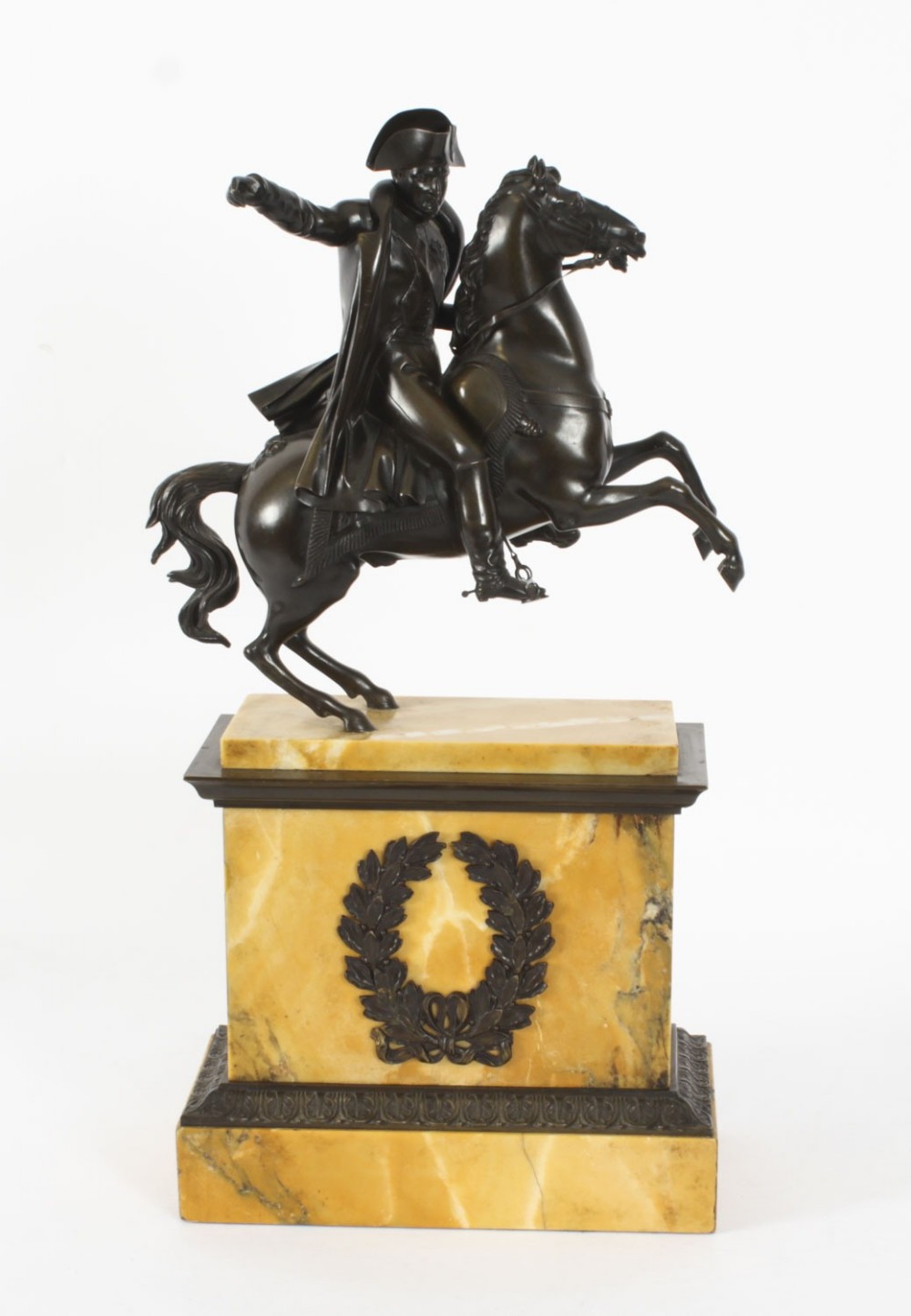
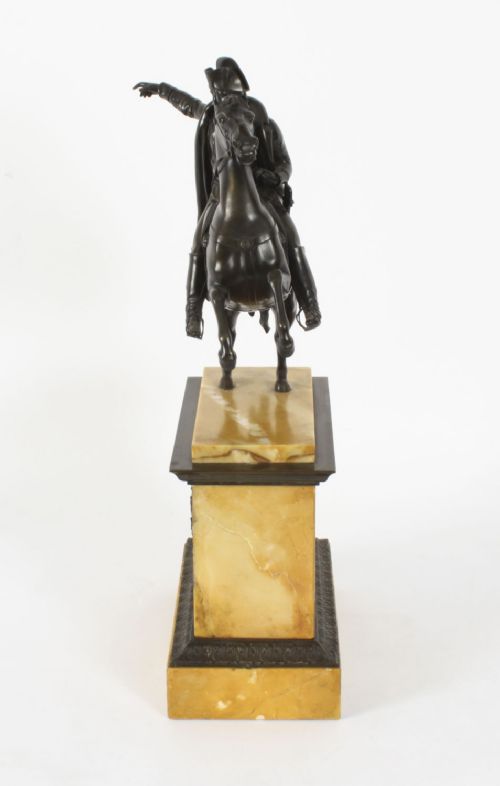
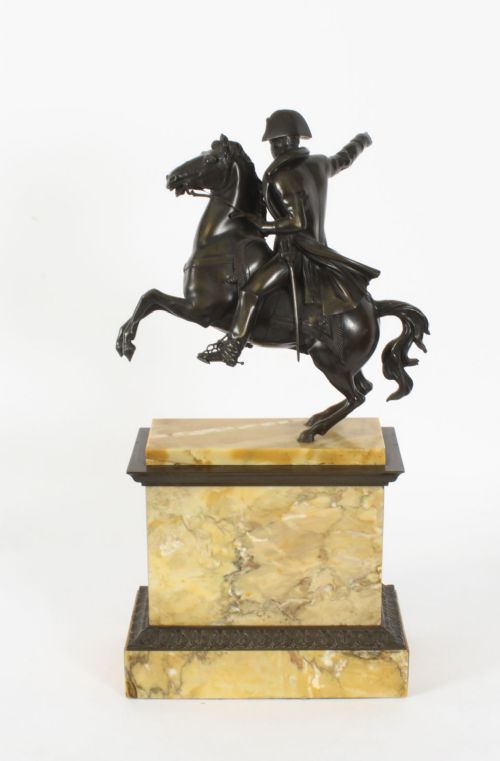
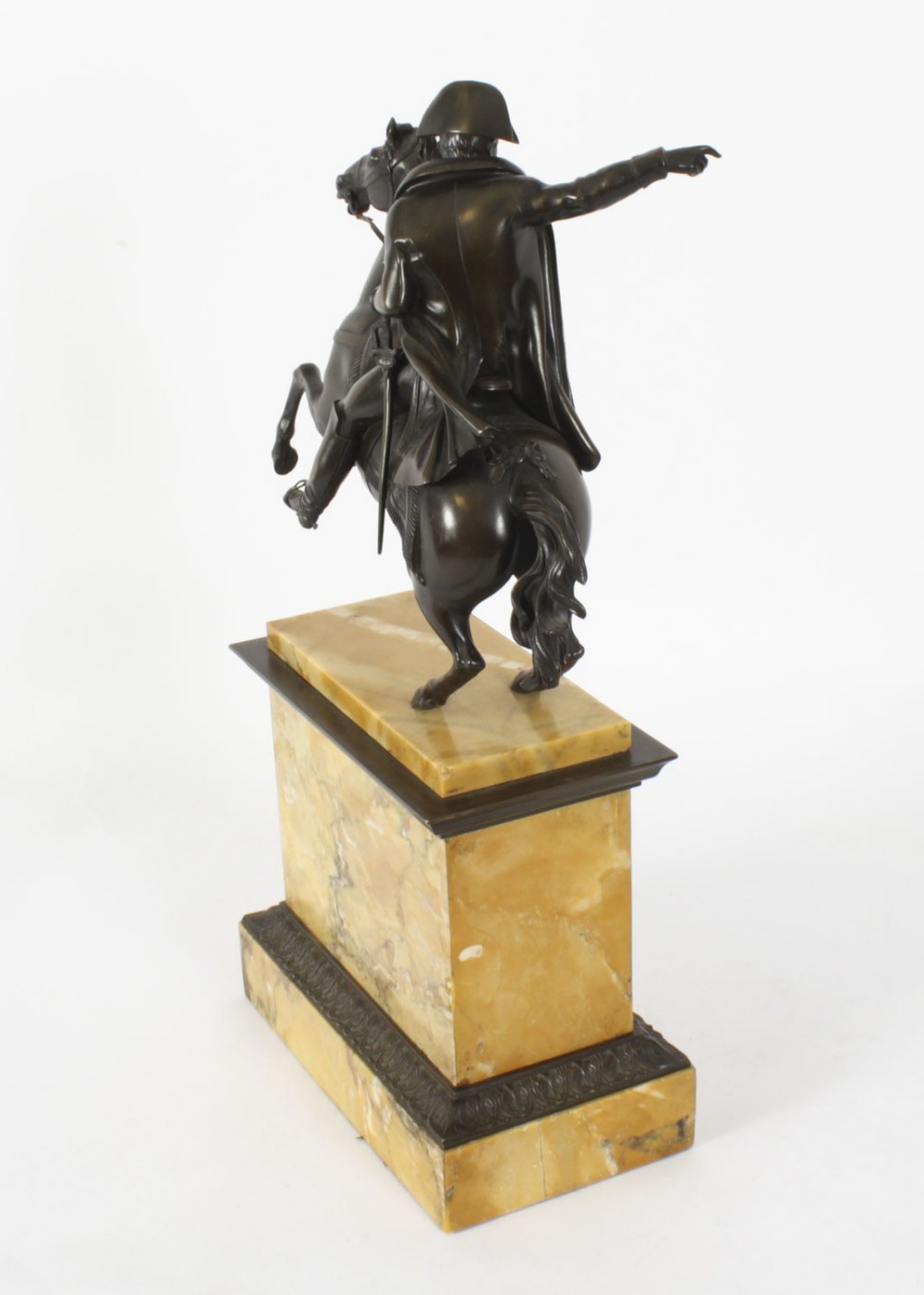
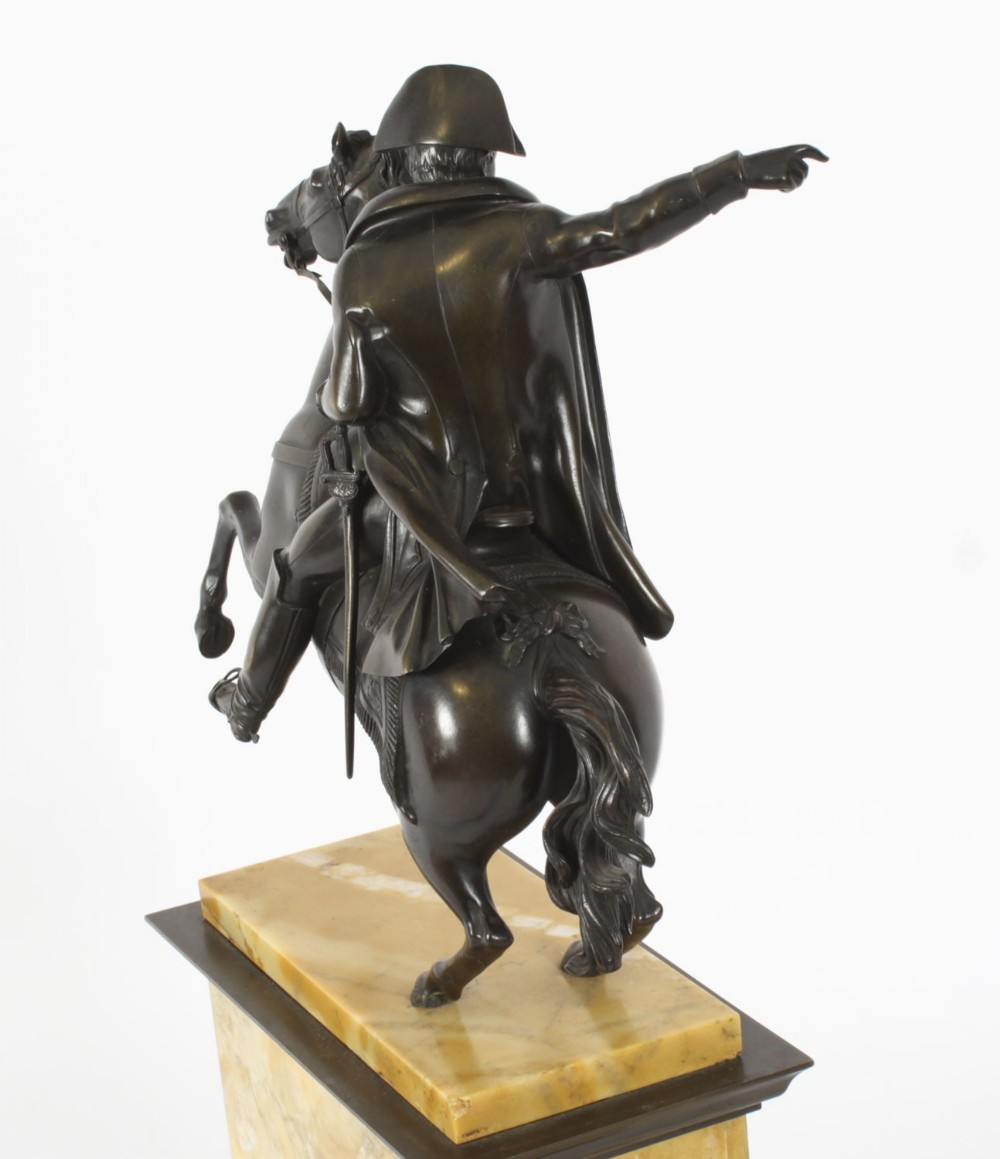
This is a superb antique patinated bronze Equestrian Statue of Napoleon Bonaparte, circa 1870 in date.

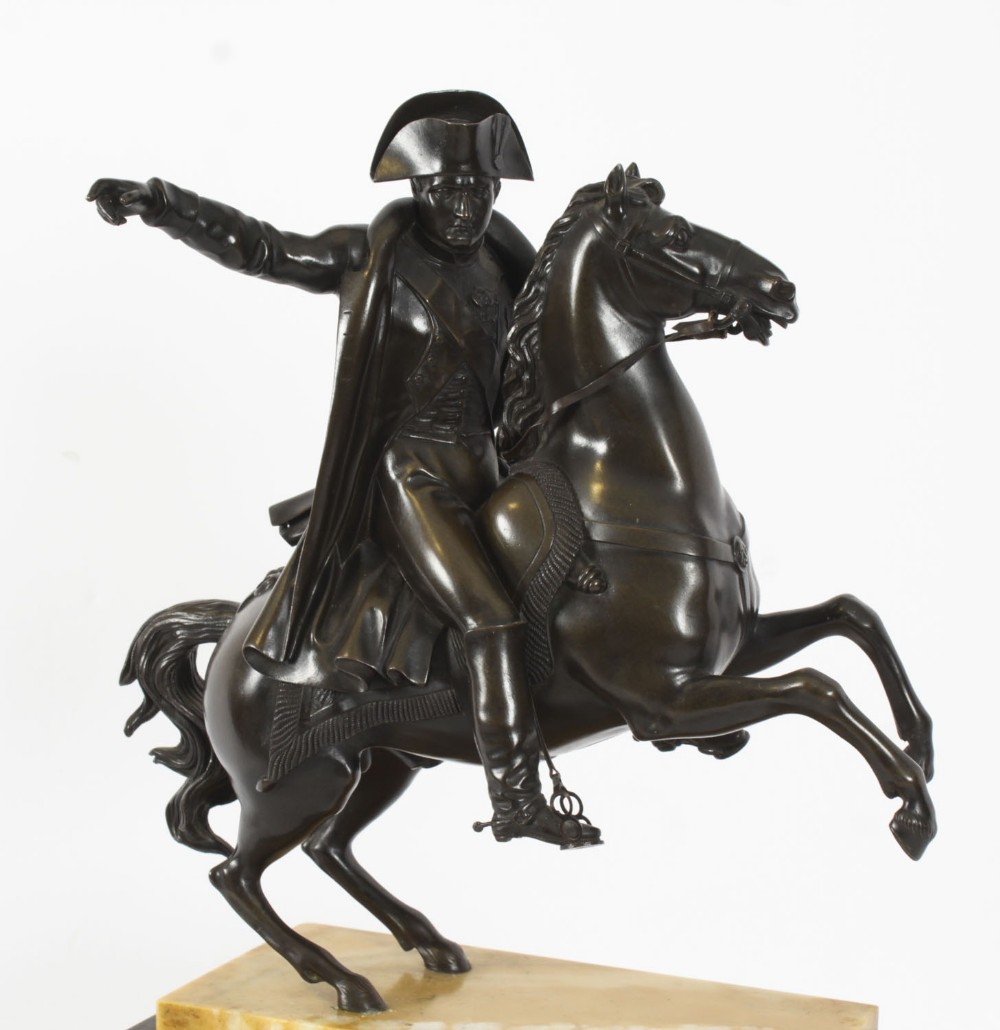
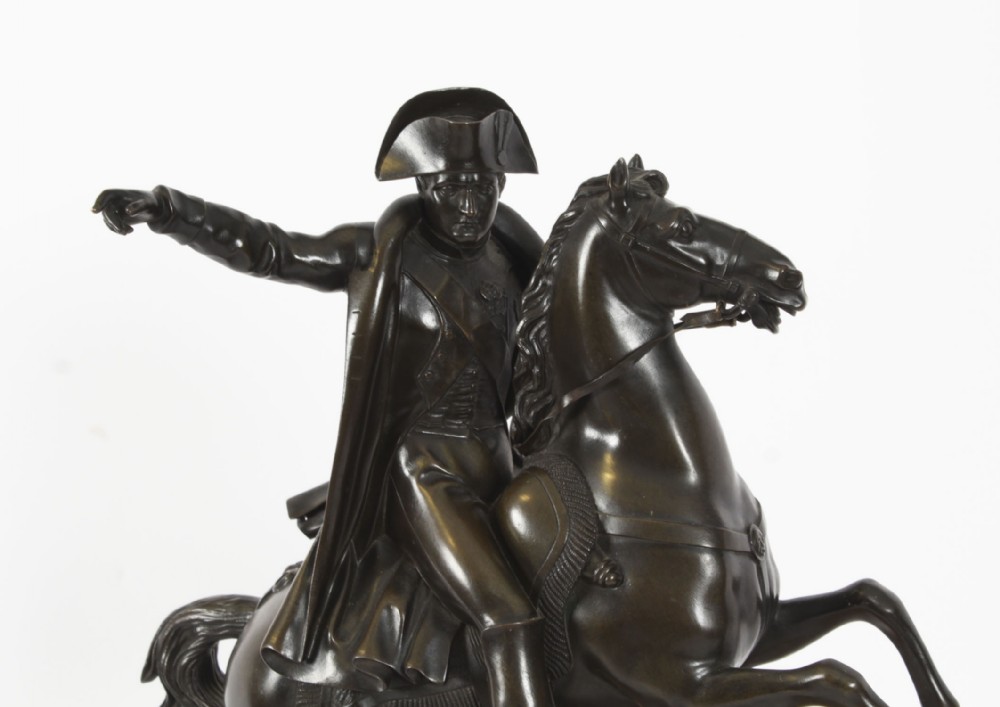
This stunning patinated bronze statue portrays the French leader in his typical uniform - wearing a bicorn hat, epaulettes, chivalrous orders and military decorations, waistcoat, sword and knee-high boots - while riding his horse, Marango, with his right-hand arm raised upward in the act of commanding.

The horse is moving with the two front legs raised conveying a great sense of movement. The figure of Napoleon is extremely life-like as much as to convey the idea of a strong military leader, emanating power and energy.

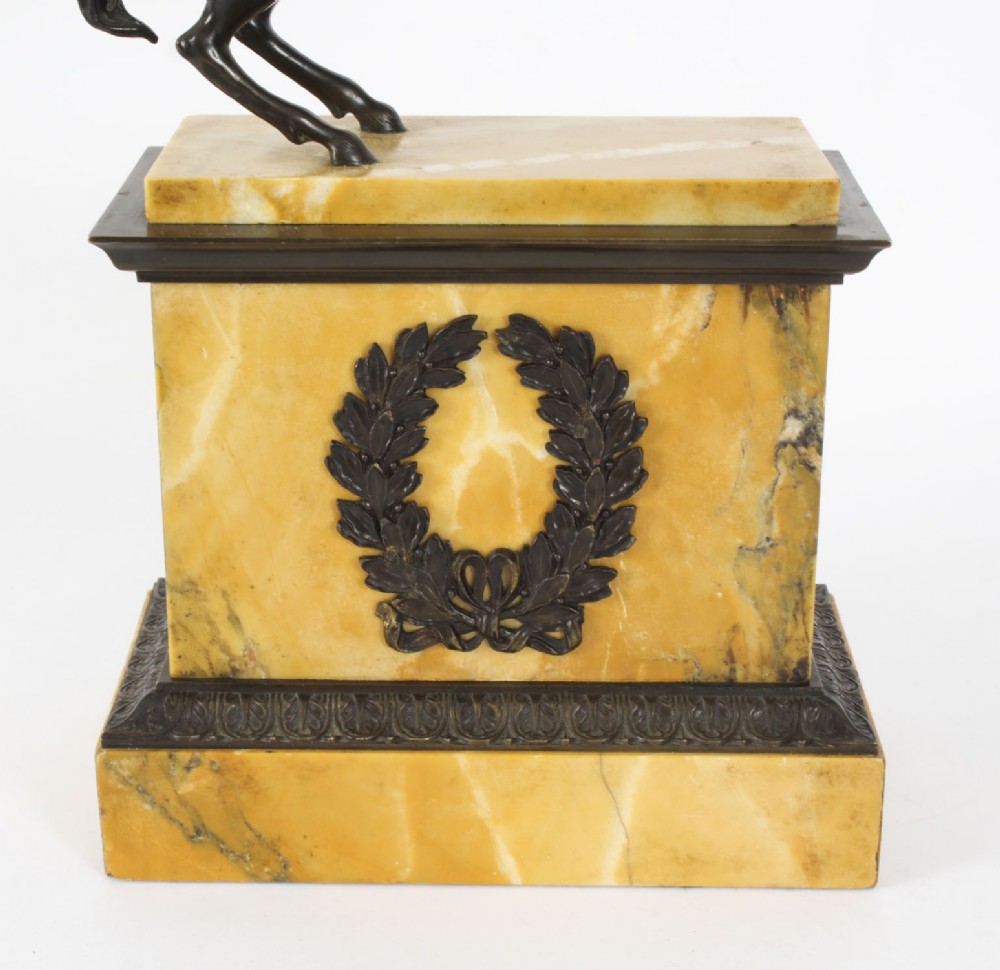
It is raised on a magnificent foliate parcel-gilt bronze and sienna marble stepped rectangular plinth with a large bronze laurel wreath.

This high-quality hot cast solid bronze was produced by using the traditional "lost wax" process, otherwise known as the "cire perdue" method.

The craftsmanship is second to none throughout all aspects of this bronze which is sure to add an unparalleled touch of class to your home.

Condition:

In excellent condition, please see photos for confirmation.

Dimensions in cm:

Height 46 cm x Width 24 cm x Depth 15 cm

Dimensions in inches:

Height 1 foot, 6 inches x Width 9 inches x Depth 6 inches

Napoleon Bonaparte (French:15 August 1769 – 5 May 1821) was a military and political leader of France and Emperor of the French as Napoleon I, whose actions shaped European politics in the early 19th century.

Napoleon was born in Corsica to parents of minor noble Italian ancestry and trained as an artillery officer in mainland France. Bonaparte rose to prominence under the French First Republic and led successful campaigns against the First and Second Coalitions arrayed against France. In 1799, he staged a coup d'état and installed himself as First Consul; five years later the French Senate proclaimed him emperor. In the first decade of the 19th century, the French Empire under Napoleon engaged in a series of conflicts—the Napoleonic Wars—involving every major European power. After a streak of victories, France secured a dominant position in continental Europe, and Napoleon maintained the French sphere of influence through the formation of extensive alliances and the appointment of friends and family members to rule other European countries as French client states.

The French invasion of Russia in 1812 marked a turning point in Napoleon's fortunes. His Grande Armée was badly damaged in the campaign and never fully recovered. In 1813, the Sixth Coalition defeated his forces at Leipzig; the following year the Coalition invaded France, forced Napoleon to abdicate and exiled him to the island of Elba. Less than a year later, he escaped Elba and returned to power, but was defeated at the Battle of Waterloo in June 1815. Napoleon spent the last six years of his life in confinement by the British on the island of Saint Helena. An autopsy concluded he died of stomach cancer, though Sten Forshufvud and other scientists have since conjectured he was poisoned with arsenic.

Napoleon's campaigns are studied at military academies throughout much of the world. While considered a tyrant by his opponents, he is also remembered for the establishment of the Napoleonic code, which laid the administrative and judicial foundations for much of Western Europe.

Sometimes called by the French name of 'cire perdue' or the Latin, 'cera perduta' is the process by which a bronze or brass is cast from an artist's sculpture.In industrial uses, the modern process is called investment casting. An ancient practice, the process today varies from foundry to foundry, but the steps which are usually used in casting small bronze sculptures in a modern bronze foundry are generally quite standardised.

Lost Wax Method

sometimes called by the French name of cire perdue or the Latin, ce

Date of Manufacture

Regent Antiques has dated this Bronze Equestrian Statue to the 1870s.

Physical Dimensions
Height
46cm (18.11")
Width
24cm (9.45")
Depth
15cm (5.91")
Reference Numbers
Sellingantiques Reference
SA1115377
Dealers Internal Reference
A4255
A patinated dark bronze equestrian statue of Napoleon mounted on a rearing horse, set upon a yellow marble plinth base.Detail view 1Detail view 2Detail view 3Detail view 4Detail view 5Detail view 6Detail view 7Detail view 8Detail view 9Detail view 10Detail view 11
SOLD6+ MONTHS AGO
1 / 12
1870s · SA1115377
Antique Patinated Bronze Equestrian Statue of Napoleon Bonaparte C1870 19th C
Sorry, but this item has been sold.
Description
This is a superb antique patinated bronze Equestrian Statue of Napoleon Bonaparte, circa 1870 in date.

This stunning patinated bronze statue portrays the French leader in his typical uniform - wearing a bicorn hat, epaulettes, chivalrous orders and military decorations, waistcoat, sword and knee-high boots - while riding his horse, Marango, with his right-hand arm raised upward in the act of commanding.

The horse is moving with the two front legs raised conveying a great sense of movement. The figure of Napoleon is extremely life-like as much as to convey the idea of a strong military leader, emanating power and energy.

It is raised on a magnificent foliate parcel-gilt bronze and sienna marble stepped rectangular plinth with a large bronze laurel wreath.

This high-quality hot cast solid bronze was produced by using the traditional "lost wax" process, otherwise known as the "cire perdue" method.

The craftsmanship is second to none throughout all aspects of this bronze which is sure to add an unparalleled touch of class to your home.

Condition:

In excellent condition, please see photos for confirmation.

Dimensions in cm:

Height 46 cm x Width 24 cm x Depth 15 cm

Dimensions in inches:

Height 1 foot, 6 inches x Width 9 inches x Depth 6 inches

Napoleon Bonaparte (French:15 August 1769 – 5 May 1821) was a military and political leader of France and Emperor of the French as Napoleon I, whose actions shaped European politics in the early 19th century.

Napoleon was born in Corsica to parents of minor noble Italian ancestry and trained as an artillery officer in mainland France. Bonaparte rose to prominence under the French First Republic and led successful campaigns against the First and Second Coalitions arrayed against France. In 1799, he staged a coup d'état and installed himself as First Consul; five years later the French Senate proclaimed him emperor. In the first decade of the 19th century, the French Empire under Napoleon engaged in a series of conflicts—the Napoleonic Wars—involving every major European power. After a streak of victories, France secured a dominant position in continental Europe, and Napoleon maintained the French sphere of influence through the formation of extensive alliances and the appointment of friends and family members to rule other European countries as French client states.

The French invasion of Russia in 1812 marked a turning point in Napoleon's fortunes. His Grande Armée was badly damaged in the campaign and never fully recovered. In 1813, the Sixth Coalition defeated his forces at Leipzig; the following year the Coalition invaded France, forced Napoleon to abdicate and exiled him to the island of Elba. Less than a year later, he escaped Elba and returned to power, but was defeated at the Battle of Waterloo in June 1815. Napoleon spent the last six years of his life in confinement by the British on the island of Saint Helena. An autopsy concluded he died of stomach cancer, though Sten Forshufvud and other scientists have since conjectured he was poisoned with arsenic.

Napoleon's campaigns are studied at military academies throughout much of the world. While considered a tyrant by his opponents, he is also remembered for the establishment of the Napoleonic code, which laid the administrative and judicial foundations for much of Western Europe.

Sometimes called by the French name of 'cire perdue' or the Latin, 'cera perduta' is the process by which a bronze or brass is cast from an artist's sculpture.In industrial uses, the modern process is called investment casting. An ancient practice, the process today varies from foundry to foundry, but the steps which are usually used in casting small bronze sculptures in a modern bronze foundry are generally quite standardised.

Lost Wax Method

sometimes called by the French name of cire perdue or the Latin, ce
Date1870s
Height46cm (18.11")
Width24cm (9.45")
Depth15cm (5.91")
ReferenceSA1115377
Dealer's referenceA4255
Regent Antiques
Regent AntiquesSellingantiques verified since Sep 2016

We specialise in english and continental furniture, silver, porcelain and decorative items.

Member of LAPADA CINOA

SHARE
SAVE
Archive I A patinated dark bronze equestrian statue of Napoleon mounted on a rearing horse, set upon a yellow marble plinth base. SOLD6+ MONTHS AGO

Antique Patinated Bronze Equestrian Statue of Napoleon Bonaparte C1870 19th C

Archive II A patinated dark bronze equestrian statue of Napoleon mounted on a rearing horse, set upon a yellow marble plinth base. View II
Archive III A patinated dark bronze equestrian statue of Napoleon mounted on a rearing horse, set upon a yellow marble plinth base. View III
Archive IV A patinated dark bronze equestrian statue of Napoleon mounted on a rearing horse, set upon a yellow marble plinth base. View IV
Archive V A patinated dark bronze equestrian statue of Napoleon mounted on a rearing horse, set upon a yellow marble plinth base. View V
Archive VI A patinated dark bronze equestrian statue of Napoleon mounted on a rearing horse, set upon a yellow marble plinth base. View VI
Archive VII A patinated dark bronze equestrian statue of Napoleon mounted on a rearing horse, set upon a yellow marble plinth base. View VII
Archive VIII A patinated dark bronze equestrian statue of Napoleon mounted on a rearing horse, set upon a yellow marble plinth base. View VIII
Archive IX A patinated dark bronze equestrian statue of Napoleon mounted on a rearing horse, set upon a yellow marble plinth base. View IX
Archive X A patinated dark bronze equestrian statue of Napoleon mounted on a rearing horse, set upon a yellow marble plinth base. View X
Archive XI A patinated dark bronze equestrian statue of Napoleon mounted on a rearing horse, set upon a yellow marble plinth base. View XI
Archive XII A patinated dark bronze equestrian statue of Napoleon mounted on a rearing horse, set upon a yellow marble plinth base. View XII
FURTHER BROWSING

Visitors also looked at these ⇣

Enlarged Archival View
Location
Manor Warehouse
318 Green Lanes
London
N4 1BX
United Kingdom
Verified Since Sep 2016
Items For Sale 639
Items Sold 2,756
Regent Antiques
Regent Antiques
Verified Since Sep 2016
View Dealer Info
Location: Manor Warehouse, 318 Green Lanes, London, N4 1BX, United Kingdom
Verified
Sep 2016
For Sale
639
Sold
2,756
A patinated dark bronze equestrian statue of Napoleon mounted on a rearing horse, set upon a yellow marble plinth base.
Antique Patinated Bronze Equestrian Statue of Napoleon Bonaparte C1870 19th C
Ref: SA1115377
A patinated dark bronze equestrian statue of Napoleon mounted on a rearing horse, set upon a yellow marble plinth base.
Detail View 1
Detail View 2
Detail View 3
Detail View 4
Detail View 5
Detail View 6
Detail View 7
Detail View 8
Detail View 9
Detail View 10
Detail View 11
Archival Detail
Every single antique dealer on our platform is individually approved by our internal team. We verify their professional trade history, ethical standards, and photographic quality to ensure a secure, high-standard buying environment. Upon joining, every dealer agrees to a strict 9-point code of conduct. While issues can occasionally arise, our dealers typically resolve them swiftly and directly with the buyer. In fact, since our founding in 2002, Sellingantiques has only had to step in to help resolve an issue on roughly five occasions—a true testament to the quality of our dealers and their dedication to your happiness.
Our dealers are highly experienced in packing and shipping fragile, high-value antiques. Because you are in direct contact with the dealer, you will be able to easily go through all available shipping and insurance options together to ensure your item arrives safely.
Antiques are the ultimate green purchase. By choosing historical pieces over newly manufactured goods, you completely eliminate the carbon footprint of modern mass production while preserving exceptional, timeless craftsmanship.
Written by Sellingantiques from the dealer’s photographs and listing
  • ObjectSculptures & Statues
  • Period19th century
  • StyleVictorian & Gothic
  • MaterialBronze, Marble
  • ColourDark Brown
  • MotifsRearing horse, Bicorne hat, Laurel wreath, Plinth base
  • SizeH 46 cm (18 in) x W 24 cm (9 in) x D 15 cm (6 in)

Nineteenth-century French bronzes frequently celebrated military leadership, classical heroism, and historical figures using precise metal casting techniques.

These pieces are typically produced using the lost-wax casting method, resulting in solid or hollow metal forms finished with a chemical patination.

Authentic examples exhibit natural surface oxidisation, fine chisel work detailing post-casting, foundry marks, and substantial weight appropriate for bronze.

Position the piece as a focal point on a sturdy surface such as a mantelpiece, office desk, or bookcase to add historical depth and architectural gravity.

Dust gently with a soft, dry microfibre cloth and avoid chemical cleaners or excessive handling to preserve the integrity of the historical patina.
items
Add keywords to the filter
Price
£100
£250000
Era
Period
Style
Material
Origin
Stock Location
Recently Added
Online Payments
Categories