
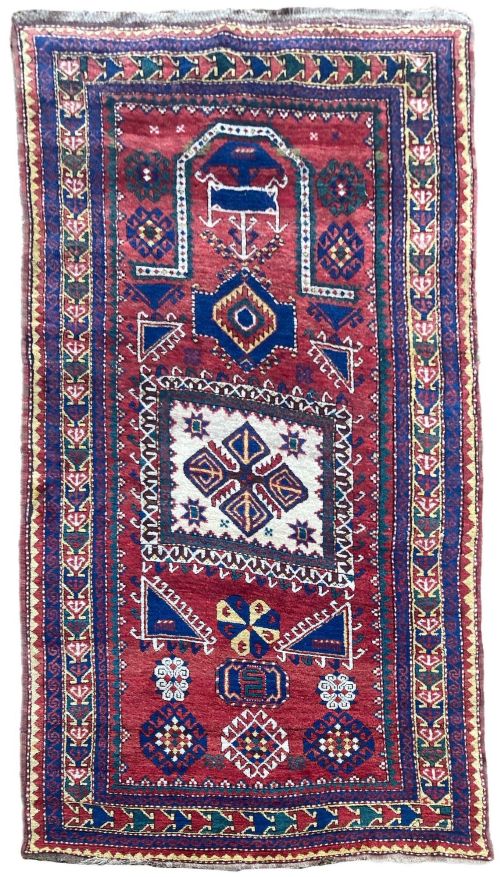
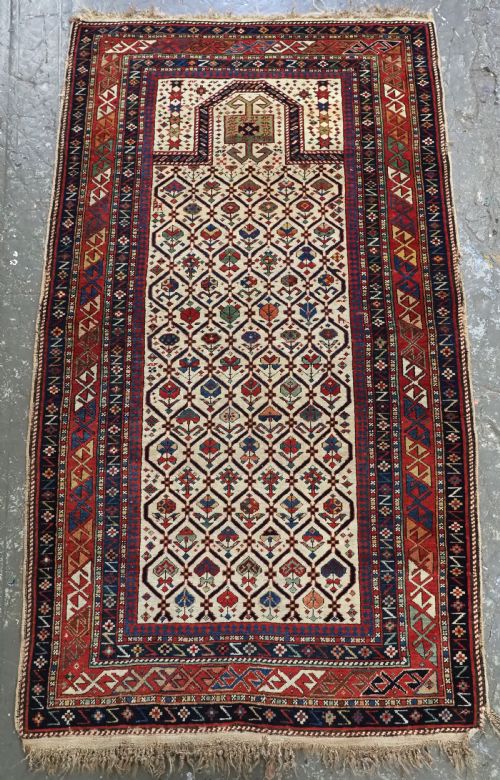
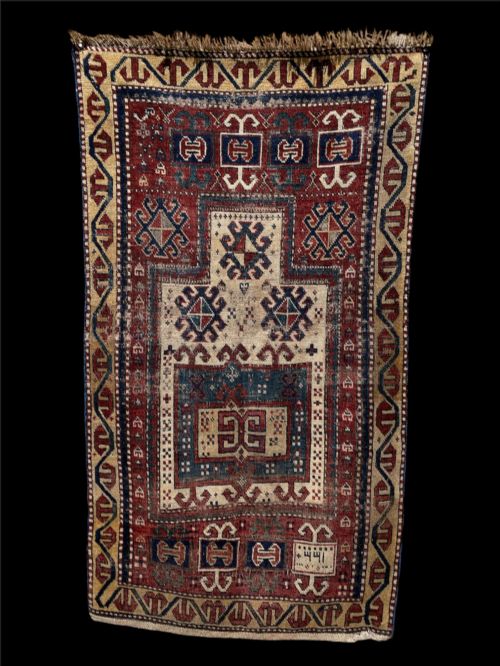


Wool Caucasian Prayer Rug
These wool caucasian prayer rug examples are tribal weavings featuring architectural prayer niches, collected for their geometric power and saturated natural dyes.
Wool Caucasian Prayer Rug
A wool caucasian prayer rug is a tribal weaving originating from the Caucasus region, typically distinguished by a distinct arched mihrab or niche design intended for devotional use. When you search for a wool caucasian prayer rug, you encounter pieces spanning from the mid-nineteenth century through to the early twentieth century.
The selections available here showcase specific regional subtypes such as Kazak, Gendje, Dagestan, Shirvan, Kuba, Karabagh, and Marasali. These floor coverings vary from square formats to long runner proportions, often displaying bold geometric medallions, floral lattices, or repeated boteh motifs.
Materials and construction methods
These textiles rely on handspun wool for the pile, foundations, and fringes, yielding a dense and resilient surface that withstands daily use. Cotton also appears in the structural elements of certain pieces from the region.
Weavers knotted the wool by hand onto vertical looms, employing traditional symmetrical or asymmetrical knotting techniques passed down through generations. Natural dye sources provided the deep blue, yellow, ivory, and red colour palettes seen across the surviving inventory.
Regional styles represented include Kazak, Dagestan, Gendje, Shirvan, Kuba, Karabagh, and Marasali.
Assessing quality in regional weavings
Quality rests upon the crispness of the geometric drawing, the saturation and clarity of the wool pile, and the survival of the original outer borders. Pieces displaying scarce ground colours or unusually precise lattice work generally sit at the higher end of the spectrum.
The handle of the textile, determined by the tightness of the knotting and the preparation of the wool, signals the competence of the workshop or tribal weaver. Condition plays a role, with original end finishes and minimal pile interruption preserving the integrity of the design.
The Wool Caucasian Prayer Rug Glossary
- Mihrab
- The pointed architectural arch or niche at one end of a prayer rug, which symbolises the direction of prayer. This motif directs the eye toward the centre of the composition.
- Kazak
- A regional designation for rugs woven in the western Caucasus, known for large geometric medallions and robust wool piles. These pieces often utilise primary red and blue tones.
- Boteh
- A stylised almond, pear, or flame-shaped motif of ancient Persian origin, frequently repeated across Caucasian field designs. Marasali rugs are particularly noted for this element.
- Gendje
- A town and weaving district in the eastern Caucasus producing rugs with diagonal stripes, star motifs, and dense geometric borders. They date predominantly to the nineteenth century.
- Shirvan
- A northern Caucasian weaving centre famous for ivory ground prayer rugs and balanced floral lattice patterns. Their output generally exhibits fine knotting and precise geometric control.
Wool Caucasian Prayer Rug: Frequently Asked Questions
What is a prayer rug?
A prayer rug is a small carpet featuring a distinct pointed arch or niche design at one end. This architectural motif served to indicate the direction of prayer during daily devotions.
Historically, owners placed these textiles on the floor or hung them on walls within domestic spaces. Their portable nature allowed families to transport them easily.
How do I identify a Kazak rug?
Kazak rugs are distinguished by their bold geometric medallions, thick wool pile, and primary use of saturated red, blue, and green hues. They originate from the western Caucasus and possess a heavy, rustic handle.
Unlike the finer, more delicate lattices found in Shirvan or Dagestan weaving, Kazak designs favour large-scale octagons, squares, and stylized animal or human forms.
What does a boteh motif mean?
The boteh is a traditional pear or flame-shaped motif representing life and eternity. It appears extensively across Caucasian and Persian tribal textiles.
In Marasali and Dagestan prayer rugs, these motifs often fill the field in neat rows or surround the central niche. Variations range from stiff geometric shapes to flaming, curved silhouettes.
How should I care for an antique rug?
Protect antique wool floor coverings by placing a breathable rug pad underneath to prevent slipping and reduce friction. Vacuum gently with a suction-only attachment, avoiding motorized brush rolls that pull at aged fibres.
Keep these textiles out of direct, prolonged sunlight to prevent natural dye fading. Rotate the rug periodically to ensure even wear patterns across the surface.