
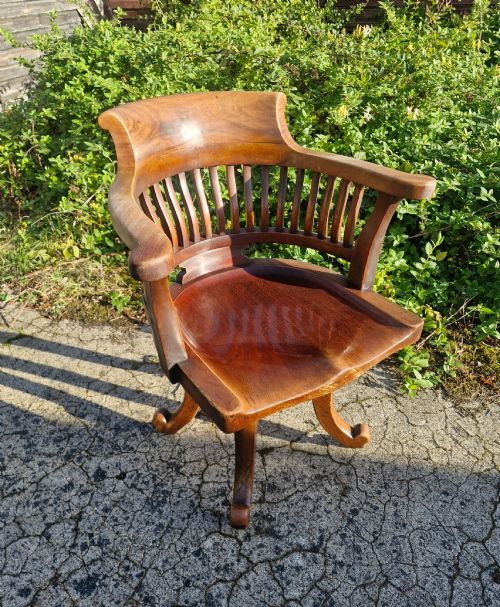
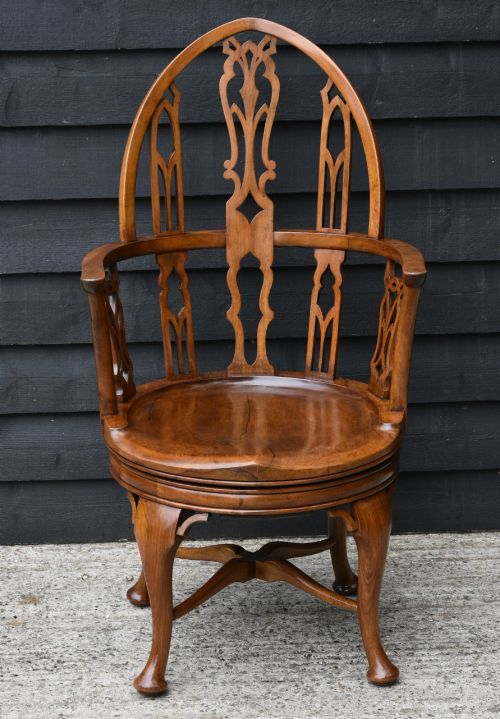
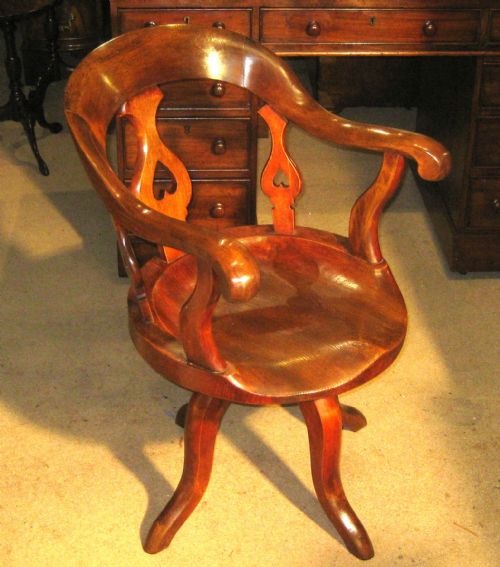
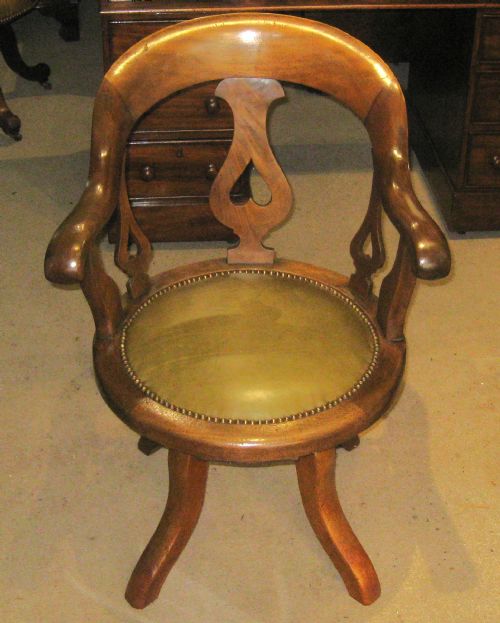
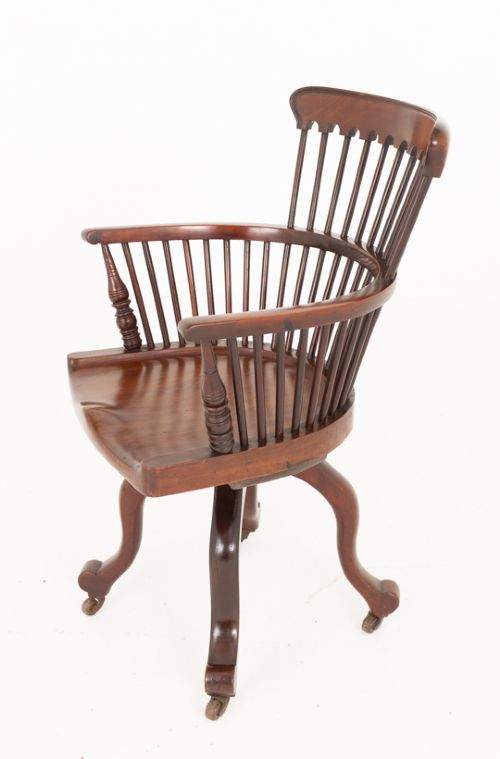
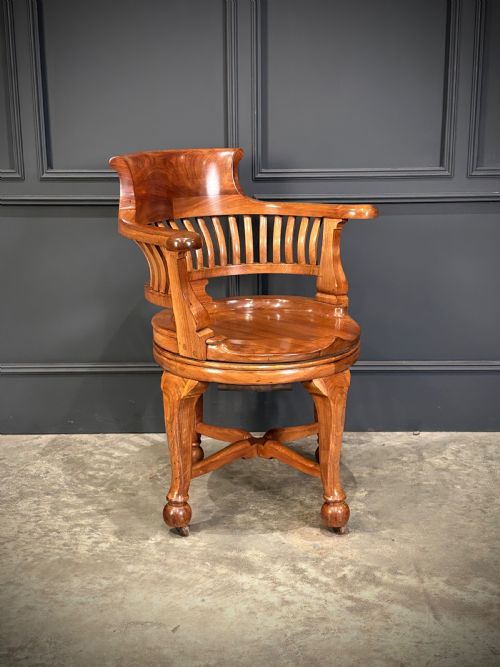
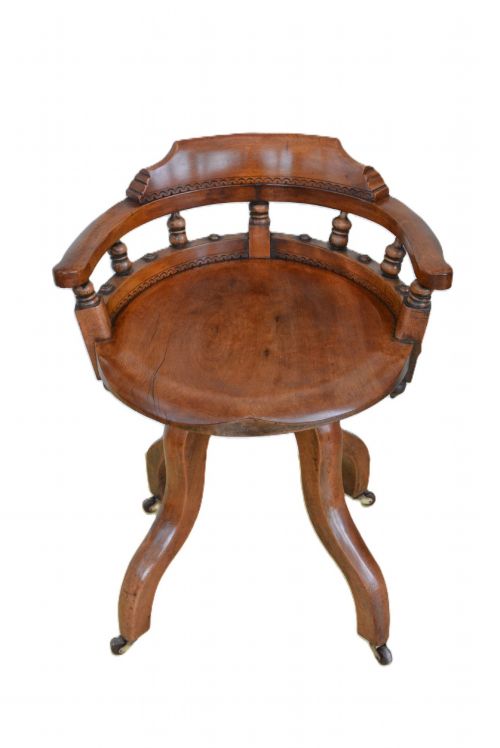
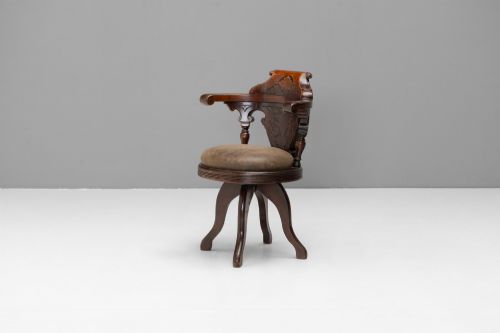


Wooden Revolving Armchair
A wooden revolving armchair delivers sturdy support and effortless turning for long hours at a desk.
Wooden Revolving Armchair
A wooden revolving armchair functions primarily as a practical desk or office chair designed for steady movement and support. These pieces emerge across the Victorian, Edwardian, and Art Deco periods, alongside distinct styles like the Aesthetic Movement and Arts and Crafts.
The most common examples encountered on this page date from the late nineteenth and early twentieth centuries, particularly spanning the 1870s through the 1930s. Desk chairs and office chairs dominate the selection, often taking the form of swivel and tilt designs intended for heavy daily use.
Materials and construction methods
Makers constructed these chairs using resilient timbers such as mahogany, oak, walnut, ash, and beech, frequently pairing them with leather upholstery for added comfort. Structural stability relied heavily on internal iron, brass, and cast iron swivel mechanisms that permitted rotation and tilting.
Joinery techniques ranged from plain turned supports to heavily carved frames, reflecting the aesthetic preferences of periods like the Gothic Revival and the Arts and Crafts movement. Polished wooden seats appeared alongside upholstered pads, secured to metal swivel mechanisms beneath.
Listings feature oak, mahogany, and walnut woods alongside iron and brass swivel mechanisms spanning the Victorian to Art Deco periods.
Factors that define quality
The sophistication of the timber figure and the complexity of the carving separate standard workshop pieces from finer examples. Richly grained solid mahogany and figured walnut indicate superior material selection.
The mechanical engineering of the swivel and tilt mechanism dictates the standard of execution. Robust iron and brass swivel hardware that operates smoothly points to higher workshop capability.
Edward William Godwin·Kendrick & Jefferson·Shoolbred
The Wooden Revolving Armchair Glossary
- Swivel
- A mechanism allowing the upper portion of the chair to rotate fully on its base. This mechanical pivot is central to the function of any revolving desk chair.
- Bergere
- A type of upholstered armchair with an enclosed cane back or sides. It appears occasionally on swivel chair variants utilising oak frames.
- Aesthetic Movement
- A late nineteenth-century design style emphasising visual beauty over narrative subject matter. Pieces from this movement display clean architectural lines and refined ornamentation.
- Arts and Crafts
- A design movement valuing traditional craftsmanship and visible construction. Chairs from this tradition often display honest joinery and solid oak or walnut builds.
- Gothic Revival
- An architectural and decorative style drawing on medieval forms. This style manifests in heavy carvings and pointed arches on nineteenth-century seating.
Wooden Revolving Armchair: Frequently Asked Questions
How do I date a wooden revolving armchair?
Dating relies on observing stylistic markers such as heavy Victorian carvings, Edwardian simplicity, or later Arts and Crafts construction details. Examining the timber types, from solid mahogany to ash and beech, also helps establish the era.
Hardware offers further clues, as early cast iron and brass swivel mechanisms differ noticeably from twentieth-century engineering. Comparing the joinery against known period pieces confirms the manufacturing decade.
Were these chairs used only in offices?
While primarily built as desk chairs and office chairs, these revolving armchairs also served in libraries and domestic studies. Their swivel and tilt functions suited administrative tasks and reading alike.
Some variants, such as ships chairs, incorporated similar revolving designs for maritime use or stable domestic seating. Their sturdy wooden construction ensured durability across various working environments.
What is the difference between an office chair and a desk chair?
In historical listings, office chairs and desk chairs often overlap in form and function, both featuring central swivel mechanisms and armrests. Office variants frequently highlight tilt functions for extended seating.
Desk chairs may lean towards specific aesthetic styles like the Aesthetic Movement or Gothic Revival. Both types prioritise robust timber frames and reliable mechanical rotation.
How should I care for the wooden frame?
Maintain the timber by keeping the chair away from direct heat sources and sudden humidity changes to prevent wood splitting. Regular dusting with a dry cloth preserves the polished surface.
Apply a suitable wax polish occasionally to nourish hardwoods like mahogany, oak, and walnut. Avoid harsh chemical cleaners that might strip the historic finish.