




William IV Marble Table
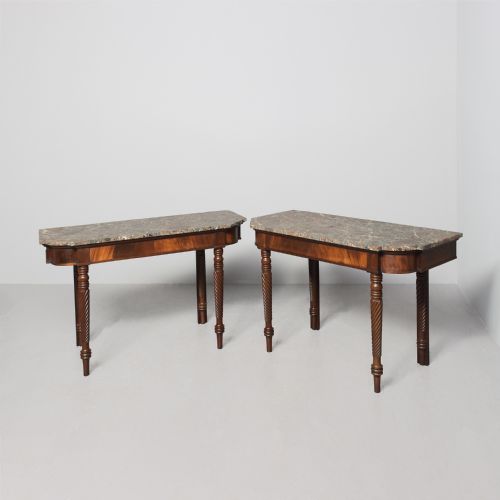
A william iv marble table brings structural weight and geological variety into a room through heavy timber and cool stone.
William IV Marble Table
When you search for a william iv marble table, you encounter substantial furniture built primarily for formal reception rooms during the early nineteenth century. Console tables, centre tables, and side tables dominate the selection, frequently paired with matching mirrors or cabinets from the same era.
The prevailing timber framework aligns with the William IV, Regency, and early Victorian periods, drawing upon traditional cabinet-making centres in Britain. Scottish larchwood and English workshops both contribute to the surviving variety.
Console tables designed for wall placement appear alongside freestanding centre tables and tripod stands. Many pieces reflect the stylistic transition from late Regency restraint towards heavier Victorian ornamentation.
Materials and construction
Makers utilised dense native and imported timbers, pairing mahogany and rosewood frames with heavy slabs of white, grey, or specimen marble. Walnut, giltwood, and brass mounts also appear in supporting roles, securing structural stability for weighty stone tops.
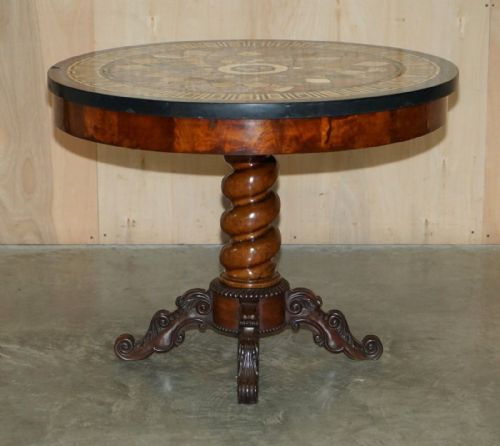
Advanced stone-cutting techniques allowed craftsmen to inlay complex geometric patterns or multi-coloured hardstone and pietra dura specimens directly into the marble surfaces. Joinery relied on solid timber construction designed to bear the considerable load of polished stone.
Listings feature mahogany, rosewood, walnut, and larchwood combined with white marble, grey marble, and multi-coloured hardstone specimens.
Judging quality and execution
Carved details upon the rosewood or mahogany bases distinguish standard production pieces from workshop outputs influenced by makers such as Gillows or Kentian design principles. Crispness in carved scrolls and solid brass mounts elevates a piece above simpler domestic examples.
The William IV Marble Table Glossary
- Console table
- A table designed to stand against a wall, frequently secured to the structure or supported by heavy front legs. These tables often feature shaped marble tops intended to display decorative objects.
- Specimen marble
- A polished stone top composed of numerous pieces of different coloured marbles or hardstones arranged in geometric or pictorial patterns. This technique showcases geological variety.
- Pietra dura
- An artistic technique using cut and fitted polished coloured stones to create detailed images. It appears on table tops from this period as a mark of high status.
- Gueridon
- A small circular table supported by a central pillar or tripod base. In this context, they frequently feature inset marble tops.
William IV Marble Table: Frequently Asked Questions
How do I clean a marble top?
Wipe the surface using a soft cloth dampened with warm water and mild, neutral soap. Avoid acidic cleaners or vinegar, which etch polished stone.
Dry the marble thoroughly afterwards to prevent water spots and maintain the natural lustre of the polished surface.
Where should I place a console table?
Position console tables against a flat wall in a hallway, drawing room, or dining space. They provide a stable surface for lamps, decorative bowls, and mirrors.
Because many period console tables were designed to anchor against a wall for support, placement in open rooms requires checking their freestanding stability.
What is a specimen marble top?
A specimen top incorporates multiple small pieces of different coloured marbles, fossils, or hardstones arranged into a decorative geometric composition. Each section is meticulously cut and fitted together.
Tables featuring these tops represent higher workshop investment and geological display during the nineteenth century.
How do I identify the wood?
Examine the grain pattern, colour, and density of the timber frame beneath the marble top. Mahogany displays a warm reddish-brown tone with straight or ribbon-like grain.
Rosewood exhibits darker purple-brown streaks with an oily sheen, while walnut shows a softer, highly figured grain structure.