




White Staffordshire Poodles
White staffordshire poodles are earthenware companion figures modelled as curly-coated dogs, prized by collectors for their charming Victorian domestic presence.
White Staffordshire Poodles
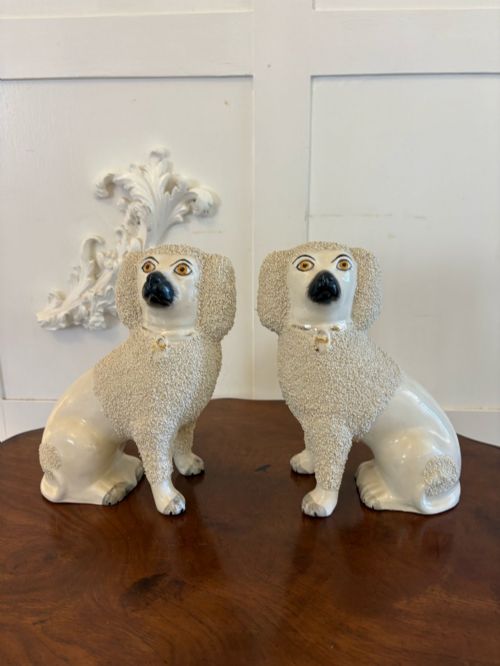
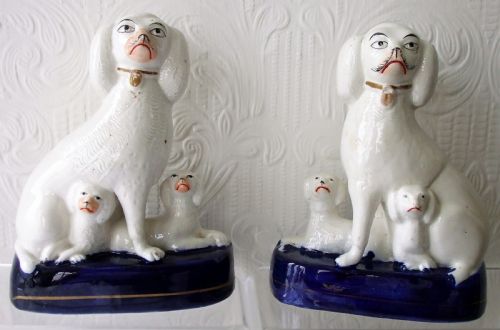
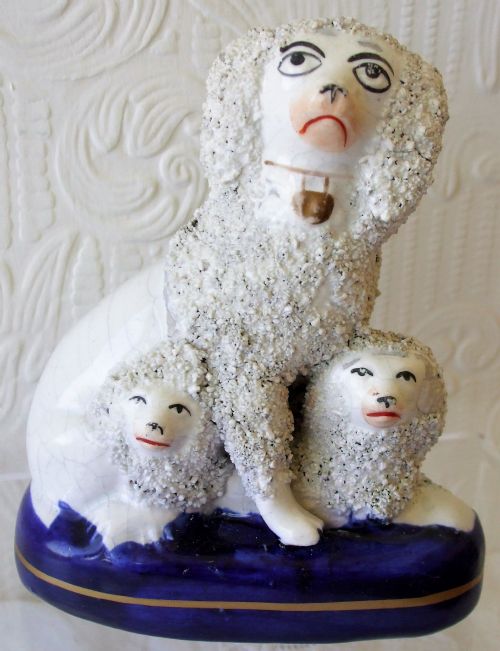
White staffordshire poodles appear primarily as pairs of decorative figurines and figure groups, often accompanied by pups or baskets. These earthenware subjects date from the nineteenth century, including specific references around eighteen hundred and forty-five and eighteen sixty, spanning the Victorian era.
The forms range from miniature poodles to fireside dogs with separate front feet and decorative quill holders or clock groups. Most examples take the shape of seated or standing dogs adorned with modelled coats and gilded collars.
How they were made
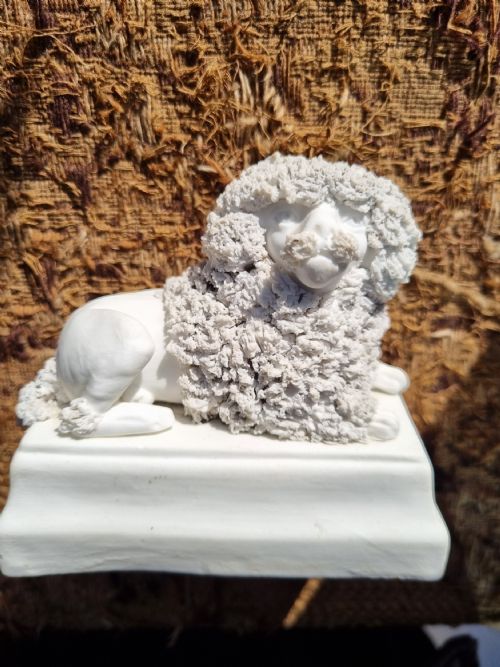
Potters shaped these figures using earthenware and glazed ceramic, applying lead glaze to create a smooth surface finish. Some pieces utilise unglazed white bisque pottery to render the texture of the dog without a shiny coat.
Materials recorded across the archive include lead glaze, enamel, gold leaf, and unglazed white bisque pottery.
What varies in quality
The application of gilding and enamel adds distinction, with well-preserved gold leaf collars and cleanly painted eyes raising the visual standard. Miniature scale and complex group arrangements like clock cases or quill holders also demonstrate greater technical ambition.
James Dudson
The White Staffordshire Poodles Glossary
- Earthenware
- A porous pottery body fired at lower temperatures, serving as the standard ceramic material for these figures. It requires a glaze to become impermeable.
- Bisque
- Unglazed fired pottery that presents a matte, porous white surface. This finish highlights the sculptural form without the shine of a lead glaze.
- Gilt
- A thin layer of gold or gold leaf applied to collars and decorative accents. It catches the light and denotes a more ornate finish.
- Encrusting
- Small applied clay particles or slip used to create a textured, woolly coat on the poodle figures. This technique mimics the dense curls of the breed.
White Staffordshire Poodles: Frequently Asked Questions
What are white staffordshire poodles?
White staffordshire poodles are nineteenth-century ceramic figures modelled as seated or standing dogs, frequently created as decorative pairs for the Victorian home.
They often appear alongside pups, baskets, or clock groups, reflecting popular domestic ornaments of the period.
How were these poodles used?
These figures served primarily as mantelpiece ornaments and fireside decorations during the Victorian era. Some specific examples also functioned as quill holders on writing desks.
Pairs were typically arranged symmetrically on either side of a fireplace or shelf to anchor the room's decor.
How do I date staffordshire poodles?
Dating relies on stylistic clues, ceramic bodies, and manufacturing techniques associated with the nineteenth century. Many pieces connect to the Victorian period, with specific examples dated around eighteen sixty or eighteen hundred and forty-five.
Details such as separate front feet, gilt collars, and woolly encrusting help narrow the production era.
What is woolly staffordshire pottery?
Woolly pottery refers to figures covered in small, applied clay particles that imitate the dense, curly coat of a poodle. This textured technique is characteristic of mid-nineteenth-century Staffordshire production.
Potters used this method to give the white earthenware a realistic and tactile animal coat.