
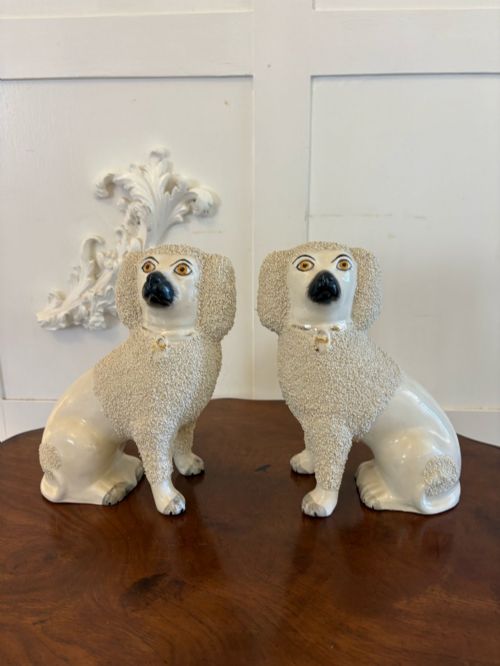
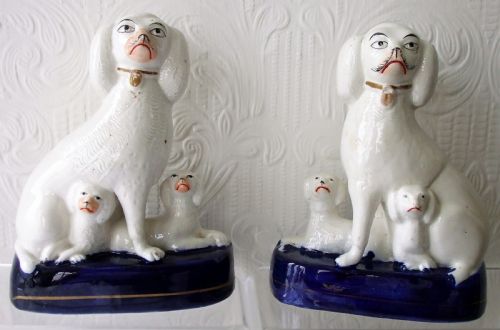


Victorian Earthenware Poodle Pair
These Victorian earthenware poodle pair figures bring genuine nineteenth-century character to a room, offering the charm of Staffordshire pottery at its most collectable.
Victorian Earthenware Poodle Pair
When you search for a victorian earthenware poodle pair, you encounter decorative mantel ornaments fashioned in nineteenth-century Staffordshire potteries. These figures typically depict seated dogs facing one another, sometimes accompanied by tiny pups or resting upon cushions.
The selections available here range from standard cabinet ornaments to smaller miniature versions, spanning the broader Victorian era into the dawn of the twentieth century around 1900. Most examples reflect traditional English pottery workshops, capturing the domestic sentimentality prized by period collectors.
Alongside standard adult poodles, certain pairs incorporate textured clay coats or distinct blue cushion bases that link them directly to mid-nineteenth-century manufacturing traditions. Each matched pair provides a symmetrical display arrangement intended for nineteenth-century mantelpieces and side tables.
How they were made
Certain specialist pieces feature applied clay work known as encrusting, creating textured wool effects across the poodle coats through meticulous hand-application. Firing in traditional kilns set the base ceramic body before enamels and surface gilding were fixed in subsequent lower-temperature firings.
Current listings demonstrate materials including lead glaze, enamel, and gold leaf applied to traditional nineteenth-century earthenware.
What varies in quality
Quality in these earthenware figures rests primarily on the crispness of the moulding and the precision of the hand-painted enamels. Superior examples retain sharp facial detailing and clean gilding without excessive blurring across the ceramic surface.
The presence of secondary elements like nursing pups or textured wool coats generally denotes a more ambitious workshop output. Scale also influences desirability, with miniature pairings demonstrating exceptional skill in miniature ceramic modeling.
James Dudson
The Victorian Earthenware Poodle Pair Glossary
- Earthenware
- Porous pottery fired at relatively low temperatures and rendered waterproof through the application of a vitreous glaze. This ceramic body forms the structural base for the vast majority of nineteenth-century Staffordshire animal figures.
- Enamel
- Opaque vitreous composition fused to the ceramic surface during a secondary firing to provide permanent surface colour. Enamels deliver the distinct black markings and facial details seen on these dog pairs.
- Lead Glaze
- Glossy liquid coating applied to pottery before firing to seal the porous earthenware body and impart a reflective shine. This finish gives the pieces their characteristic nineteenth-century lustre.
- Gilt
- Finely ground gold or metallic leaf applied to ceramic highlights such as collars and chains. This decorative touch elevates domestic mantel ornaments into smarter decorative objects.
- Encrusting
- Applied ceramic slip or clay particles pressed onto the body to simulate textured fur or decorative foliage. This labor-intensive technique creates the tactile wool appearance found on specialist poodle models.
Victorian Earthenware Poodle Pair: Frequently Asked Questions
How old are these poodles?
The pieces listed across this category date predominantly from the nineteenth century, with specific examples recorded from the mid-Victorian period around eighteen-forty-five to eighteen-sixty. Production of these decorative ceramic animals extended into nineteen-hundred.
Matching pairs from the Victorian era reflect the manufacturing methods and ceramic bodies typical of English earthenware potteries of that timeframe.
Why were they made in pairs?
Victorian mantelpiece decoration relied heavily on symmetry, requiring two matching figures to flank a central clock or ornament. Poodles and spaniels were modeled as left- and right-facing counterparts for this exact purpose.
Displaying them together preserves the intended balance of nineteenth-century interior arrangement.
How do I care for antique earthenware?
Antique earthenware requires gentle handling and protection from sudden temperature changes or excessive moisture. Dusting with a soft, dry brush keeps the glaze and enamel surfaces clean without risking abrasion.
Avoid using chemical cleaners or submerging the ceramic in water, as nineteenth-century glazes can develop hairline crazing over time.