


White Porcelain Dinnerware
White porcelain dinnerware brings crisp elegance to the table, spanning grand Georgian armorial services and delicate Victorian child’s sets.
White Porcelain Dinnerware
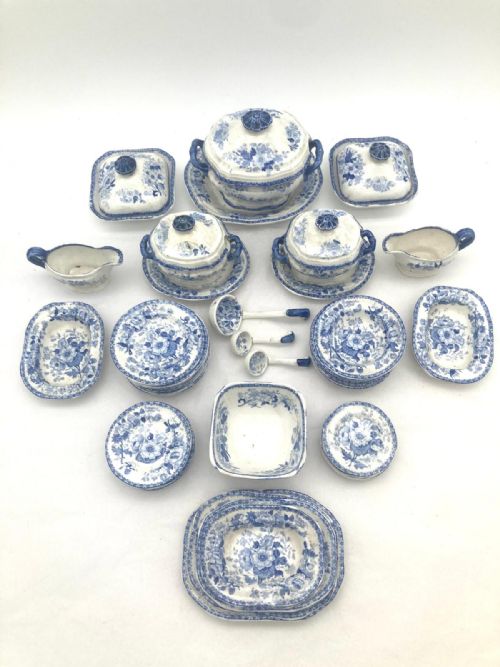
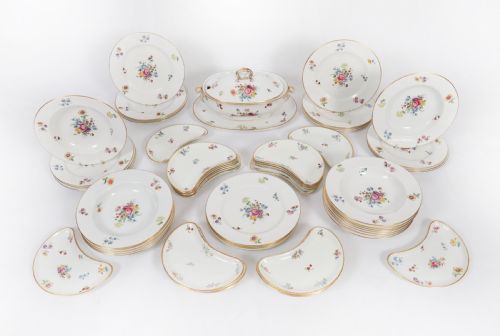
When searching for white porcelain dinnerware, you encounter comprehensive dinner services, soup tureens, individual plates, and miniature child's sets. The listings include pieces from the Georgian, Regency, and Victorian eras, alongside Edwardian and later twentieth-century productions.
The selection ranges from extensive Copeland Spode and Müller Volkstedt services to single cabinet plates by Mintons and Worcester. Many items feature traditional blue and white transfer prints, floral patterns, or hand-painted details upon a white ceramic ground.
You also find specialised forms such as soup tureens by Coalport and armorial plates from Barr, Flight and Barr. These items represent English and continental European manufacturing traditions across the nineteenth and early twentieth centuries.
How they were made
The objects in this category are fashioned from porcelain and earthenware, finished with a smooth ceramic glaze. Many pieces incorporate transfer printing techniques, particularly for popular blue and white patterns.
Decoration often extends to hand-painted enamel colours and delicate gilding using gold leaf. Specialised techniques such as pâte-sur-pâte appear on select nineteenth-century cabinet plates to build layered relief designs.
Listings feature periods from the Georgian and Regency eras through the Victorian and Edwardian periods up to the twentieth century.
What varies in quality
Quality in these services rests upon the fineness of the ceramic body and the precision of the potter's execution. Early nineteenth-century porcelains from established factories exhibit superior translucency and refined potting compared to later wares.
Hand-painted enamels, detailed armorial crests, and intricate gilding elevate individual plates and tureens above standard transfer-printed table settings. The scale of the service, from cabinet pieces to sixty-piece dining sets, also defines the scope of the work.
Minton·Copeland Spode·Coalport·Müller Volkstedt·Doulton·Wedgwood·Barr Flight and Barr·Mintons
The White Porcelain Dinnerware Glossary
- Porcelain
- A hard, fine-grained ceramic material fired at high temperatures to achieve vitrification and translucency. It forms the primary body for fine nineteenth-century plates and dinner services.
- Transfer Printing
- A mechanical decoration technique where an engraved copper plate transfers a design onto paper and then onto the ceramic surface before glazing. This method enabled consistent production of intricate patterns such as Italian landscapes.
- Armorial
- A ceramic piece decorated with a personal coat of arms or heraldic crest. These bespoke commissions were typically produced for landed families by notable factories.
- Soup Tureen
- A large, deep serving vessel with a lid, designed for holding and presenting soup at the dining table. They frequently feature matching stands and elaborate handles.
- Pâte-sur-Pâte
- A method of porcelain decoration where liquid white clay is painted in successive layers onto a contrasting coloured body to create a cameo-like relief.
White Porcelain Dinnerware: Frequently Asked Questions
How do I date antique white porcelain dinnerware?
Dating relies on factory marks stamped or painted on the underside, alongside stylistic cues like Regency neoclassical shapes or Victorian transfer patterns. Examining the potting technique and glaze characteristics also helps place a piece within its nineteenth-century period.
Makers often changed their backstamps with the reigning monarch or partnership changes, providing a reliable window of production for services and individual plates.
Are child's dinner services usable for dining?
Child's toy and miniature dinner services were manufactured in smaller scales specifically for juvenile use or display during the nineteenth century. While made from the same ceramic materials as full-sized tableware, their diminutive proportions make them impractical for standard modern meals.
Collectors typically preserve these miniature sets as cabinet displays rather than utilising them for everyday dining.
What is the difference between porcelain and earthenware?
Porcelain is fired at much higher temperatures, resulting in a dense, vitreous, and often translucent body that resists liquid absorption. Earthenware is a softer, more porous ceramic that requires a complete glaze to become waterproof.
Many antique dinner services utilise fine ceramic bodies that bridge these traditional categories depending on the factory recipe used.
How should I care for antique ceramic plates?
Antique plates require gentle hand washing in lukewarm water with mild soap, avoiding modern dishwashers that can damage delicate glazes and historical gilding. Storing them on edge in plate racks or with felt dividers prevents surface scratching.
Keeping pieces away from direct sunlight and rapid temperature fluctuations protects the enamel decorations and gold leaf from fading or crazing.