

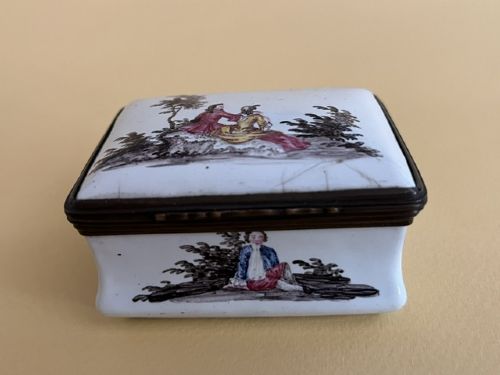


White Georgian Enamel Box
A white georgian enamel box is a small, functional luxury from the eighteenth century, sought after for its delicate painted lids and bright metal mounts.
White Georgian Enamel Box
A white georgian enamel box is typically a pocket-sized container designed for snuff, patches, or small trinkets during the eighteenth century. These pieces emerge predominantly from the eighteenth century, often associated with the Georgian era and specific English production centres.
The versions most commonly met on this page take the form of rectangular patch boxes and snuff boxes. Collectors also encounter bonbonniere forms alongside occasional nineteenth-century interpretations and later twentieth-century silver items such as coffee spoons.
How they were made
These items are constructed primarily from copper bodies coated in opaque white enamel, then fitted with hinged mounts made of brass, gilt metal, or sterling silver. Artisans painted surface scenes directly onto the enamel ground, often depicting landscapes, figures, or inscriptions like Cheltenham Wells.
Techniques relied on fusing powdered glass to metal substrates through kiln firing, creating a smooth surface suitable for detailed miniature painting. Mounts and hinges were soldered to the copper or brass foundations to secure the lids.
White Georgian Enamel Box Retail Price Guide 2026
Typical asking prices for white georgian enamel box among the pieces listed under this phrase on Sellingantiques today, from the lower quarter to the upper quarter. They describe what is for sale here now, not the wider market.
Some eighteenth-century boxes double as portable art galleries, depicting detailed scenes of musicians in parkland or spa towns like Cheltenham Wells.
What varies in quality
Quality rests in the crispness of the hand-painted decoration on the lid and the precision of the metal mounts. Finer examples display detailed figural scenes, such as musicians in parkland, executed with controlled brushwork.
The integrity of the enamel surface and the snugness of the hinge closure distinguish superior pieces from standard production. Softer paint application or later replacements of the metal mounts alter the character of the object.
South Staffordshire·Bilston Enamel
The White Georgian Enamel Box Glossary
- Snuff box
- A small hinged receptacle designed to hold dry powdered tobacco for inhalation. They reflect the social habits of the Georgian period.
- Bonbonniere
- A small ornamental box intended to hold sweets or sugarplums. They often took playful shapes departing from standard rectangular formats.
- Enamel
- A glassy substance fused to a metal base through high-temperature firing. In these pieces, an opaque white ground forms the canvas for painted decoration.
White Georgian Enamel Box: Frequently Asked Questions
What did people keep in a white georgian enamel box?
Owners used these small containers to store scented snuff or tiny silk cosmetic patches worn on the face during the Georgian period.
They also served as trinket boxes for small personal items carried in pockets or reticules.
How can I tell an eighteenth-century box from a later one?
Examine the copper base, the weight of the metal, and the style of the hand-painted scenes on the lid. Eighteenth-century pieces show specific enamel textures and mounting techniques typical of Georgian workshops.
Nineteenth-century items and later pieces like silver coffee spoons exhibit different manufacturing marks and stylistic details.
Where were these enamel boxes made?
Production centred in English regions known for metalwork and enamel industries, particularly Staffordshire and Bilston.
Local workshops specialised in shaping the copper bases and applying the white enamel coatings before hand-painting.
How do I care for antique enamel?
Keep the boxes away from moisture, extreme temperature shifts, and hard surfaces that could chip the glass coating. Clean them gently with a dry, soft cloth without using liquid polishes.
Protect the delicate gilt metal or brass mounts from harsh cleaning agents.