
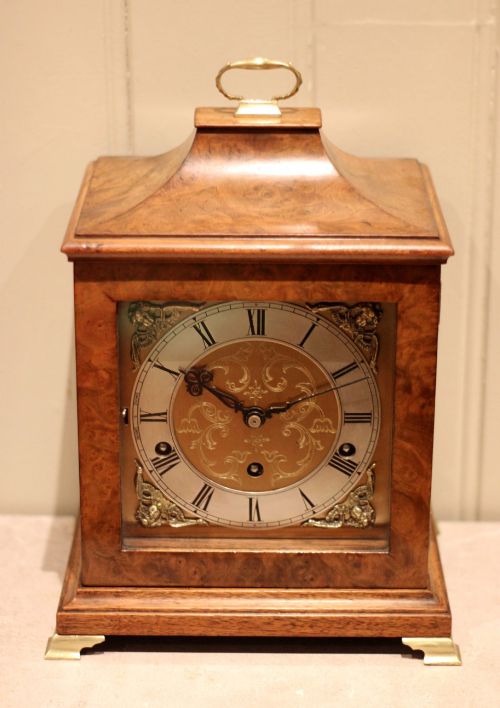


Westminster Chime Mantel Clock
These heavy, resonant timepieces bring four-quarter melody to a room, and a westminster chime mantel clock remains a satisfying anchor for any shelf or bracket.

Westminster Chime Mantel Clock
A westminster chime mantel clock sits on a bracket or shelf, sounding the familiar four-note quarter-hour melody derived from the Cambridge quarters at Great St Mary's. These pieces span the Victorian period through the Edwardian era into the clean geometric lines of Art Deco.
Most examples encountered here are substantial wooden cases housing spring-driven or fusee movements. Mahogany, walnut, burr walnut and oak dominate the forms, often paired with brass dials or ormolu mounts.
The bracket clock format appears frequently alongside traditional mantel pieces, offering portable architectural presence. Simpler lancet shapes sit alongside elaborate architectural and revival cases from the nineteenth and twentieth centuries.
Materials and construction
Cabinetmakers used dense hardwoods like mahogany, walnut and oak, occasionally applying ebonising or intricate burr veneers to the exterior. Glass doors protect the dial while allowing the brass bezel and movement plates to remain visible.
Movements rely on complex brass gear trains, sometimes driven by triple fusee chains or robust spring barrels to power the timekeeping, striking and chiming functions. Ormolu mounts and chrome details provide metallic contrast against the polished timber surfaces.
Westminster Chime Mantel Clock Retail Price Guide 2026
Typical asking prices for westminster chime mantel clock among the pieces listed under this phrase on Sellingantiques today, from the lower quarter to the upper quarter. They describe what is for sale here now, not the wider market.
Listings feature walnut, mahogany, oak and ebonised wood across Victorian, Edwardian and Art Deco periods.
What separates the grades
The complexity of the internal movement dictates much of the standing, moving from standard two-train spring drives up to substantial triple fusee mechanisms with multiple bells or gongs. Heavier cases with substantial timber selection and precise veneering separate standard production pieces from workshop highlights.
The crispness of the dial engraving, the weight of the cast brass bezels, and the resonance of the chime rods or bells determine the overall execution. Maker attribution to established London firms or specialist German factories marks out the upper tier.
Mappin and Webb·Winterhalder·Thomas Haller·Gustav Becker·Elliott·Thwaites and Reed
The Westminster Chime Mantel Clock Glossary
- Bracket clock
- A portable clock originally designed to sit on a wall bracket to improve sound distribution. Many examples retain this designation despite resting on mantelpieces.
- Fusee
- A conical pulley used with a cord or chain to maintain equal force on the clock movement as the mainspring unwinds. This mechanism improves timekeeping accuracy.
- Train
- A sequence of gears within a clock movement that transmits power from the source. Clocks with chiming capabilities typically employ multiple trains for time, strike and chime.
- Ormolu
- Gilded bronze or brass applied as decorative mounts to furniture and clock cases. It provides bright metallic highlights against dark woods.
- Lancet top
- A clock case shape featuring a pointed, gothic arch profile resembling a lancet window. This silhouette appears frequently on mahogany bracket clocks.
Westminster Chime Mantel Clock: Frequently Asked Questions
How do I wind the clock?
Use the appropriate winding key on the dedicated arbours located on the dial face. Turn gently until resistance is felt, avoiding overwinding the mainspring.
Different trains require separate winding, so ensure each arbour receives attention according to the specific movement layout.
What causes the chimes to go out of sequence?
Moving the minute hand backwards or letting the clock run down during a chime sequence can cause the mechanism to drop out of step. Allow the chime train to finish its cycle completely before adjusting the time.
Most movements self-correct after a few hours, though some require manual synchronisation via the rack or snail levers.
Where should I place the clock?
Position the piece on a stable, level surface such as a heavy mantelpiece or secured wall bracket. Uneven foundations affect the pendulum beat and disrupt reliable operation.
Keep the clock away from direct sunlight, damp areas, and extreme temperature fluctuations to protect the timber veneer and internal oils.
How do I date a piece?
Examine the case style, timber choice, and dial execution alongside any maker signatures stamped on the backplate. Victorian models often display heavy proportions and classical revival details.
Art Deco examples shift toward streamlined walnut and chrome, while Edwardian pieces balance traditional woods with lighter architectural proportions.