
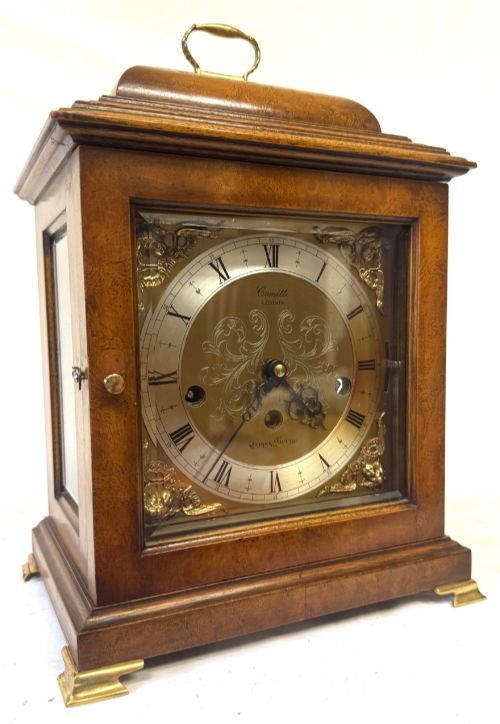
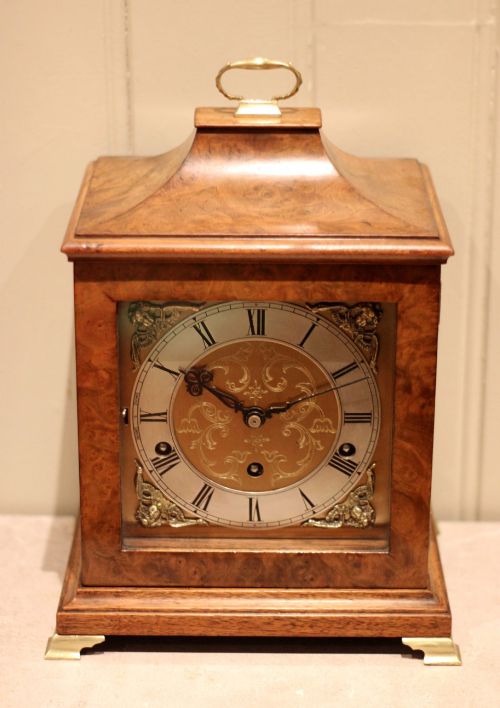
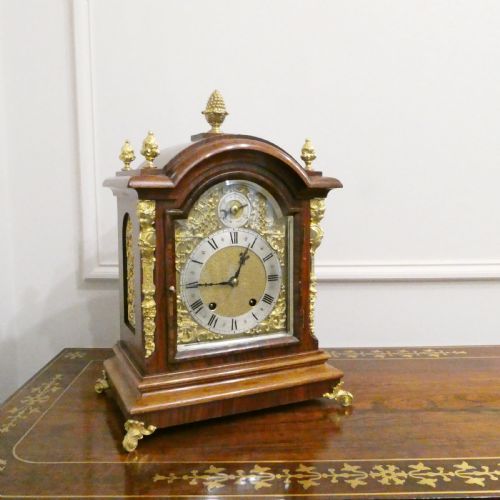


Brass Spandrel Mantel Clock
These brass spandrel mantel clock pieces bring traditional striking movements and striking dial corners into a room.
Brass Spandrel Mantel Clock
A brass spandrel mantel clock sits on a shelf or table, combining functional timekeeping with decorative brass corner ornaments framing the dial. When you search for a brass spandrel mantel clock, you encounter bracket clocks and table clocks spanning the eighteenth century through to the twentieth century.
The pieces on this page include eighteenth-century London examples alongside later revival pieces and twentieth-century Westminster-chime bracket clocks. Traditional English forms predominate, featuring striking and quarter-striking movements housed in timber cases.
Materials and construction
Cases utilise timber such as mahogany, oak, walnut, and burr walnut, alongside ebonised finishes and red and gold lacquer. Brass forms the dial spandrels and often the bezel and feet, complemented by silvered metal chapter rings and steel components within the movement.
Brass Spandrel Mantel Clock Retail Price Guide 2026
Typical asking prices for brass spandrel mantel clock among the pieces listed under this phrase on Sellingantiques today, from the lower quarter to the upper quarter. They describe what is for sale here now, not the wider market.
Some models hide alarm mechanisms and musical tune barrels behind their brass spandrels, ready to surprise anyone expecting a simple timekeeper.
Judging quality
Quality rests in the precision of the movement and the execution of the timber case, from eighteenth-century London maker pieces to later productions. The crispness of the cast brass spandrels and the engraved detail on the dial distinguish finer examples from standard production.
Cabinetry finish also determines standard, with rich burr walnut veneers, bell-top wooden cases, and fine lacquer work showing superior craftsmanship. Movement complexity, such as quarter-striking trains or multiple tunes, further elevates the piece.
William Withers London·James Smith London·Chater & Son London·John Taylor Of London·Winterhalder & Hofmeier·Schneckenburger·Mappin & Webb·Comitti Of London·Garrards
The Brass Spandrel Mantel Clock Glossary
- Spandrel
- The decorative corner piece set between the dial circle and the square frame, typically cast in brass. These ornaments became prominent on bracket and mantel clocks during the seventeenth and eighteenth centuries.
- Fusee
- A conical pulley used in mechanical clocks to maintain even power from the mainspring as it unwinds. This mechanism improves timekeeping accuracy across the duration of the wind.
- Bracket clock
- A portable spring-driven clock originally designed to sit upon a matching wall bracket. Later versions functioned simply as large mantel or table clocks.
- Ting-tang
- A striking train that sounds two notes on different bells or gongs to mark the quarters or the hours. It offers a distinct auditory chime compared to standard single-bell strikes.
- Chapter ring
- The circular ring on the clock face displaying the hour and minute numerals. Silvered metal rings provide high contrast against the brass dial plate.
Brass Spandrel Mantel Clock: Frequently Asked Questions
What is a brass spandrel?
A brass spandrel is the decorative corner ornament placed in the four corners of a square clock dial. It fills the space between the circular chapter ring and the outer edge of the dial plate.
These ornaments were cast in brass and often chased or engraved with floral, scroll, or architectural motifs. They became a defining feature of seventeenth and eighteenth-century clock design.
How do bracket clocks work?
Bracket clocks are driven by mainsprings rather than hanging weights, allowing them to be placed on furniture rather than mounted on a wall. Internal gear trains regulate the timekeeping via an escapement and drive the striking mechanisms.
Many examples feature fusee cones to equalise power delivery from the spring. Some models also include chime tunes, alarm systems, or date displays.
Where should I place a mantel clock?
Place the clock on a stable, level surface such as a mantelpiece, sideboard, or sturdy table away from direct sunlight and draughts. A level surface ensures the pendulum or balance wheel beats evenly.
Avoid placing mechanical clocks in damp environments or areas with significant temperature fluctuations. Proper placement helps maintain the precision of the brass and steel movement.