
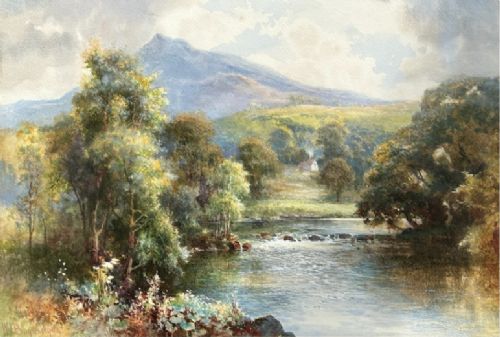


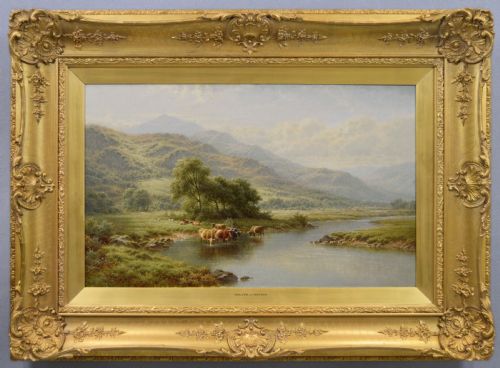

Welsh River Landscape Painting
These works capture a welsh river landscape painting, preserving pastoral valleys, rushing waters, and mountain backdrops from the nineteenth and early twentieth centuries.
Welsh River Landscape Painting
A welsh river landscape painting typically depicts familiar rural terrain across Snowdonia and North Wales, focusing on waterways like the Conwy, Llugwy, and Mawddach. You will encounter framed watercolours on paper and oil paintings on canvas created during the Victorian and Edwardian periods.
The compositions frequently combine flowing rivers with distant peaks, wooded glens, and occasionally figures or livestock near the water. Most examples on this page date from the late nineteenth century, reflecting a strong period interest in British naturalism and pastoral scenery.
How They Were Made
Artists worked primarily in oil paint on canvas or panel, or applied watercolour pigments to paper, capturing atmospheric light over Welsh valleys. Works were traditionally housed in period frames constructed from wood, gesso, and giltwood.
Pigments were layered to achieve depth in the water and foliage, while fine brushwork defined the rocky outcrops and distant mountains characteristic of the topography.
Listings feature works in oil on canvas and watercolour on paper, framed in period giltwood and gesso.
What Varies in Quality
Quality rests in the precision of the handling and the artist's ability to render the specific light and atmosphere of Welsh river valleys. Stronger pieces demonstrate confident brushwork in the water and rocks, paired with balanced composition.
The condition of the original giltwood and gesso frames also influences the piece, alongside the clarity and preservation of the paper or canvas surface.
William Joseph Boyes·Cornelius Pearson·Thomas Spinks·Clarence Henry Roe·Sidney Richard Percy·William Mellor·Walter J Watson·John Syer·Harold Lawes·William Langley·John Cuthbert Salmon·William Henry Mander·David Bates·Alfred de Breanski·George Parson-Norman·James Poole·Henry Bright·Charles A Bool·J W Law·Archer L Smith
The Welsh River Landscape Painting Glossary
- Gesso
- A plaster-like mixture applied to wooden frames before gilding, providing a smooth base for ornamentation. It can develop fine craquelure over time.
- Giltwood
- Wood carved and covered with a thin layer of gold leaf, commonly used for framing nineteenth-century paintings.
- Watercolour
- A painting method where the paints are made of pigments suspended in a water-based solution, typically worked on paper.
- Oil on Canvas
- A technique utilising pigments bound in a drying oil applied to stretched fabric, allowing for rich colour depth and texture.
Welsh River Landscape Painting: Frequently Asked Questions
What subjects appear in these paintings?
These works generally portray rivers, valleys, and mountain ranges situated in North Wales and surrounding regions. Common geographical reference points include Snowdonia, the Conwy valley, and various wooded glens.
Artists often integrated rural elements such as stone bridges, cottages, cattle, and travellers into the river scenery to evoke a pastoral atmosphere.
How should I care for these watercolours and oils?
Keep works out of direct sunlight to prevent the fading of watercolours on paper and the yellowing of varnish on oil paintings. Stable room temperatures protect both the canvas and the wooden frames from warping.
Display pieces away from damp walls and sources of excessive heat to preserve the integrity of the gesso and giltwood framing.
Which periods do these paintings represent?
The available pieces originate primarily from the nineteenth century and the early twentieth century, spanning the Victorian and Edwardian eras. This timeframe encompasses stylistic movements such as Romanticism and Victorian naturalism.
Dates inscribed on the paintings or documented by signatures typically point to the decades between eighteen-forty and nineteen-twenty.
How do I identify a signed piece?
Signatures generally appear in the lower corners of the canvas or paper, rendered in paint or pencil by the artist's hand. Some works also include inscriptions on the reverse detailing the specific Welsh location.
Comparison with documented signatures from listed artists helps confirm attribution for works bearing initials or full names.