




Antique North Wales Art
Antique North Wales art captures rugged mountain passes and quiet river valleys through the eyes of nineteenth-century painters and mapmakers.
Antique North Wales Art
When you search for antique north wales art, you encounter a focused selection of regional landscapes that celebrate Snowdonia, local riverways, and historic castles. These works document the dramatic scenery that drew landscape artists out into the hills during the Victorian era and beyond.
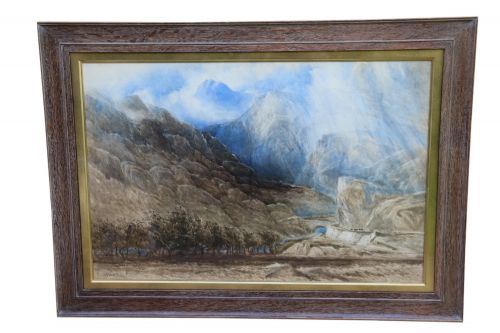
Oil on canvas works dominate the selection, accompanied by detailed watercolours on paper and occasional decorative earthenware plaques. You will find scenes depicting specific landmarks such as the pass of Llanberis, the river Conwy, and the Llugwy, alongside seventeenth-century cartography.
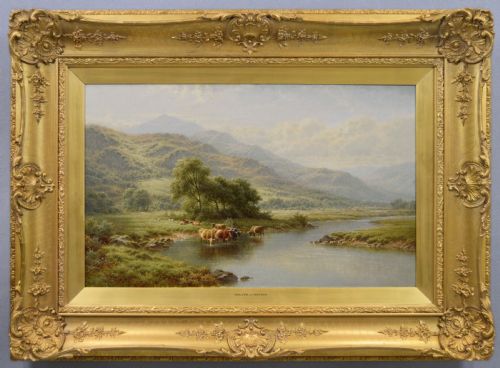
The material record spans the nineteenth century predominantly, with Victorian naturalism and pastoral styles shaping how artists viewed the terrain. Painters utilised oil and watercolour to record cattle by riverbanks, travellers beneath mountain peaks, and wooded glens.
How they were made
Canvas serves as the primary ground for larger landscape oils, stretched over wooden frames and built up with oil pigments to capture the play of light over Welsh mountains. Watercolour paintings on paper employ transparent washes and fine brushwork to render atmospheric mountain mists and river reflections.
Giltwood and gesso frames frequently house these paintings, finished with ornate moulded ornamentation that complements the Victorian fine art aesthetic. Earthenware plaques provide an alternative medium, hand-painted with ceramic colours and fired to preserve topographical views.
Several paintings include small, resolute donkeys stationed deliberately by the water's edge to steady the vast mountain scale above them.
What varies in quality
Top-tier examples demonstrate confident brushwork and precise topographical observation by listed artists who understood the specific light and topography of Snowdonia. Weaker pieces rely on formulaic foliage and generic mountain shapes without capturing the particular atmosphere of the location.
Original framing contributes significantly to the overall integrity of a painted work, particularly when giltwood and gesso mouldings match the period of the canvas. The clarity of provenance and legible artist signatures on the reverse or front elevate the standing of individual oils and watercolours.
Henry Martin Pope·Copeland Pottery·Thomas Spinks·Clarence Henry Roe·William Mellor·Walter J Watson·J Barclay·William Hole·John Cuthbert Salmon·Samuel Sidley·Thomas Swift Hutton·Carleton Grant·George Parson-Norman·James Poole·Benjamin Williams Leader
The Antique North Wales Art Glossary
- Gesso
- A plaster-like mixture applied to wooden frames before gilding. It provides a smooth base that accepts intricate moulding and gold leaf.
- Watercolour
- A painting method where fine pigment is suspended in a water-soluble binder. Artists apply it in translucent washes upon paper.
- Giltwood
- Wood that has been coated with a thin layer of gold leaf or gilt powder. It forms the decorative border around many Victorian canvases.
- Cartography
- The science and art of making maps. Early examples involve engraved copper plates printed on paper and sometimes hand-coloured.
- Pastoral
- An artistic style portraying rural life and idealized natural scenery. It emphasises the quiet harmony of livestock and river landscapes.
Antique North Wales Art: Frequently Asked Questions
What subjects appear most often in North Wales art?
Landscapes featuring Mount Snowdon, river valleys, and mountain passes form the core of these regional works. Artists focused heavily on bodies of water such as the Conwy and the Llugwy.
Human figures, cattle, and travellers occasionally populate the foreground to provide a sense of scale against the imposing terrain.
How should I care for nineteenth-century oil paintings?
Keep canvases away from direct sunlight and dramatic fluctuations in household temperature to prevent cracking in the paint layer. Dust giltwood frames gently with a dry, soft brush rather than liquid cleaners.
Allow professional conservators to handle any cleaning or varnish removal to protect the integrity of the original pigment.
Are these watercolours originals or prints?
The watercolours listed in this category are hand-painted original works on paper rather than mechanical reproductions. Close examination reveals brush texture and variations in pigment density.
Framed watercolours benefit from acid-free mounts and UV-filtering glass to prevent fading over time.
What is the historical context of these landscapes?
The nineteenth century saw a surge in domestic travel as artists and tourists explored the picturesque scenery of Snowdonia. Improved transport links made remote valleys accessible to painters seeking dramatic natural vistas.
Regional art from this period reflects the growing Victorian appreciation for British topography and naturalism.