


Welsh Mountain Landscape Art
Welsh mountain landscape art captures dramatic peaks and river valleys through nineteenth-century oils and watercolours that bring rugged rural scenery directly into your interior.
Welsh Mountain Landscape Art
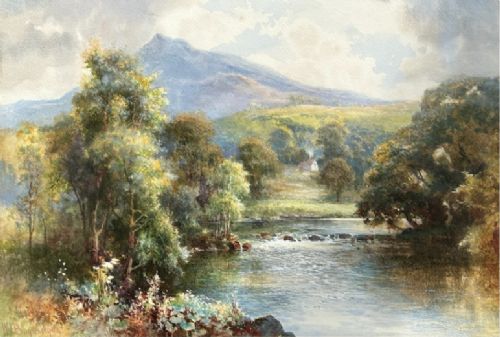
When you search for welsh mountain landscape art, you encounter nineteenth-century depictions of Snowdonia and surrounding valleys executed in oil or watercolour. These works celebrate specific regional locations such as the River Conwy, the Ogwen Valley, and the slopes of Snowdon and Moel Siabod.
The pieces you meet most often on this page date from the Victorian and Edwardian periods, stretching from the eighteen-seventies into the early twentieth century. Artists working in this genre recorded pastoral scenes, mountain passes, and river cottages with careful attention to topography and changing weather.
Compositions frequently feature human figures or farm workers placed within vast, towering ranges to establish a sense of scale and romantic atmosphere. The artistic approach balances topographical accuracy with the dramatic light effects characteristic of late nineteenth-century British landscape painting.
How these artworks were produced
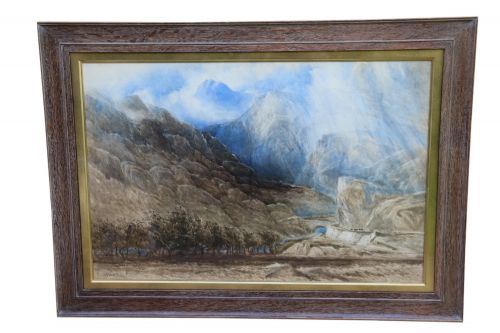
The physical objects rely primarily upon oil on canvas or watercolour on paper, framed in period giltwood or gesso moulded wood. Painters built their images using traditional pigments applied to stretched linen or heavy paper supports.
Makers housed these works in ornate gilded frames that often display intricate ornamentation and wood construction consistent with Victorian and Edwardian framing standards. These surrounds complement the tonal depth of the landscape within.
Several canvases capture sudden summer rain showers passing over Snowdonia, ensuring you stay dry indoors.
What distinguishes finer examples
Quality in welsh mountain landscape art rests upon the sureness of the brushwork and the artist's ability to render atmospheric light, particularly when depicting heavy rain showers or bright summer sun over mountain ranges. Superior paintings capture the distinct geological character of Welsh peaks rather than relying on generic formulas.
The handling of the original giltwood frame also distinguishes better pieces, as period frames matching the creation date of the canvas add significant integrity to the object. Condition of the paint surface and paper support, free from excessive restoration or fading, marks the upper tier of the range.
William Joseph Boyes·Henry Martin Pope·Sidney Richard Percy·Thomas Spinks·Charles Leslie·Walter J Watson·J Barclay·John Syer·William Henry Mander·Cornelius Pearson·Samuel Towers·Benjamin Williams Leader·Alfred de Breanski·James Poole·Henry Bright
The Welsh Mountain Landscape Art Glossary
- Giltwood
- Wood carved and covered with a thin layer of gold leaf. This material forms the primary decorative frame surrounding nineteenth-century paintings.
- Gesso
- A plaster-like mixture applied to wood frames before gilding. It provides a smooth base for intricate moulded ornament.
- Oil on canvas
- Pigment mixed with drying oil applied to a stretched woven fabric. This medium allows for rich colour blending and textured brushwork in landscape scenes.
- Watercolour
- Paint consisting of water-soluble pigments used on paper. It creates luminous washes that suit the damp, atmospheric conditions of Welsh valleys.
Welsh Mountain Landscape Art: Frequently Asked Questions
Are these paintings genuine period works?
The listings comprise authentic nineteenth-century and early twentieth-century paintings created during the Victorian and Edwardian eras. Artists documented specific locations across North Wales using traditional oil and watercolour techniques.
Signatures, artist dates, and framing materials correspond to the historical periods recorded in the evidence. These details confirm the age and origin of each individual piece.
How should I frame and display them?
Original giltwood and gesso frames complement the traditional aesthetic of these nineteenth-century landscapes. Displaying them away from direct sunlight protects vulnerable watercolours and oil pigments.
Stable indoor humidity prevents cracking in both the wooden stretcher bars and the delicate gilt frames. Proper placement ensures the longevity of the canvas or paper support.
What is the difference between the oils and watercolours?
Oil paintings on canvas offer heavier pigment build-up and deep, saturated tones suited to dramatic mountain weather. Watercolours on paper provide delicate washes and luminous transparency.
Both mediums capture the distinct light of Welsh mountain environments but utilise different technical methods. Watercolours are typically mounted behind glass, whereas oil canvases remain exposed.