





Victorian Mountain Scenery Artwork
Victorian mountain scenery artwork brings dramatic peaks and sweeping valleys into the room, offering a window into nineteenth-century landscape appreciation.
Victorian Mountain Scenery Artwork
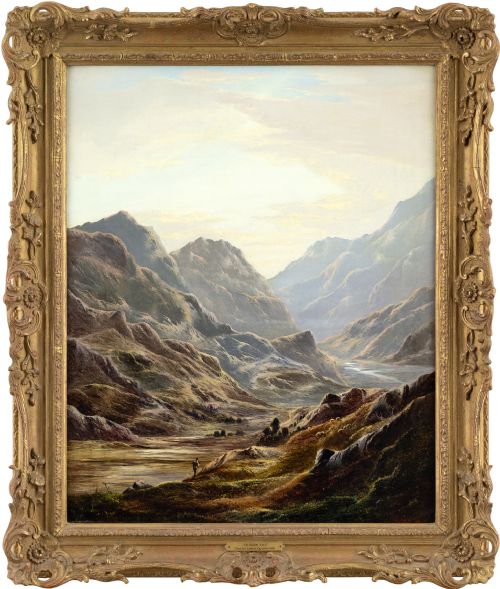
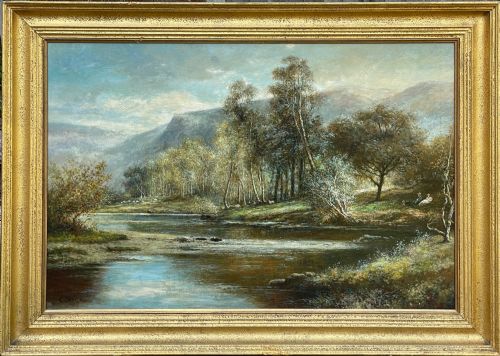
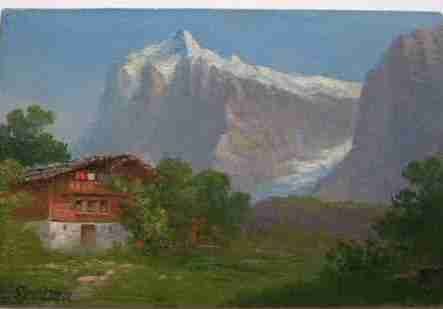
Victorian mountain scenery artwork captures dramatic topography, from Scottish highlands and Welsh peaks to Bavarian castles and Alpine valleys, rendered through nineteenth-century painting traditions. These pieces reflect a period fascination with untamed terrain, depicting lakes, rivers, and crags with atmospheric depth.
The most common examples on this page are oil paintings on canvas, often housed in decorative gesso and giltwood frames. Artists working in this genre recorded specific locations such as Glen Tilt, Moel Siabod, Borrowdale, Lake Windermere, and Grindelwald.
The selections span various nineteenth-century movements, encompassing Victorian romanticism, realism, and European landscape traditions. Works range from intimate cabinet pieces to large paired canvases depicting specific geographical views.
How they were made
These works rely on oil paint applied to stretched canvas, allowing artists to build rich layers of pigment and achieve subtle gradations of light across distant peaks and shadowed valleys. The medium lent itself to capturing atmospheric effects such as mist over water and sunlight breaking through heavy clouds.
Frames are integral to the presentation, frequently constructed from carved wood with gesso mouldings and gilt finishes. Composition and gilding added weight and visual brilliance, framing the painted window onto nature for Victorian drawing rooms.
Victorian Mountain Scenery Artwork Retail Price Guide 2026
Typical asking prices for victorian mountain scenery artwork among the pieces listed under this phrase on Sellingantiques today, from the lower quarter to the upper quarter. They describe what is for sale here now, not the wider market.
Nineteenth-century artists occasionally added tiny figures walking near immense cliffs to remind viewers just how large the mountains really were.
What varies in quality
Quality rests upon the handling of light and atmospheric perspective, distinguishing works with profound depth from routine topographic records. Skilled brushwork captures the texture of rock, water, and foliage with convincing immediacy.
The sophistication of the original giltwood and gesso framing contributes significantly to the overall presence of the piece. Well-preserved surfaces on both the canvas and the frame maintain the visual integrity intended by the nineteenth-century maker.
E Brown·Charles Leslie·John Grenville Fennell·Sidney Richard Percy·Karl Herrle·Stephen Enoch Hogley·Alfred de Breanski·Alfred de Breanski Snr·Robert John Hammond·Hubert Sattler
The Victorian Mountain Scenery Artwork Glossary
- Giltwood
- Wood carved and covered with a thin layer of gold leaf. This material was extensively utilised for ornate nineteenth-century picture frames.
- Gesso
- A plaster-like mixture applied to wooden frame foundations as a base for moulding and gilding. It allows for intricate sculptural relief work around the edge of the canvas.
- Oil on Canvas
- Pigments bound in a drying oil medium applied to a woven fabric support. This combination provides durability and a flexible surface for painterly manipulation.
- Romanticism
- An artistic movement emphasising emotion, individualism, and awe of the natural world. Mountain scenery paintings frequently draw upon these dramatic landscape tropes.
- Composition
- A prepared material applied to picture frames to create raised decorative ornaments. It hardens into a durable surface ready for gilding.
Victorian Mountain Scenery Artwork: Frequently Asked Questions
What subjects do these paintings show?
The artworks portray dramatic upland terrain, including Scottish highlands, Welsh peaks, Lake District views, and Alpine summits. Many record specific geographical sites and valleys.
Scenes frequently incorporate bodies of water such as lakes and streams, alongside architectural elements like castles or figures engaged in rural pursuits.
How should I hang an oil painting?
Choose a wall protected from direct sunlight and steady moisture to safeguard both the canvas and the historic giltwood frame. Secure hardware rated for the weight of the piece directly into wall studs.
Allow sufficient clearance above heating sources to prevent the canvas and gesso from drying out and cracking over time.
How do I identify nineteenth century frames?
Nineteenth-century frames typically feature moulded gesso ornamentation over a wooden base, finished with gold leaf. Close inspection reveals hand-tooled details and natural ageing in the gilding.
Corner joints and underlying timber construction provide further clues to the period of manufacture.
What is the difference between realism and romanticism here?
Realism focuses on accurate topographic detail and naturalistic light conditions. Artists working in this mode prioritized botanical and geological precision.
Romanticism amplifies atmospheric drama through moody skies, steep gradients, and emotional intensity. These works evoke awe rather than serving as precise botanical records.