


Vintage Signal Cannon
These vintage signal cannon examples range from heavy garden ornaments to polished desk models, offering tactile pieces of maritime history for your study or lawn.
Vintage Signal Cannon
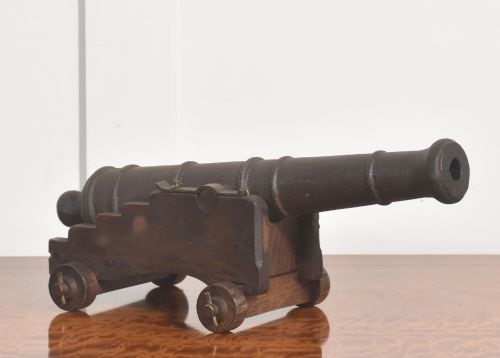
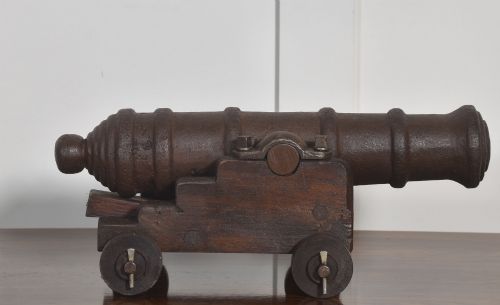
When you search for a vintage signal cannon, you encounter solid metal barrels mounted on timber carriages designed for display, ceremonial firing, or garden ornamentation. The examples span from the eighteenth century through the Edwardian period, reflecting both military precision and decorative intent.
The most common versions on this page are cast iron and brass pieces set upon oak or mahogany carriages. You will find items scaled for desk tops as well as heavier garden models that command attention in an outdoor space.
Origins stretch across English workshops and French foundries, encompassing styles from Victorian maritime to early twentieth century military. Each piece serves primarily as a decorative object or model cannon rather than active artillery.
How they were made
Barrels were cast in heavy metals, primarily bronze, brass, cast iron, and polished steel, creating durable tubes designed to withstand the stress of a blank charge or simply to hold a bright finish. Foundries poured these metals into moulds that reproduced reinforcing rings and touch holes with varying degrees of military accuracy.
Carriages and undercarriages were constructed from dense hardwoods such as oak and mahogany, shaped to support the heavy metal barrels securely. Metal brackets, wheels, and fastenings were then fitted to the wooden frames to complete the artillery form.
Listings span the 18th, 19th, and early 20th centuries, featuring materials from cast iron and bronze to mahogany and oak.
What varies in quality
The distinction between standard decorative objects and superior models lies in the crispness of the metal casting and the fidelity of the scaling. Better pieces exhibit sharply defined barrel mouldings and securely joined wooden carriages without clumsy modern fasteners.
Materials also dictate the character of the piece, with polished bronze and heavy cast iron commanding a different visual weight than lighter brass models. The integration between the metal barrel and its wooden undercarriage determines the overall balance of the object.
The Vintage Signal Cannon Glossary
- Signal cannon
- A small piece used to fire blank charges for starting races, signalling sunset, or celebrating maritime occasions. They are distinct from full-scale artillery by their compact size.
- Carriage
- The wooden or metal mounting frame that supports the cannon barrel. In these listings, carriages are frequently fashioned from solid oak or mahogany.
- Signal mortar
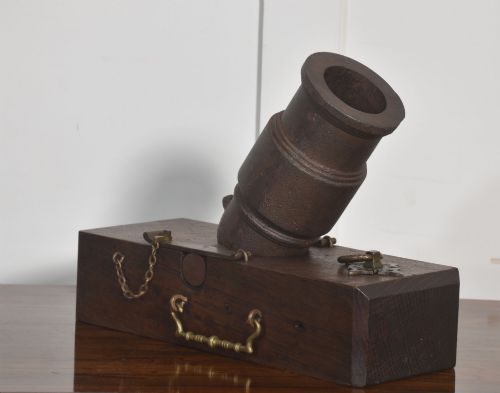
- A short, wide-bore variant designed to project sound vertically rather than fire a flat trajectory. These typically sit upon heavy wooden blocks or carriages.
- Undercarriage
- The base structure supporting the main carriage or barrel directly, often seen in desk models. Mahogany and oak are traditional choices for these lower mounts.
- Militaria
- Artefacts collected for their association with military history and armed forces. This category includes model cannons, scale models, and related equipment.
Vintage Signal Cannon: Frequently Asked Questions
What is a signal cannon?
A signal cannon is a small ordnance piece traditionally used to fire blanks for maritime communications, starting yacht races, or marking ceremonial hours.
Unlike combat artillery, these pieces prioritise acoustic report and decorative presence over ballistic range.
How do I display a desk cannon?
Desk cannons fit well on studies, libraries, or office sideboards where their polished brass or bronze barrels can catch the light.
Ensure the wooden undercarriage rests on a stable surface away from dampness to protect the mahogany or oak.
Can these cannons still be fired?
While many metal barrels are cast solidly, some vintage signal cannon examples were built as functional ordnance for blank charges.
Buyers should consult a professional before attempting to fire any historic piece due to potential metal fatigue over the centuries.
How do I date a brass cannon?
Dating relies on stylistic clues in the carriage design, the composition of the metal, and any foundry marks stamped into the bronze or iron.
Victorian and Edwardian models often feature heavier proportions and specific wood-turning styles compared to eighteenth-century counterparts.